
Buy OEM where a failure is dangerous or where the engineering is genuinely hard to copy — main hydraulic pumps, travel motors, final drives, ECU-linked components, and any machine still inside its warranty. Buy quality aftermarket for wear parts that are consumed by the pallet: pins, bushings, bucket teeth, undercarriage and seal kits. The decision is not about a brand on a box; it is about how much specification matters at that position and what a failure costs you.
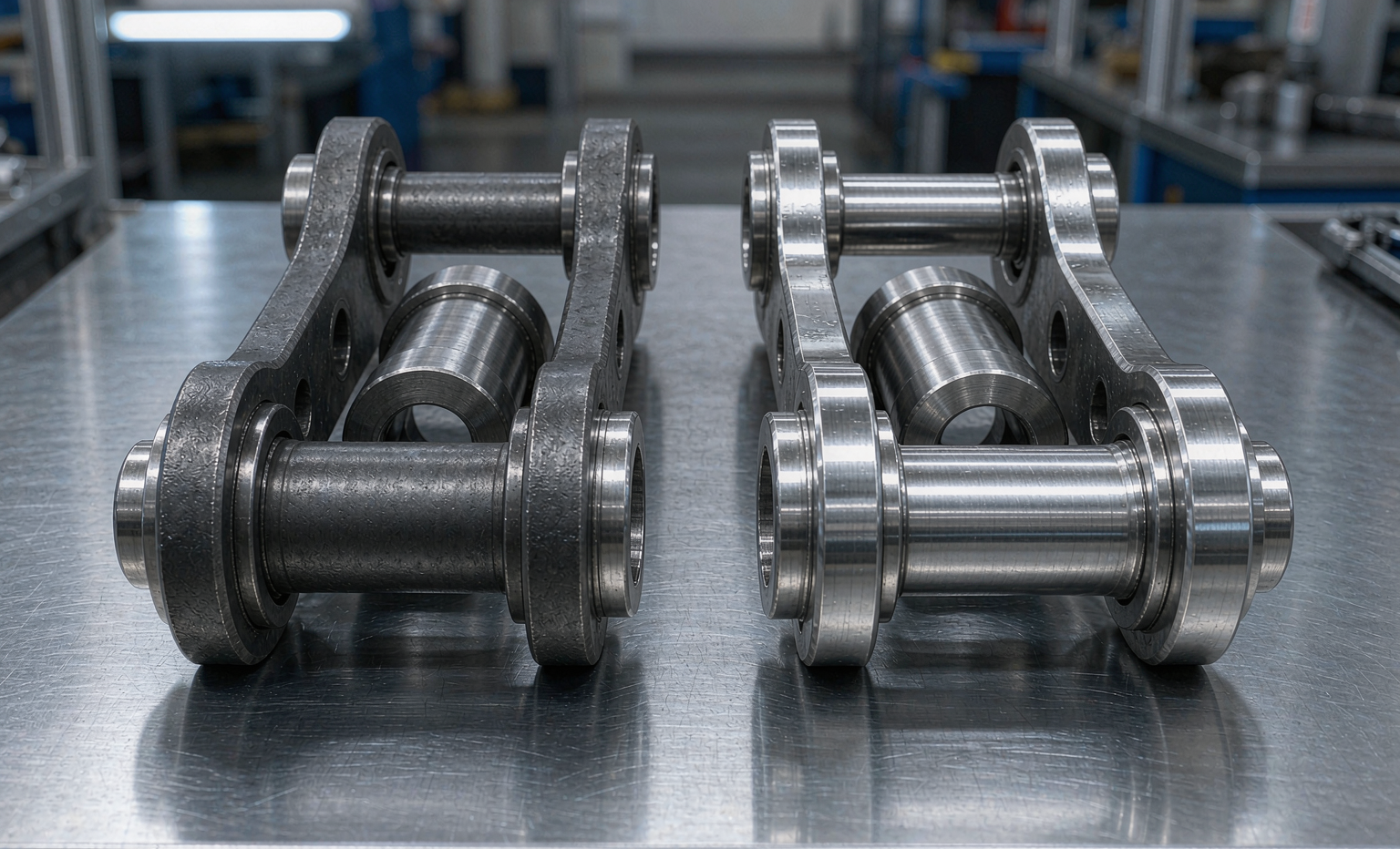
What actually separates an OEM part from an aftermarket one?
Only the source and the documentation. An OEM part is made by or for the machine brand and sold through the dealer network with that brand's backing. An aftermarket part is made by an independent manufacturer to fit the same machine. Aftermarket is not one quality tier — it is at least three:
- OEM-equivalent. Built to the original dimensions, material specification and tolerance, with its own part number and inspection records.
- Functionally compatible. Fits and works, but may substitute a cheaper material grade or a looser tolerance.
- Low-cost copy. Sold on price alone, usually with no material data. This tier is where the stories about "aftermarket failures" come from.
When does OEM earn its premium?
- The machine is under a manufacturer warranty and a non-OEM part could complicate a claim.
- The component is safety-critical or high-stress, where a failure risks injury or collateral damage to the machine.
- It is a complex precision assembly where the original engineering is not easily replicated — pumps, valves, final drives, control units.
- Fitment must be exact and there is no room to adjust — a poor fit here damages the surrounding component, not just itself.
Where does quality aftermarket win clearly?
Wear parts and consumables, where the specification is straightforward and well understood by any competent manufacturer: teeth and adapters, pins and bushings, track chains, rollers, idlers and sprockets, seal kits, hoses and filters. Also on older machines, where OEM supply is slow, discontinued or priced against a machine that is no longer worth the dealer premium.
The full catalogue is grouped at excavator parts, with the high-volume wear families under excavator bucket pins and bucket bushings.
How do you tell an engineered equivalent from a cheap copy?
Three signals, and one of them is decisive:
- The supplier publishes its own part numbers. An equivalent states its equivalence openly. A copy reproduces the OEM part number and packaging, which is where legitimate competition turns into counterfeit goods.
- Material data exists. Ask for the steel grade and a hardness or chemistry result for the batch. A supplier who cannot produce either has nothing to be measured against.
- The warranty is expressed in operating hours, not just against visible defects on arrival. A part that is warranted only until it is unpacked has not really been warranted.
Add one practical test that costs nothing: does the supplier confirm the part number against your machine model and serial number before shipping, or only after you complain?
What does the cost comparison really look like?
Compare cost per operating hour, not purchase price:
(part price + fitment labour) ÷ expected hours to failure, plus the cost of an unplanned stop if it fails early.
A cheap tooth at half the price that lasts a third as long is more expensive, before you count the downtime. A vetted equivalent at 70 percent of OEM price that runs 90 percent of OEM life is clearly cheaper per hour. The calculation is easy; the honest difficulty is that most buyers do not yet have failure-hour data for their own fleet. Start logging it — install hours and failure hours, per part position — and within a season the decision stops being a matter of opinion.
A working policy by part category
- Bucket teeth and adapters: aftermarket, bought on material specification and hardness, not unit price.
- Pins and bushings: aftermarket, bought on measured dimensions and tolerance. This is the easiest category to audit — a caliper settles the argument.
- Undercarriage: aftermarket, bought as matched sets rather than single components.
- Seal kits and hoses: aftermarket, specified by material and temperature rating.
- Main hydraulic pumps, travel motors, final drives: OEM, or genuine remanufactured units, on newer machines.
- Engine overhaul kits: quality aftermarket is well established here, provided the kit is matched as a set of liners, pistons, rings and gaskets.
- Sensors and electronic controls: OEM. Calibration and protocol compatibility are not a place to save money.
What belongs on the purchase order either way?
Machine make, model and serial number; the OEM part number as read from the parts book, not from the casting; the dimensions you measured yourself; the quantity; and the destination port. Hydraulic components and undercarriage are covered under hydraulic excavator parts and excavator undercarriage. Sending all five items in the first message is what turns a quotation into a correct shipment.