
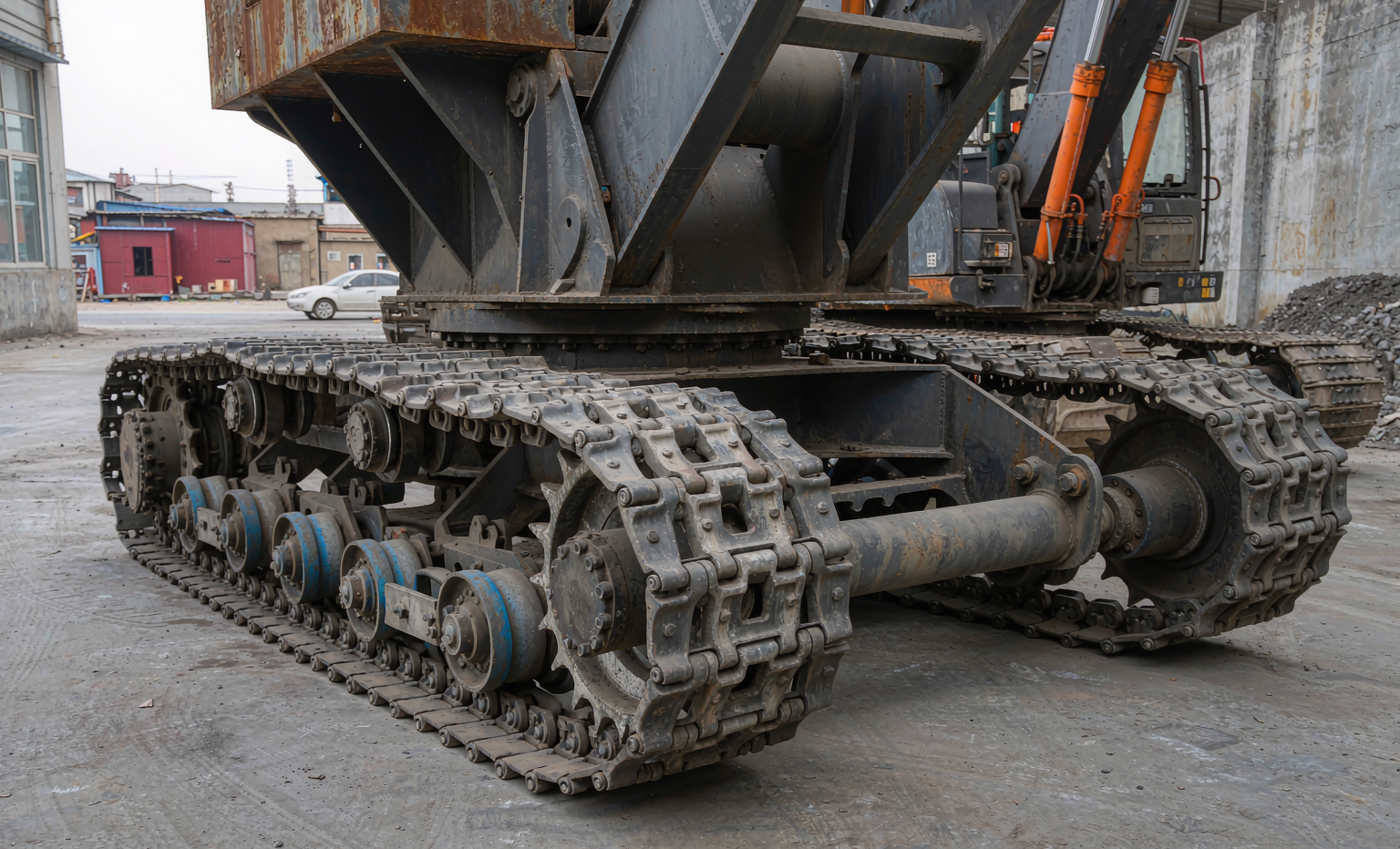
The aftermarket versus OEM question comes up on every undercarriage replacement, and the honest answer is that it depends on the component and the supplier — not on the label. There are aftermarket undercarriage parts that last as long as OEM, and there are cheap ones that fail in a season. Here is how to tell the difference before you spend the money.
What Actually Determines Undercarriage Life
Four things, and the OEM badge is not one of them:
- Material and heat treatment. Link and pin hardness, and the depth of the hardened case, decide wear life more than anything else. A shallow case wears through quickly and then the part fails fast.
- Machining tolerance. Bushing bore, pin diameter and link pitch must be held within tolerance. Sloppy tolerances show up as rapid elongation and early seal failure.
- Seal quality. Sealed chains live or die on the seal and the lubricant retained behind it.
- Manufacturing consistency. A good supplier produces the same part to the same spec every time; that consistency is what you are really paying for.
Where Aftermarket Makes Sense
For high-wear, frequently replaced components, aftermarket is usually the right call — provided the supplier can state the material specification and heat treatment. Undercarriage wear parts are built to published dimensions, and a competent manufacturer can meet them. Track shoes, bucket teeth, pins, bushings and rollers fall into this category. The savings are real, commonly in the range of 30–60 per cent against OEM, and on a component that wears out anyway that difference compounds over the machine's life.
Where OEM Still Wins
Components that must interact precisely with a control system or a regulated safety function are usually worth buying original: hydraulics with model-specific calibration, electronic sensors, and anything the manufacturer's warranty is contingent on. Undercarriage is generally not in this category, because it is mechanical and dimension-driven. The exception is a machine still inside a manufacturer's warranty period with a warranty clause requiring original parts — read the clause before you decide.
Comparing the Two Honestly
| Factor | Quality aftermarket | OEM |
|---|---|---|
| Cost | Typically 30–60% lower | Highest |
| Wear life | Can match OEM if material and heat treatment are stated | Consistent and known |
| Fit | Good if dimensions are published and verified | Guaranteed by design |
| Availability | Usually faster, especially on older machines | Can mean long lead times on legacy models |
| Warranty | Varies — must be checked | Standard manufacturer terms |
| Support on legacy machines | Often the only option still in production | May be discontinued |
The Questions That Separate Good From Cheap
- What is the base material and the surface hardness of the part?
- What is the hardened case depth, not just the surface reading?
- Are the critical dimensions published, and do they match the original?
- Is the chain sealed, and what is the seal construction?
- What is the warranty period and what does it actually cover?
- Can the supplier provide a material certificate or a test report on request?
- Can they supply a reference from a fleet doing similar work in similar ground?
Running a Fair Test
If you are unsure, run a controlled comparison instead of arguing in the abstract. Fit one aftermarket component and one OEM component of the same type on a machine doing the same work, measure at the same intervals, and compare the wear rate against cost. That gives you a cost-per-hour figure, which is the only number that matters. Our guide on measuring undercarriage wear sets out the measurements to take, and the JALE undercarriage range covers chains, rollers and idlers for common machine classes.
The Practical Position
Buy aftermarket where the supplier can specify the material, the heat treatment and the tolerance, and where the component is a wear item. Buy OEM where the part interacts with a control or safety system, or where a warranty clause requires it. Avoid the middle ground entirely: an unbranded part with no specification and no warranty is not a saving, it is a deferred repair.
JALE Excavator Parts manufactures bucket pins, bushings, bucket teeth, hydraulic seals, undercarriage and breaker parts in Shandong, China, and exports to the Middle East, Southeast Asia, Africa, South America and Europe. We publish material and hardness specifications on request and supply bucket bushings and bucket pins alongside our undercarriage range.