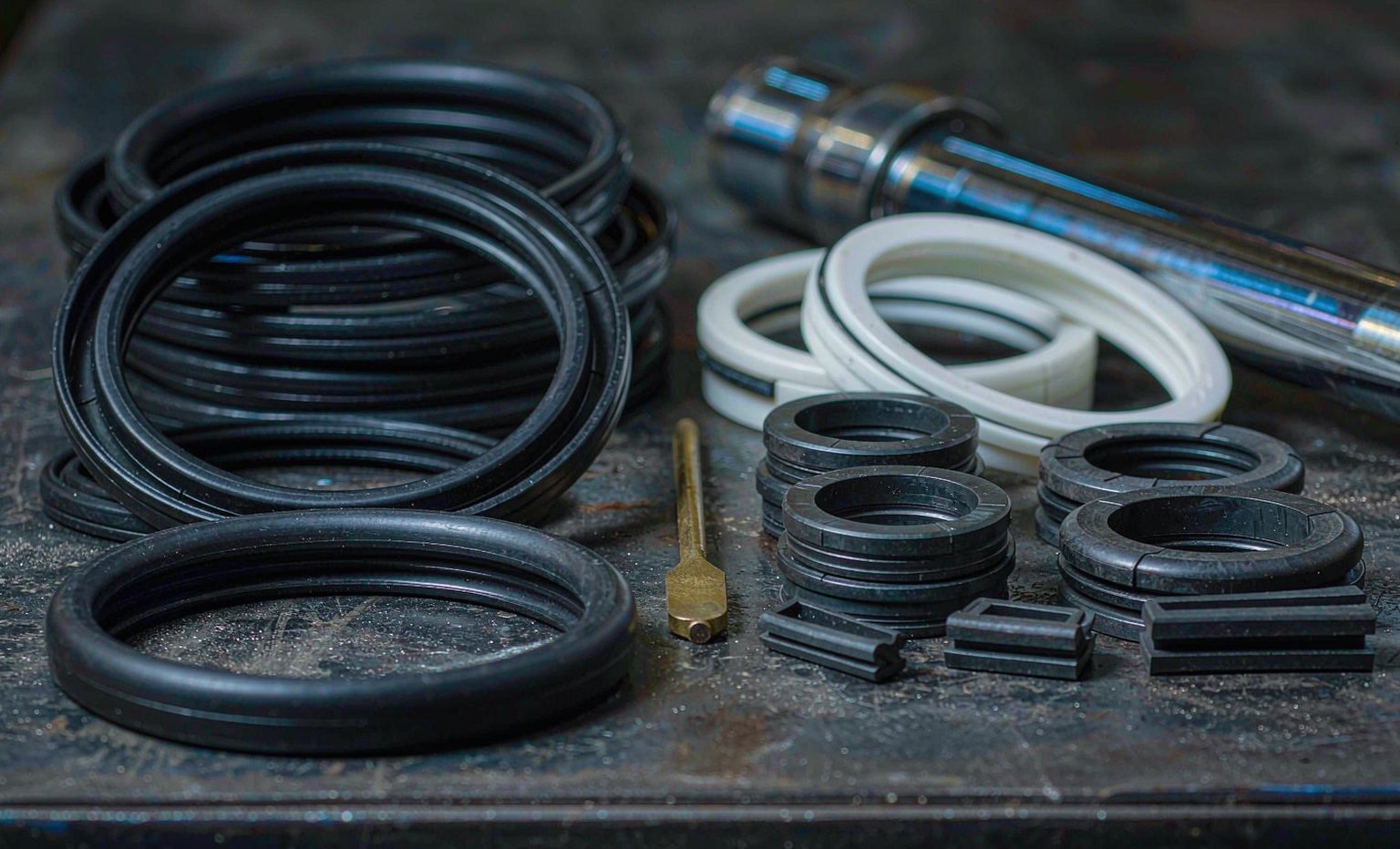
A BRV32 breaker seal kit is the set of elastomer and plastic seals that keep a hydraulic hammer's piston, cylinder and accumulator working as one pressure unit. In a kit of this class that normally means a rod seal, a rod wiper, two piston seals, guide rings, a buffer seal, the accumulator seals, and a handful of O-rings and backup rings for the valve block and through-bolts. Buyers order it by the model number stamped on the breaker, which is reasonable, and it is also the first place the order goes wrong: a model number identifies a family, not a seal cross-section, and two hammers carrying the same badge from different production years can have different gland dimensions inside.
This is what is actually in the kit, what each part does, how the failures present, and what has to be measured before a kit is ordered so it fits on the bench instead of going back into a box.
What is actually inside a BRV32 breaker seal kit
A complete kit for a hammer in this size class carries roughly fifteen to thirty pieces. The list below is the working set; a kit missing any of the first five is a partial kit, whatever the packaging says.
- Rod seal. The primary dynamic seal between the piston rod and the front head or cylinder gland. Usually a polyurethane U-cup or a filled-PTFE step seal, energised by an O-ring.
- Rod wiper / dust seal. Sits outboard of the rod seal and scrapes rock dust and grit off the rod before it reaches the sealing lip. Cheap part, disproportionate effect on the life of the expensive one behind it.
- Piston seal. Seals the striking piston in the cylinder bore. On most breakers this is the part that takes the hardest duty, because it sees full accumulator pressure and the highest sliding speed.
- Guide rings / wear rings. Non-sealing, load-bearing rings that hold the piston concentric in the bore so the seals are not asked to carry side load.
- Buffer seal. Absorbs the pressure spike ahead of the rod seal on the return stroke. Omit it and the rod seal fails early, which is exactly what happens on kits assembled from generic O-rings.
- Accumulator seals. Either a diaphragm or a piston accumulator, depending on the breaker. The seal set here is small and often the reason a "fully re-sealed" hammer still will not hold pressure.
- Static O-rings and backup rings. Valve block, through-bolt passages, plug bosses. Static seals fail from compression set and from incorrect groove fill, not from wear.
If a supplier quotes a kit containing only O-rings, it is a re-seal of the statics and nothing else. It will stop an external leak and will not restore striking force.
Why the model number does not identify the seal
Seal dimensions follow the cylinder bore, the piston groove width and depth, the rod diameter and the gland bore. None of those are in the model designation. Three things routinely move them without the badge changing:
- Production revisions. Manufacturers revise cylinder internals, seal profiles and accumulator design across a model's life. A 2014 hammer and a 2021 hammer with the same label can use different rod seals.
- Aftermarket cylinders. A replacement cylinder or front head from a non-OEM source is machined to that source's drawing, not the original. The seal kit has to follow the metal, not the label.
- Grey-market assemblies. Complete hammers assembled from mixed provenance are common in this trade. The badge on the housing may not describe what is inside it.
The authority is the parts book for the serial number, not a model search. Where the parts book is unavailable, the old seals are the drawing: measure them, and measure the grooves they came out of. A supplier who will not work from measurements is selling a guess.
Materials, and what each one is being asked to do
Four materials cover almost the whole kit. Knowing which is where explains most premature failures.
| Material | Typical hardness | Working temperature | Where it is used | How it fails |
|---|---|---|---|---|
| NBR (nitrile) | 70–90 Shore A | about −30 to +100 °C | Static O-rings, accumulator seals | Compression set, hardening, cracking with age and heat |
| PU (polyurethane) | 90–95 Shore A | about −30 to +80 °C, briefly higher | Rod seal, wiper, piston seal | Hydrolysis in wet oil, extrusion into a wide gap, tearing at the lip |
| PTFE, bronze filled | not measured in Shore A | about −50 to +200 °C | Backup rings, guide rings, step-seal faces | Cold flow, scoring from contamination, wear against a rough bore |
| FKM (fluorocarbon) | 70–90 Shore A | about −20 to +200 °C | High-temperature statics | Swelling with some fluids, high cost, poor low-temperature flexibility |
Two substitutions are common and both are false economies. Replacing a polyurethane rod seal with nitrile gives a seal that is softer, sets faster and extrudes sooner. Replacing a bronze-filled PTFE backup ring with a plain PTFE one removes the anti-extrusion function entirely, and the rod seal then fails by extrusion rather than wear.
Failure modes that look like seal problems
Most hammers that arrive for a re-seal do not have a seal problem. They have one of the following, and a new kit fixes it for a few weeks:
- Scored piston rod. A raised burr or a scored band on the rod destroys a new lip seal in hours. The rod has to be inspected, and polished or replaced, before any kit goes in.
- Oval or tapered bore. Wear in the cylinder is rarely uniform. A bore that is out of round by more than a few hundredths of a millimetre will not hold a piston seal regardless of material.
- Contaminated oil. Grit between the lip and the rod acts as a lapping compound. If the oil is dark and gritty, the kit is the second purchase, not the first.
- Accumulator pressure loss. Low pre-charge produces a hammer that strokes weakly and heats the oil. The symptom is mistaken for worn seals because the hammer "feels soft".
- Loose through-bolts. Relaxed bolt tension lets the front head and cylinder move relative to each other, which frets the joint faces and pinches seals.
- Wrong oil viscosity or a restricted case drain. Both raise temperature, and heat is what hardens every elastomer in the kit.
The diagnostic value is in the old seals. Read them before they go in the bin.
Reading the old seals
| What you see | What it means | What to change besides the kit |
|---|---|---|
| Hard, glossy, flattened lip | Age and heat; compression set | Oil cooler or duty cycle; check oil temperature |
| Nibbled or frayed on one side | Extrusion into an oversized gap | Check groove width and bore clearance; fit correct backup ring |
| Longitudinal scores | Contamination, or a burr on the rod | Flush the circuit, replace filters, polish the rod |
| Swollen, soft, oversized | Wrong hydraulic fluid or a contaminated mix | Confirm fluid specification; full oil change |
| Torn lip, clean tear | Installation damage | Assembly method, not the parts |
| Seal intact, hammer still weak | Not a seal fault | Accumulator pre-charge, valve, relief setting |
This table is worth more than any supplier's claim about compound quality. The old parts tell you which of the four materials was doing the failing, and why.
Clearance, extrusion and the backup ring
A dynamic seal only holds because the gap it has to bridge is small. In breaker service the extrusion gap is the radial clearance between the piston and the bore, plus any groove clearance, and it grows as the bore and piston wear. Once the gap exceeds what the seal compound can bridge at working pressure, the seal extrudes into it — the nibbled edge in the table above — and then it is finished.
This is the reason housing dimensions are standardised rather than invented per manufacturer. ISO 5597 defines the housing dimensions and tolerances for single-acting piston and rod seals in reciprocating hydraulic cylinders, and ISO 7425 covers housings for elastomer-energised, plastic-faced seals. Those two documents are why a seal from one supplier can fit a housing designed by another, and why a kit built to a different housing standard will not fit yours no matter how close the bore measures.
Practically: measure the groove width and depth as carefully as the bore. A seal that is 0.3 mm too wide will not seat; one that is 0.3 mm too narrow will move in the groove and wear its own shoulders.
Installation: four things that decide service life
- Cleanliness. Every part washed, dried and handled with clean gloves. One piece of grit under a lip is a leak path. Work on a clean bench, not on the machine deck.
- No sharp edges. Cover every spline, thread and groove with tape or a fitting sleeve before a seal passes over it. Most installation damage happens in the last 20 mm of travel.
- Lubrication with the system oil. Not grease, not assembly paste that will not mix with the hydraulic fluid. The seal has to slide into place wet.
- Seating, not forcing. A seal that needs force is the wrong seal. Twisted O-rings and rolled lips are invisible once the gland is closed and are the classic cause of a leak on first start.
Through-bolts, torque and the accumulator
Breaker assembly is a pre-loaded stack: cylinder, front head and back head held by through-bolts that must be torqued in the maker's sequence and to the maker's figure. Under-torque frets the joint faces and pinches seals; over-torque stretches the bolts and lifts the stack. If the figures are not available, do not invent them — obtain the manual. A hammer that comes back with loose bolts was usually assembled without a torque wrench.
The accumulator must be depressurised before the hammer is opened, using the maker's procedure. Nitrogen is the charge gas; oxygen or compressed air in an accumulator is a fire and fragmentation hazard, not a shortcut.
Oil, filtration and heat
Breaker circuits run hot and dirty by design. Typical practice is a mineral hydraulic oil in the ISO VG 46 to VG 68 range depending on ambient temperature, with cleanliness maintained to a recognised ISO 4406 code — 18/16/13 is a common target for this class of equipment, and many breakers want better. Case drain back-pressure above the maker's limit will blow a rod seal irrespective of its material. Check the return filter and the case drain line before blaming the kit.
The measurements to take before ordering a BRV32 breaker seal kit
| Measurement | Instrument | Why it decides the order |
|---|---|---|
| Cylinder bore diameter | Internal micrometer or bore gauge | Sets piston seal outside diameter and guide ring size |
| Piston groove width and depth | Vernier and depth gauge | Sets seal cross-section; wrong width will not seat |
| Rod diameter | Micrometer, at three positions | Sets rod seal and wiper inside diameter |
| Gland bore and groove | Internal micrometer | Sets rod seal outside diameter |
| Old seal cross-section | Vernier on a cut section | Confirms the profile, not just the diameter |
| Serial number and plate photo | Camera | Identifies the production revision |
Six numbers and one photograph settle an order that otherwise takes three attempts and two months of shipping.
Seal kit, or a rebuilt breaker?
A kit is the right answer when the metal is sound: bore round and unmarked, rod unblemished, no fretting on the joint faces. It is the wrong answer when the bore is oval, the rod is scored through its chrome, or the piston shows heat discolouration. In those cases a re-seal buys weeks. The honest options are to re-hone and fit oversize components, replace the cylinder assembly, or exchange the hammer — and the decision is made on measurements, not on the price of the kit.
Storage and shelf life
Elastomers age on the shelf. Nitrile and polyurethane parts are good for roughly five years stored cool, dark and unstretched, and considerably less in a hot container. Keep kits in their sealed bags until the moment of fitting, away from electric motors and welding sets, which generate ozone that cracks rubber. Never hang a seal on a nail or stretch it over a pipe "to keep it handy" — that sets a permanent deformation before it ever sees pressure.
What to put in the enquiry
Send the breaker model and serial, a photograph of the identification plate, the six measurements above, the hydraulic oil specification in use, the machine hours and the symptom in the operator's words — weak blow, oil from the front head, hammer hot, or hammer stops when the tool is loaded. A supplier holding that information can confirm a kit against a drawing instead of matching a name.
Our breaker parts range covers seal kits, through-bolts, chisels and front-head bushings for this class of hammer, and this guide to identifying seal kits covers the measurement method in more detail. If the hammer is being replaced rather than repaired, the breaker hammer range lists the sizes that match common carrier classes. Send the measurements and we will confirm the kit before it is packed.