
Aftermarket research in 2026 puts a useful number on the problem: a single excavator involves more than 2,800 replaceable parts, and roughly 35 percent of them are low-frequency items with annual demand below five units. That long tail is why parts sourcing feels complicated. It is also why it pays to be selective about what you actually manage: three part families account for most of the money and most of the downtime.
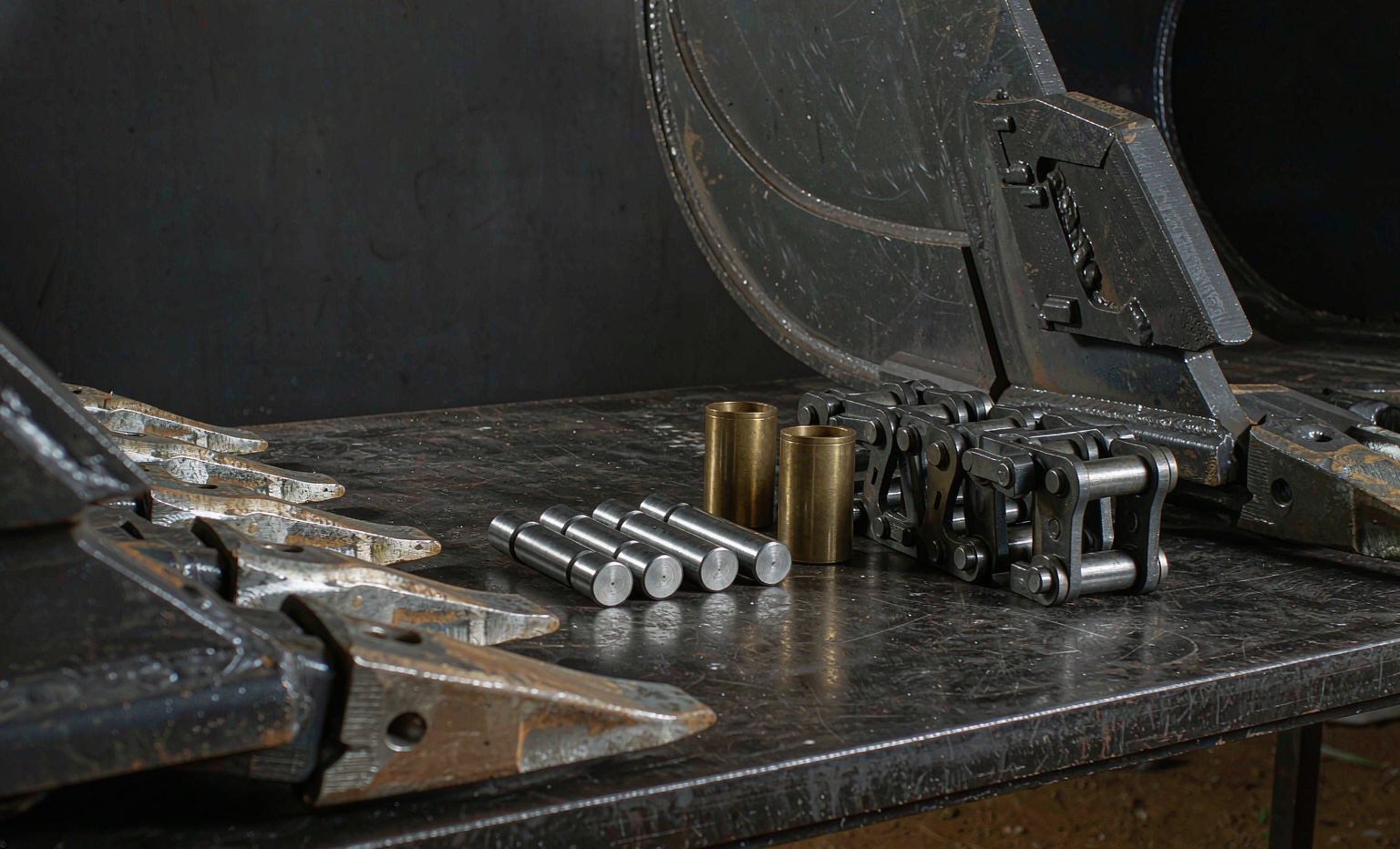
1. Bucket teeth — the consumable with a specification
Teeth are consumed by abrasion, and the wear rate is set by the ground you work in, not by the machine. The mistake buyers make is treating them as an undifferentiated commodity and buying on unit price.
What actually determines whether a tooth is good value:
- Profile and fitment. A tooth is designed for a specific adapter and machine class. A near-match that needs forcing on will not stay on, and a loose tooth moves, which wears the adapter.
- Alloy and hardness. Abrasive rock and general earthmoving do not call for the same material. Ask what the tooth is specified for.
- Whether it protects the adapter. Adapters are expensive and slow to change. A tooth that costs slightly more but wears in a way that shields the adapter is cheaper over a season.
See the range in excavator bucket teeth, or a specific example in 1U3352PT bucket teeth and Volvo EC360 cross pin teeth. Complete buckets are listed under buckets.
2. Pivot pins — the part whose tolerance you can measure
Pins and bushings are the best-understood and worst-specified parts on any excavator. Unlike electronics, their quality is auditable with a calliper, which means there is no reason to buy them blindly.
Three questions decide 90 percent of pin problems:
- Is the diameter and tolerance correct? A pin that is under-size by a few hundredths will hammer in the bore and destroy the bushing. This is the single most common aftermarket failure.
- Is the surface treated correctly? Pins live in a rolling or oscillating contact. Case hardness and finish are what stop premature galling.
- Is the retention correct? Snap rings, plate retainers and end caps differ by machine. Fit the retention the machine was built for.
Browse excavator pins, including Hitachi EX200 arm pins, Doosan DX380LC boom pins and Kobelco SK210/SK330-8/SK460 boom cylinder pins.
3. Bushings — where the real cost hides
Bushings are cheap to buy and expensive to ignore. When a bushing wears oval, the load stops being carried where it was designed to be carried, and the damage spreads to the boss and the pin. Replacing a bushing on schedule is maintenance. Replacing a bushing late is a line-boring job.
Look for:
- Material and lubrication path. Bronze, bi-metal and hardened steel bushings suit different joints and different greasing arrangements. Match the original design.
- Grease groove and hole alignment. If the grease hole does not line up with the drilling in the boss, the joint will not accept grease no matter how hard the fitter tries.
- Wall thickness consistency. Uneven wall thickness is how a bushing goes oval early.
See excavator bushings, for example the Komatsu PC200-6 bucket bushing, JCB JS130/JS200 H-link bushing and R55 link bushing.
Cost per tonne, not cost per part
The calculation that matters is simple to state and rarely done:
cost per tonne = (part price + fitting labour + lost production hours) ÷ tonnes moved between replacements
A tooth at 20 percent higher price that lasts 50 percent longer wins. A pin that is marginally cheaper but out of tolerance loses badly, because it takes the bushing and eventually the boss with it. Working in these terms turns a price conversation into an engineering one, which is where a parts supplier should be able to hold its end up.
Frequently asked questions
Should pins and bushings always be replaced as a set?
Where a pin runs in a bushing, yes in most cases. A new pin in a worn bushing will not last, and a new bushing on a worn pin is the same mistake in reverse.
How do I know when bucket teeth need replacing?
Replace on measured wear, not on appearance. Once the tooth has worn to the point where it stops protecting the adapter, the adapter becomes the consumable — and adapters are far more expensive.
Are aftermarket bucket teeth as good as OEM?
They can be, but only where the supplier publishes the alloy and the intended application. The failure mode of cheap teeth is not immediate breakage, it is wearing twice as fast without anybody noticing.
What should I send when ordering pins and bushings?
Machine model and serial, the part number if you have it, the measured pin diameter, and a photograph of the worn part. Those four items prevent nearly every wrong-part shipment.
Where to go next
The remaining 2,797 parts have to be sourced too. Start from the complete excavator parts catalogue — including track chains, rollers, bearings and cutting edges — or send your parts list and we will match it against machine and part number.