
The growth in excavator parts demand in 2026 is concentrated in compact and mini machines, because that is where the new machine population is going and where utilisation runs highest in urban, utility and landscaping work. On 20-tonne machines and above, wear-part demand is driven by replacement cycles on an existing fleet. Below about 8 tonnes, it is being driven by fleet expansion — and by machines that track constantly on hard surfaces instead of loading trucks all day.
What does the 2026 export data actually show?
China Construction Machinery Association figures reported in September 2026 showed August 2026 excavator sales of 19,716 units, up 19.3 per cent year on year, with exports at 11,730 units, up 32.7 per cent, against domestic sales of 7,986 units, up 3.9 per cent. Cumulative exports for January to August reached 96,938 units, up 31.8 per cent.
Customs data tells the same story in value terms. China's construction machinery exports reached 34.373 billion US dollars in the first half of 2026, up more than 24 per cent year on year, with excavator export growth around 33 per cent. On a customs basis for January to July, Africa grew 48 per cent, Latin America 33 per cent and Southeast Asia 29 per cent, while Western Europe grew more than 40 per cent and the US, Canada and Mexico combined grew close to 30 per cent. Russia and the Middle East both declined over the same period.
Two things follow from that distribution. First, a growing share of the world's excavator population is being commissioned in markets where dealer workshops are thin and independent repair shops do the work. Second, those machines are heavily concentrated in exactly the size classes that work in towns.
Why do compact machines consume wear parts faster per hour?
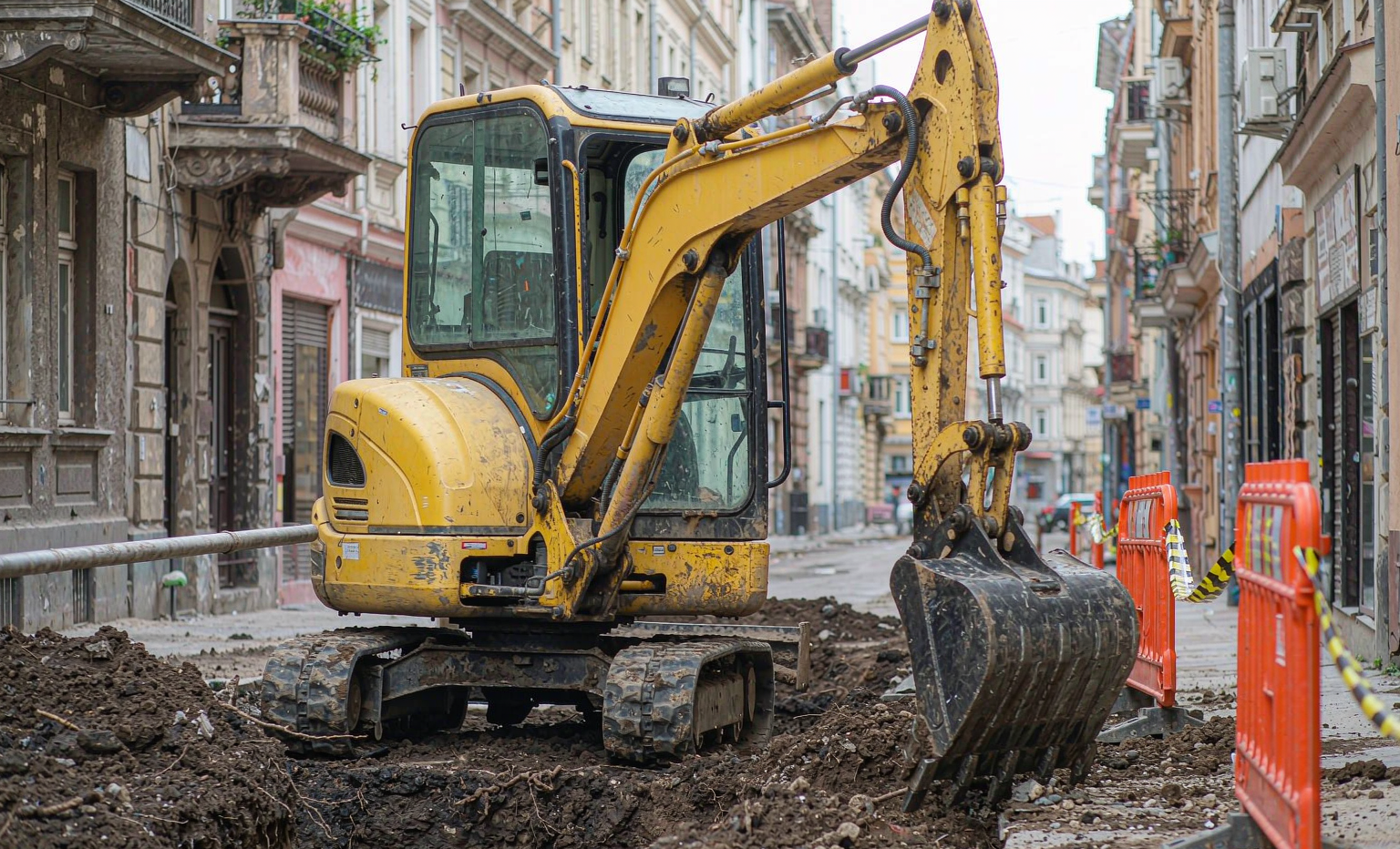
A mini excavator on an urban utility contract is not doing the same work as a 30-tonne machine in a borrow pit, even though both show the same hours on the meter:
- More tracking, less digging. Repositioning on a street or a housing plot means continuous short moves, which is what wears tracks, rollers and sprockets.
- Hard, abrasive surfaces. Working against asphalt, kerb, concrete rubble and compacted hardcore wears bucket teeth, cutting edges and rubber or steel tracks far faster than soil does.
- Constant attachment changes. Breaker, auger, thumb and grading bucket on the same machine. Every change loads the coupler and the bucket pins, and each attachment has its own wear parts to keep.
- High utilisation by many operators. Rental and hire machines in particular run long hours under operators who did not buy them.
Which compact-machine parts move fastest?
On the compact side the repeat items are rubber and steel tracks, bucket teeth in the small adapter families, bucket pins and bushings, quick couplers and bucket ears, mini breaker chisels, bushings and seal kits, and hydraulic hoses and fittings. The parts lines for these are the rubber tracks, 1 tonne class and 2 tonne class machine sections, plus mini excavator breaker consumables.
What does this mean for a dealer's stocking plan?
- Go deep on the models you actually see. A rental fleet made up of a handful of common compact models should be stocked by part number for those models, not by generic sizing.
- Treat the coupler and pins as a system. On a machine that changes attachment several times a day, pins and bushes are a consumable with a service life measured in months, not years.
- Keep tracks and undercarriage in proportion. On a compact machine, undercarriage is a larger share of the maintenance budget than it is on a large excavator, because there is no big engine and no big hydraulic pump to dominate the spend.
- Do not abandon the big iron. Undercarriage rebuilds on 20-tonne and larger machines remain the single largest parts line in the market. The compact segment is growth; the large segment is volume.
If you are building a compact-machine stock list, send the model list and the OEM part numbers you already use, and the sizes can be confirmed against drawings before the order is packed.