
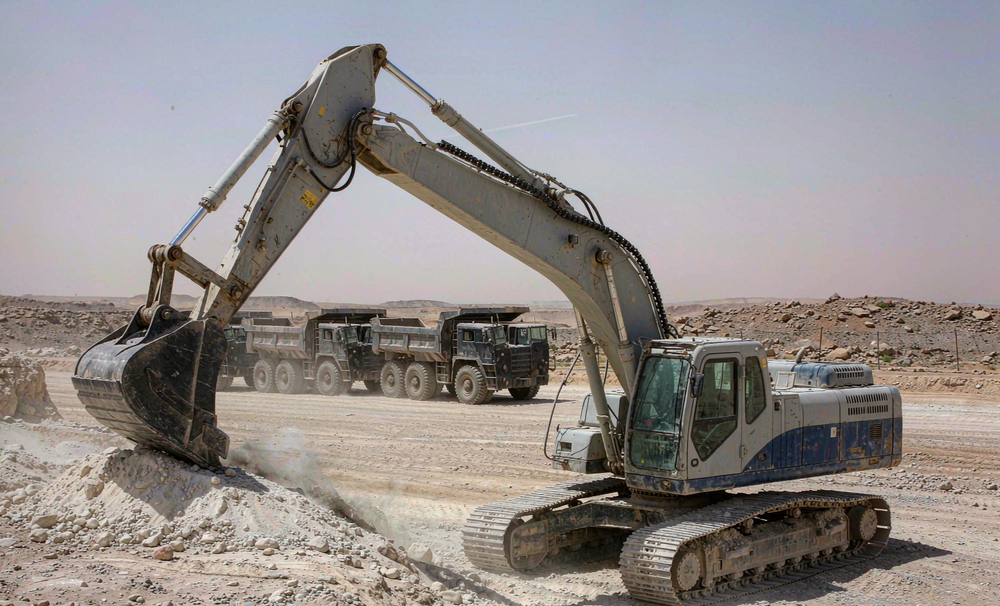
HD Hyundai Infracore has taken orders for 131 DEVELON machines across Saudi Arabia and Brazil, including thirty 53-tonne excavators and fifty large wheeled loaders for the NEOM project. For parts buyers the number that matters is not 131, it is the size mix: 53- and 80-tonne machines carry a different wear profile and a far heavier freight cost per part than the 20-tonne fleet most aftermarket stock lists are built around.
What exactly was ordered, and where is it going?
- Saudi Arabia: thirty 53-tonne excavators and fifty large wheeled loaders, split between two Saudi construction companies and destined for the NEOM project in the northwest of the Kingdom.
- Brazil: 51 excavators in total. Twenty-two large units in the 80-tonne and 53-tonne classes for a railway construction project in Mato Grosso, and 29 mid-sized 14-tonne excavators for a public bidding project in Rio Grande do Sul.
- Saudi momentum: including these orders, the company reports 846 units of excavator, wheeled loader and articulated dump truck sales in Saudi Arabia, against 558 in the same period a year earlier, a rise of about 52 percent.
The orders were announced by the manufacturer. What they tell an aftermarket supplier is where the installed base is about to grow, not who will supply its wear parts.
Why does the size mix matter more than the unit count?
A 53-tonne excavator does not simply consume more of the same parts a 20-tonne machine uses. The pins are larger, the track rollers and idlers are heavier, the shoes are wider, and the bucket hardware is built to a different scale. Every one of those parts costs more to move than to make. On heavy undercarriage components, ocean freight and container cube become the deciding number in the landed cost, which is why a buyer sourcing for a 50-tonne fleet has to think in consolidated shipments rather than individual part orders.
The tariff position differs too. Complete machines and their spare parts sit under separate headings in most schedules, and the trade-remedy measures that apply to whole excavators do not automatically reach components. Buyers in markets with active measures on Chinese-built machines should confirm the classification of the parts they import rather than assuming the machine treatment applies.
Which parts wear first on a 53-tonne machine in desert rock?
The field pattern on large machines in abrasive, hot conditions is consistent enough to plan around, even though the intervals vary by site:
- Bucket teeth and adapters go first, in weeks to months on abrasive rock. Corner teeth go before centre teeth.
- Bucket and linkage pins and bushings follow, as the lash from worn teeth and hard digging works the joints. Greasing discipline moves this interval more than any other single factor.
- Undercarriage takes the longest to wear out and costs the most when it does: track groups, rollers, idlers and sprockets. Heat and grit shorten seal life, and a failed roller seal on a 53-tonne machine means a much heavier component to change than the same failure on a 20-tonne unit.
- Hydraulic seals and breaker components where hammers are in the fleet. Dust is the enemy here, and desert sites supply it continuously.
The practical reading is that a fleet addition creates demand for teeth and ground-engaging tools almost immediately, and undercarriage demand twelve to twenty-four months later. A supplier who waits for the undercarriage orders misses the first two years of the machine's parts spend.
What does the Brazil order say about how fleets are specified?
The 14-tonne units in Rio Grande do Sul were specified with the manufacturer's own engines, at the buyer's request, for easier maintenance. That is a deliberate trade: the buyer is accepting a closed engine parts channel in exchange for dealer support and engine commonality across the fleet.
For an aftermarket supplier the lesson is where the open market actually sits. When a buyer locks the driveline to the dealer, the parts budget that remains contestable is everything the dealer does not make: the bucket, the teeth, the pins and bushings, the undercarriage, the cutting edges. Those are the categories where price, lead time and stock depth decide the order, and where a Shandong manufacturer competes on equal terms.
What should an aftermarket buyer do with this information?
- Stock the size band, not just the popular SKU. A 53-tonne fleet needs 53-tonne undercarriage. Most catalogues are deep in 20-tonne parts and thin above 40 tonnes.
- Quote by serial number. Large machines within one model family often share almost no wear parts, and a parts-book lookup by model alone produces the wrong pin diameter more often than buyers expect.
- Consolidate shipments. Mixed heavy SKUs in one container beat three separate orders once freight per kilogram is counted.
- Time the stock, not the announcement. Teeth and pins for a new fleet are needed as soon as the machines start work. Undercarriage is a later order, but it is a much larger one, and it is worth quoting early.
What this does not tell you
An order announcement says nothing about which aftermarket brand will supply those fleets, and nothing about how many of the 131 machines will still be working in five years. OEM dealers will push their own parts programmes hard on a project of this profile, and price is not the only lever they hold. The reasonable conclusion is narrower and more useful: a large population of 53- and 80-tonne class machines is being installed in two markets where aftermarket parts already compete strongly with the dealer, and the consumable categories are where that competition starts.
For reference on the categories that follow a fleet like this, see our undercarriage parts range, track rollers, bucket teeth and bucket pins and bushings.