
In late September 2026 Epiroc inaugurated an expanded manufacturing facility for hydraulic attachment tools in Kalmar, Sweden. The building adds more than 8,000 square metres and a significant increase in production capacity, and it is the result of a decision to consolidate the company's European production of hydraulic attachments into Sweden.
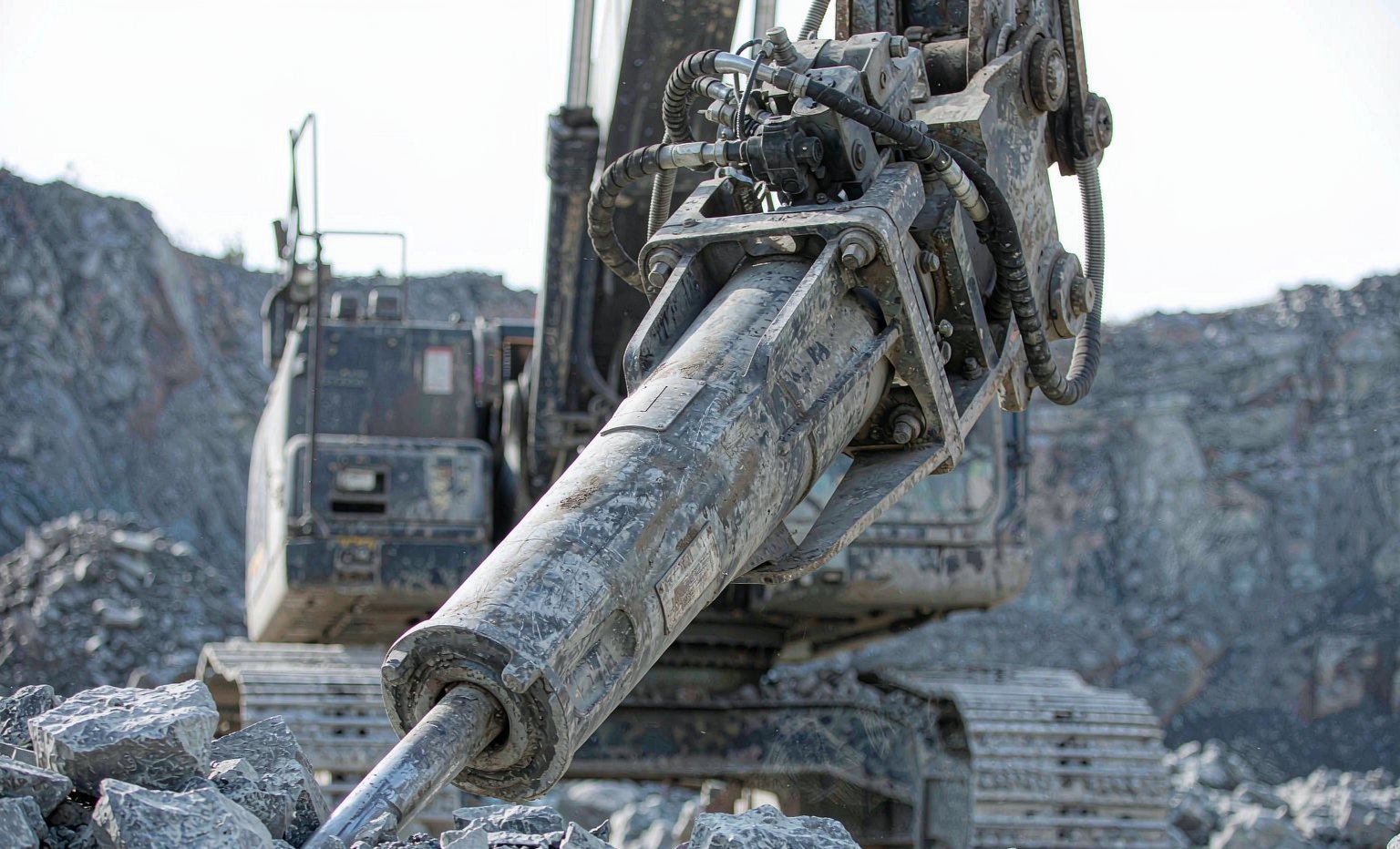
What actually changed
- One production centre for the full range. The site now produces hydraulic breakers from the smallest SB 52 up to the largest HB 10 000, rather than the range being spread across sites.
- Scale. Around 175 people work at the facility, roughly 40 of them added because of the expansion.
- Automation. The plant is described as highly automated and scalable — language that usually translates to tighter dimensional consistency on high-volume parts.
The context matters as much as the announcement: these breakers are attached to excavators and used in construction, demolition, quarrying, mining and infrastructure work. When a company builds capacity for that, it is responding to sustained demand for hammers on the end of excavator arms.
The part nobody budgets for
A breaker is bought once and consumed continuously. What wears is everything around and inside it, and that consumption is often invisible in a maintenance plan because it is not part of the machine's own service schedule. Three groups deserve attention:
1. Breaker internals
The chisel or moil point is the obvious consumable, but the parts that determine whether the breaker keeps its hitting force are the chisel bushing, the retaining pin and the through bolts. A worn chisel bushing lets the chisel wander, which costs blow energy and accelerates wear on everything downstream. Replacing a low-cost bushing on time protects a high-cost piston.
2. The mounting and linkage
A breaker transfers enormous shock loading into the excavator's own pivot points. The pins, bushings and linkage components at the boom, arm and coupler take punishment that no digging application applies. On hammer-equipped machines these should be inspected on a shorter interval than the manufacturer's general schedule.
3. The quick coupler interface
If you change attachments daily, the coupler becomes the highest-cycle joint on the machine. Coupler wear is usually discovered as slop or a rattle that nobody can locate — and by then the pin and the bore are both worn.
Why more breaker capacity is a parts story
An expanded attachment plant does not change how many breaks a chisel will take. What it does signal is that the installed base of hammer-equipped excavators keeps growing — and a hammer on an excavator roughly doubles the number of pivot joints working under shock load. Every extra hammer in service is a set of pins and bushings wearing out somewhere.
A practical inspection routine for hammer machines
- Every 250 hours: check chisel bushing clearance and retaining pin condition; a worn bushing is the cheapest early warning you have.
- Every 500 hours: grease and inspect the boom, arm and coupler pivot points for ovality rather than just for grease.
- On any change of attachment: look at the coupler pin for flat spotting, which indicates shock loading rather than rolling contact.
- Keep the greasing honest. Most pin and bushing failures on hammer machines are lubrication failures that were interpreted as material failures.
Frequently asked questions
How long should a hydraulic breaker chisel bushing last?
There is no universal figure — it depends on rock type, operator technique and greasing discipline. Check clearance at every 250-hour service and replace on measured wear rather than on hours.
Do I need different pins for a breaker than for a bucket?
The pin must suit the joint, not the attachment. What changes with a hammer is the loading mode: shock rather than steady load, which shortens grease life and makes surface hardness more important.
Why does my excavator feel loose after fitting a hammer?
Hammer work accelerates wear in the boom, arm and coupler pivots specifically. Measure the bore and the pin; by the time the play is obvious, both are usually out of tolerance.
Is greasing frequency more important than grease quality?
Frequency does more of the work. A good grease applied on schedule protects better than a premium grease applied late.
Takeaway
More breaker manufacturing capacity in Sweden is good news for hammer availability, but the cost that actually moves on your books sits in the joints around the hammer. Put the chisel bushing, the retaining pin and the boom pivots on a written interval and you will spend less on attachments and less on the excavator underneath them.
See the pins, bushings and undercarriage and linkage parts used on hammer-equipped machines, or send your machine details for a matching list.