Excavator bucket pin bushing set: how to specify one
A bucket pin and bushing set is the pins plus every bushing in the bores those pins pass through, sold as one matched group for one bucket. The part buyers get wrong is the count: most emailed "sets" price a single joint, while a working bucket needs three.
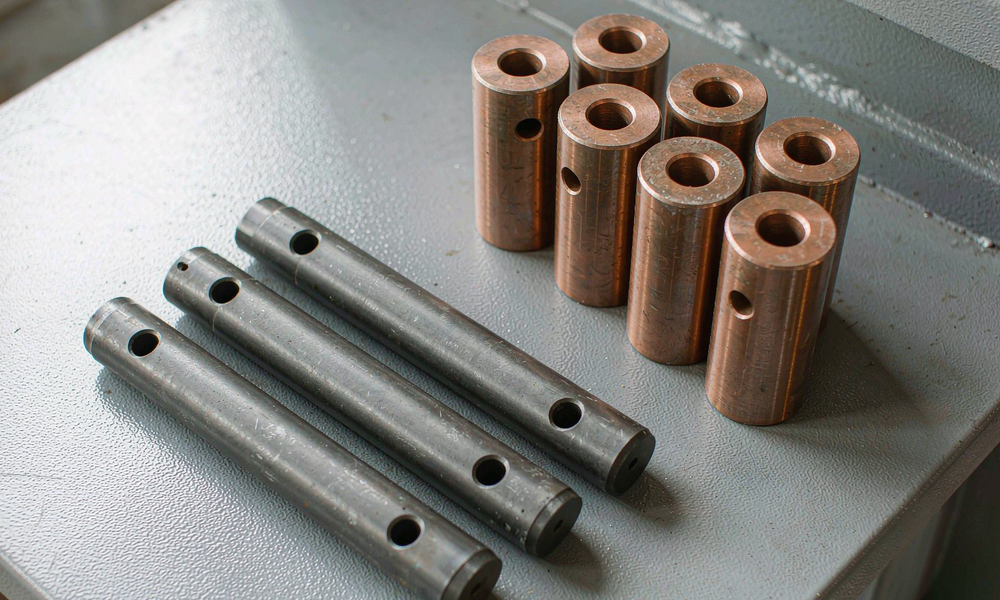
What does an excavator bucket pin and bushing set actually contain?
A standard excavator bucket hangs on three pin joints: bucket to arm, bucket to H-link, and H-link to arm. Each joint is one pin plus the bushings in the bores that move on it. On a typical bucket that works out as two bushings in the bucket ears and one in the mating boss for each joint, so six to nine bushings for the bucket.
A complete set therefore looks like this:
- 3 pins, each with the correct head, chamfer and retention feature
- 6 to 9 bushings, plain, flanged or lipped depending on the bore
- Retention hardware: cross bolts and nuts, snap rings or keeper plates
- Grease nipples where the pin is cross-drilled for lubrication
If a quotation lists one pin and two bushings, it is quoting one joint. Ask which joint, and ask for the price of the full bucket set before you compare suppliers.
How many bushings does each joint need?
Count bores, not joints. Every bore the pin passes through that is a wearing surface needs a bushing, so the number is set by the bucket design rather than by the machine size. Two patterns are common. The first is three separate bushings per joint, one per ear plus one in the link or arm boss. The second is a single long bushing pressed through both ears, which is cheaper to fit but harder to extract when it seizes.
Tell the supplier which pattern your bucket uses, or send a photo of the joint with the pin out. It changes the price per set by a wide margin and it is the most common reason a delivered set does not fit.
What dimensions do you need before asking for a price?
Two pairs of dimensions decide whether the set works: bushing outside diameter against the boss bore, which is the press fit, and bushing inside diameter against the pin diameter, which is the running clearance. Everything else is secondary.
- Pin: shank diameter, overall length, head diameter if headed, cross-hole diameter and its distance from the head
- Bushing: inside diameter, outside diameter, width, and whether it is plain, flanged or lipped
- Grease path: whether the pin is drilled, and where the groove or hole sits in the bushing
Measure a used pin on an unworn band, under the head or at the very end, never on the polished wear land. The wear land is smaller than the original diameter by definition, and quoting from it produces a set that rattles from the first shift.
How tight should the fit be?
The bushing should go into the boss with interference and be pressed, not hammered. As a general guide that is a few hundredths of a millimetre on a small bucket and up to around 0.15 mm on a large one. If a new bushing drops into the bore by hand, the bore is worn and the bushing will spin and destroy the ear within weeks.
The pin then runs inside the bushing with clearance rather than interference, commonly in the region of 0.10 to 0.30 mm on mid-size machines. A pin that is a tight fit in a new bushing will seize and gall as soon as the joint warms up. Confirm both figures against the machine manufacturer's specification for your model; the ranges move with pin diameter and duty.
Why buy the set rather than one pin at a time?
Pins and bushings wear as a pair. Fitting a new pin into a used bushing lets the oval bore recut the pin's hardened surface, and the joint is loose again in a fraction of the hours a matched set would give. Beyond that, a set ships as one consignment on one freight charge, comes from a single heat lot so hardness is consistent across the joints, and needs one teardown instead of three.
For a fleet, the arithmetic is straightforward: one bucket rebuild on the bench costs less downtime than three separate pin changes spread across a season.
What should you check when the set arrives?
Measure before you press anything. Check pin diameter at three points along the shank and at two angles, check bushing inside and outside diameter, and confirm the cross-hole in the pin lines up with the drilling in the boss. Check that the grease passage is drilled right through and not blocked by a swarf plug, which happens more often than suppliers admit.
If a hardness certificate is offered, keep it with the machine record. It matters at the next rebuild, when you are deciding whether the last set failed because of the part or because of the operator greasing once a month.
What should a quote request contain?
Machine model and serial prefix, bucket part number if it is legible, the three dimensions that matter for each joint, and the number of joints you are rebuilding. Add a photo of the pin and the bore. A supplier who can quote from that information alone is a supplier who has made the parts before.
Bulk orders are usually quoted against a drawing rather than a model number, because the same machine can carry different buckets in different markets. See the range of bucket pins and bucket bushings for the formats these are normally made in, or the combined bucket pins and bushings section. Linkage and arm bushings are usually ordered on the same enquiry, since the H-link joint wears at a similar rate.
,000 went viral in Norway this autumn, and behind that video sits hard data: construction machinery exports reached US.373 billion in the first half of 2026, up 21.7 percent year on year according to the China Construction Machinery Association, with compact equipment and micro excavators driving the fastest growth.
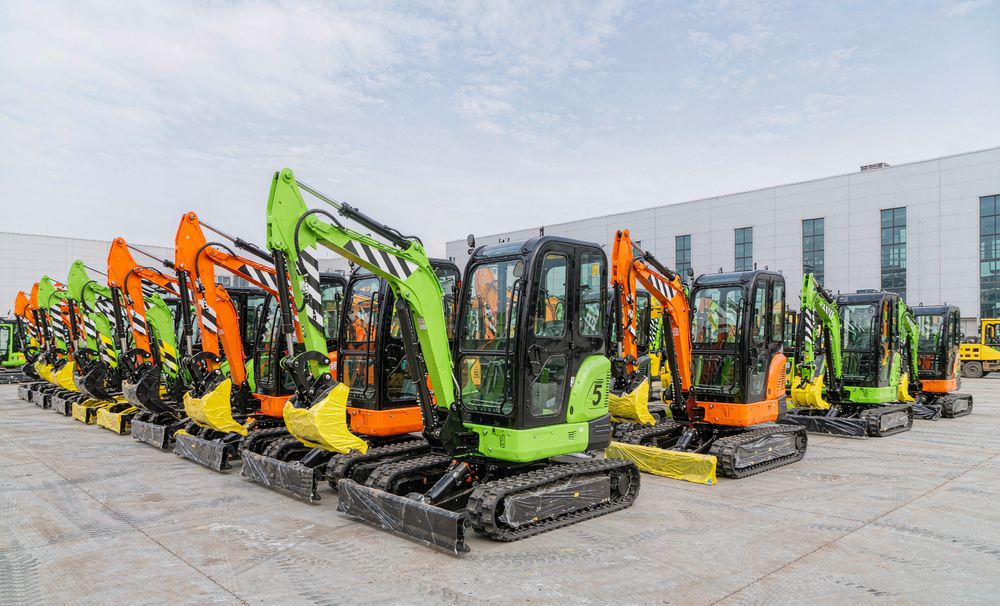
What do the H1 2026 export numbers show?
The headline figures reported by Chinese state media in late October, drawn from industry association statistics: excavator exports exceeded domestic sales for the eighth consecutive month, and cumulative excavator exports passed 85,000 units in the first seven months of 2026, up more than 31 percent year on year. Exports to the European Union reached US.626 billion, up 28.9 percent. Industry forecasts put China's compact construction machinery sales for 2026 above 180,000 units, with micro excavators making up more than 60 percent of that, roughly 110,000 machines. Trade commentary attributes the shift to buyers outside the traditional channel: private owners, small farms and tradespeople in Europe and South America discovering these machines through social media and cross-border e-commerce rather than dealer networks.
Why does this matter to parts buyers?
Because every one of those machines is a compact wear-parts consumer. A 1 to 3 tonne excavator still runs bucket pins and bushings, teeth, track rollers and sprockets; it just runs them at smaller envelopes and tighter tolerances than a 20 tonne machine. The parts market for this segment behaves differently from the large-machine market in three ways:
- Volumes are high and per-unit margins are thin, so parts supply consolidates around the same Shandong manufacturing clusters that build the machines.
- Many compact machines are sold direct to first-time owners, so sourcing spare parts is often the owner's first experience with the brand. A parts page that does not answer "which pin fits my machine" loses that buyer instantly.
- Fleet-scale after-sales networks, the normal channel for 20 tonne iron, barely exist for micro machines, which pushes owners toward online parts suppliers and pushes suppliers toward clear part-number discipline.
What does this mean for a Shandong parts maker?
JALE Excavator Parts is a Shandong manufacturer of excavator wear parts, and it sits inside the same industrial cluster that is shipping these machines. Unlike most parts suppliers, it also builds its own compact range, including the JALE08, JALE10-1 and JALE12 mini excavators, so the fit between a small machine and its pins, bushings and undercarriage parts is designed rather than reverse-engineered.
Do compact machines need different parts discipline?
The wear parts are the same families, but the failure pattern is not. A micro excavator's pins and bushings are physically smaller, so a few tenths of a millimetre of wear is a larger share of the original clearance, and the symptoms, play at the bucket ear, grease that will not hold, a knocking sound on direction change, arrive sooner relative to machine hours. Owners who would never inspect a 20 tonne machine weekly can and should walk around a 1 tonne machine weekly: two grease strokes per pin, a visual check that the bucket ears have not bell-mouthed, and a feel for slop at the linkage. The parts themselves are cheap; the deciding factor is knowing the pin diameter and ear spacing before ordering, because a 25 mm and a 30 mm pin look identical in a photo.
One honest caveat: no association figures have been published for compact-segment parts demand specifically, so any claim about its size would be guesswork. What the export data does establish is the installed base: over 100,000 micro and compact machines a year are entering service, largely with owners who have no dealer relationship. Their pins, bushings and teeth will be replaced on wear, on the owner's budget, from whichever supplier answers first with the right dimensions. That is the market segment forming behind the headline number, and it buys the same discipline this site has always sold: correct part numbers, honest steel grades, and hardware that fits the first time.
,000 went viral in Norway this autumn, and behind that video sits hard data: construction machinery exports reached US.373 billion in the first half of 2026, up 21.7 percent year on year according to the China Construction Machinery Association, with compact equipment and micro excavators driving the fastest growth.
What do the H1 2026 export numbers show?
The headline figures reported by Chinese state media in late October, drawn from industry association statistics: excavator exports exceeded domestic sales for the eighth consecutive month, and cumulative excavator exports passed 85,000 units in the first seven months of 2026, up more than 31 percent year on year. Exports to the European Union reached US.626 billion, up 28.9 percent. Industry forecasts put China's compact construction machinery sales for 2026 above 180,000 units, with micro excavators making up more than 60 percent of that, roughly 110,000 machines. Trade commentary attributes the shift to buyers outside the traditional channel: private owners, small farms and tradespeople in Europe and South America discovering these machines through social media and cross-border e-commerce rather than dealer networks.
Why does this matter to parts buyers?
Because every one of those machines is a compact wear-parts consumer. A 1 to 3 tonne excavator still runs bucket pins and bushings, teeth, track rollers and sprockets; it just runs them at smaller envelopes and tighter tolerances than a 20 tonne machine. The parts market for this segment behaves differently from the large-machine market in three ways:
- Volumes are high and per-unit margins are thin, so parts supply consolidates around the same Shandong manufacturing clusters that build the machines.
- Many compact machines are sold direct to first-time owners, so sourcing spare parts is often the owner's first experience with the brand. A parts page that does not answer "which pin fits my machine" loses that buyer instantly.
- Fleet-scale after-sales networks, the normal channel for 20 tonne iron, barely exist for micro machines, which pushes owners toward online parts suppliers and pushes suppliers toward clear part-number discipline.
What does this mean for a Shandong parts maker?
JALE Excavator Parts is a Shandong manufacturer of excavator wear parts, and it sits inside the same industrial cluster that is shipping these machines. Unlike most parts suppliers, it also builds its own compact range, including the JALE08 and JALE12 mini excavators, so the fit between a small machine and its pins, bushings and undercarriage parts is designed rather than reverse-engineered.
Do compact machines need different parts discipline?
The wear parts are the same families, but the failure pattern is not. A micro excavator's pins and bushings are physically smaller, so a few tenths of a millimetre of wear is a larger share of the original clearance, and the symptoms, play at the bucket ear, grease that will not hold, a knocking sound on direction change, arrive sooner relative to machine hours. Owners who would never inspect a 20 tonne machine weekly can and should walk around a 1 tonne machine weekly: two grease strokes per pin, a visual check that the bucket ears have not bell-mouthed, and a feel for slop at the linkage. The parts themselves are cheap; the deciding factor is knowing the pin diameter and ear spacing before ordering, because a 25 mm and a 30 mm pin look identical in a photo.
One honest caveat: no association figures have been published for compact-segment parts demand specifically, so any claim about its size would be guesswork. What the export data does establish is the installed base: over 100,000 micro and compact machines a year are entering service, largely with owners who have no dealer relationship. Their pins, bushings and teeth will be replaced on wear, on the owner's budget, from whichever supplier answers first with the right dimensions. That is the market segment forming behind the headline number, and it buys the same discipline this site has always sold: correct part numbers, honest steel grades, and hardware that fits the first time.
.31 billion, up 47%, and to Latin America at US.03 billion, up 60.7%. Longer routes make schedule reliability worth more than a few days of inland saving, which is why the port and the carrier matter more than the canal itself.
What it means for a parts order in practice
Production time does not move. Machining, heat treatment and packing run at the same pace whichever port the container leaves from. What a shorter inland leg changes is the buffer a supplier needs between finishing an order and handing it to the carrier, and at the margin how much working capital sits in a container on a truck.
For the buyer, the response is unchanged: plan stock against ocean transit plus clearance, not against the inland leg, and ask for the port and the sailing date rather than a single lead-time number. The parts themselves — bucket pins and bushings, track chains, bucket teeth — are priced by steel grade and machining hours, not by which river they floated down.
.90 billion, up 13.9%; to Europe, US.59 billion, up 4.2%. The growth is elsewhere: Africa at US.31 billion, up 47%, and Latin America at US.03 billion, up 60.7%.
That regional split matters for spare-parts planning. Mature markets in Europe are growing slowly, while the fastest-growing destinations are markets where machines work long hours in abrasive conditions and where the dealer and service network is thinner — exactly the profile that generates high wear-parts consumption. Trade-press analysis attributes a large share of African excavator demand to mining, and mining duty is brutal on undercarriage and on ground-engaging tools.
What should buyers and distributors plan for?
Stock the models that are actually in the field, not the models in the press release. On the evidence of the last few years that means the mainstream 20–30 tonne classes and the household names built around them — PC200 and PC300 class machines, the 320 and 330 class, the EX200 class, the R210 class and the DX225 class — plus the undercarriage groups that fit them. Those are the machines absorbing pins, bushings and track components in volume.
Do not build stock around electric-specific parts yet. At 0.6% penetration there is no volume aftermarket, and the common parts on those machines are the same parts you already carry.
Finally, plan for the replacement cycle, not just the new-machine market. Chinese trade-press analysis puts the domestic replacement cycle at roughly eight years, and with domestic sales now rising on the back of equipment replacement and emission-standard upgrades, a large second and third-owner population of machines is coming into its maintenance-heavy phase. That is the cohort that buys the most wear parts per machine — and it is a diesel cohort.
