
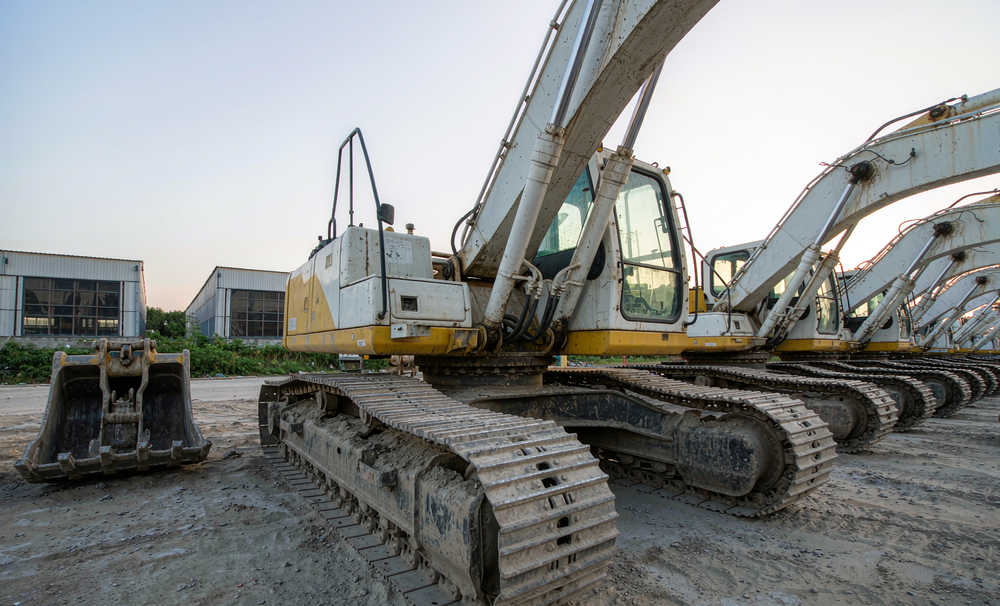
Electric loaders reached more than 58% of China's loader sales in the first three quarters of 2026, while electric excavators accounted for roughly 0.6% — 33,865 units against 629, according to China Construction Machinery Association figures reported by the Chinese trade press in October 2026. For anyone buying or stocking excavator wear parts, the useful number is not the electrification headline: 214,274 excavators were sold in the same nine months, and almost every one of them is a diesel machine that will need pins, bushings, teeth and undercarriage for the next decade.
What do the September 2026 excavator numbers actually say?
According to the China Construction Machinery Association, September sales reached 22,717 excavators, up 14.4% year on year, of which 9,911 were domestic (up about 7.2%) and 12,806 were exports (up 20.7%, or 56.4% of the month's total). Loader sales in the same month were 12,419 units, up 17.9%.
Cumulatively for January to September, excavator sales were 214,274 units, up 23.1%: 104,530 domestic, up 16.3%, and 109,744 exported, up 30.4%. That is the first time cumulative exports have exceeded cumulative domestic sales, and it is the twenty-sixth consecutive month of year-on-year export growth. Loader sales for the same period were 117,077 units, up 24.9%. Domestic working hours rose about 3.3% year on year in September while the monthly operating rate fell 2.7 percentage points — recovery in the home market, but not an overheating one.
Why are excavators so far behind loaders on electrification?
The gap is not really about technology. It is about duty cycle and where the machine stands.
A loader works a short, repetitive cycle — scoop, reverse, tip, return — around a fixed point such as a yard, a stockpile or a concrete plant. It can be charged where it works, on a predictable schedule, and the pauses in the cycle are natural charging windows. That is why electric loaders went from a novelty to the majority of the segment so quickly.
An excavator works away from any fixed point, on a site that often has no substation, and its power demand is continuous rather than intermittent: digging is a high-load, high-flow hydraulic duty that barely lets up. Add multiple shifts and long travel distances and the battery problem becomes a logistics problem. Excavator electrification is advancing, but at 0.6% penetration it is still in the demonstration and niche-mining phase, not the volume phase.
What does this mean for wear-parts demand?
A great deal, and almost all of it reassuring for anyone with money in diesel parts.
First, the wear parts on an excavator are not electrified. A bucket pin does not know what turns the hydraulic pump. Bucket pins and bushings, bucket teeth, adapters, cutting edges and the undercarriage — track chains, rollers, idlers, sprockets, track shoes — are identical whether the machine burns diesel or draws from a battery. Undercarriage wear in particular is driven by ground conditions and load, not by the powertrain.
Second, the installed base is what buys parts, and the installed base is overwhelmingly diesel and will be for a long time. Machines sold in 2026 will be buying pins and bushings into the 2030s. Even a rapid shift to electric sales would take a decade to change what is in the field.
Third, the electrification that is happening changes which parts are needed, not whether parts are needed. An electric drive removes the engine and its consumables — injectors, turbochargers, exhaust aftertreatment — and adds electrical and thermal-management components. The hydraulic and attachment wear parts stay exactly where they were.
Where is the export growth coming from?
China's customs data for construction machinery exports over January to August 2026 shows total exports at US.61 billion, up 20.8% year on year. Excavators to Asia were worth US