
A final drive that howls louder in second speed, pulls the machine to one side, or leaves thick dark gear oil behind the sprocket hub is already failing. Before you condemn the travel motor, run the hose-swap test, because a worn swivel joint or a weak main pump produces exactly the same drift and gets blamed for a great many motor replacements.
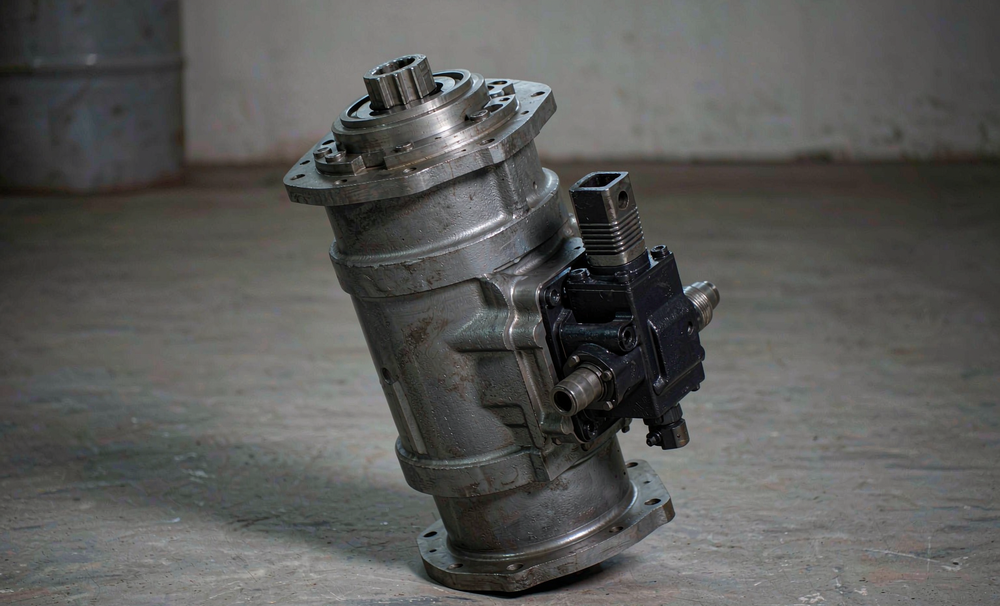
What are the first signs of a failing final drive?
Five symptoms carry most of the diagnostic weight:
- A high-pitched howl or whine while tracking, louder in high speed or when turning. That is backlash opening up as planetary bearings and gears wear.
- Drift to one side when tracking straight on level ground. One drive is running slower than the other, either from internal bypass or mechanical drag.
- Thick, dark, sticky oil pooling on the track frame or behind the sprocket hub. Gear oil, not hydraulic oil — the smell and the colour tell them apart in seconds.
- A wobbling sprocket hub visible while tracking. Main hub bearings are gone, and the sprocket can shear the casing off.
- Grinding or metallic clunking. Stop the machine. Teeth are chipped or a bearing has collapsed, and running on will destroy the housing.
How do you separate a motor fault from a pump or swivel fault?
Lift the machine so the tracks are clear, then swap the two main travel hoses on the slow side. Track it again.
- If the slow track moves to the other side, the motor is fine. The fault is in the main pump, the control valve, or the swivel joint seals.
- If the slow track stays where it was, the travel motor is bypassing internally and needs attention.
This is a fifteen-minute test that routinely prevents an unnecessary motor purchase. A leaking rotary manifold bypasses high-pressure oil into the tank line and drags one track down; no amount of new hardware at the final drive fixes that.
What does a case drain flow test measure?
The case drain is the smallest return hose on the motor. Disconnect it, put the end in a measuring container, blank the hose back to the machine, then stall the travel motor with the tracks blocked and the engine running. Measure how much oil comes out in a minute.
On mini excavators the usual ceiling is in the region of 2–4 litres per minute; consult the service manual for the exact figure, because the acceptable number scales with motor size. Well above spec means the piston block and valve plate are scored and bypassing. That is a rebuild or replacement decision, not a seal kit.
What should the gear oil tell you?
Drain a sample into a clean container and pass a magnet through it under a bright light.
- Fine silver shimmer or steel shards on the magnet — gears or bearings are wearing. Deal with it now.
- Milky, thin oil — water has crossed the duo-cone floating seal. Replace the seal before the bearings rust.
- Clean oil at the right level — the gearbox is probably not the problem, and you should be looking at hydraulics.
Check the level weekly, not annually. This is the single cheapest habit in undercarriage maintenance.
Why does a small leak matter so much?
A mini excavator final drive holds somewhere between half a litre and two litres of gear oil. A leak that looks trivial — a damp patch rather than a drip — will empty that housing within days of steady work. Once the oil is gone, the planetary set runs dry, the casing goes past 80 °C, and the gears heat-fuse. The difference between a seal replacement and a complete final drive is often a fortnight of ignoring a stain.
When is a rebuild worth it, and when do you replace?
Seals and bearings on a motor that still tracks evenly are usually worth rebuilding. Broken planetary teeth are not: once gear teeth are chipped, the housing and the shaft are typically damaged too, and a rebuild rarely outlasts a replacement by enough to justify the labour. Grinding noises are the dividing line.
If you do fit a replacement, clean or replace the case drain filter and flush the circuit first. Metallic debris from a failed motor travels backward through the case drain line into the hydraulic tank, and it will take the main pump and the control valves with it. That single omission turns a motor job into a hydraulic overhaul.
What kills final drives early?
Contamination first, by a wide margin, followed by low oil and a blocked case drain filter that backs pressure up until the shaft seal lets go. Over-tracking is the third: long runs at high speed on hard ground load the planetary set continuously and heat the oil. Correct track tension matters too — a chain that is too tight loads the idler and the track rollers as well as the drive.
A final drive rarely fails alone. When one goes, inspect the sprocket for hooked teeth, the track chain for stretched pitch, and the roller seals for the same contamination that killed the drive. Replacing a drive onto a worn undercarriage simply transfers the load to the new component and shortens its life.