Excavator parts Algeria is a demand pattern rather than a catalogue page. The machines working in the north of the country and the machines working the high plateaus and the south do not consume the same parts at the same rate, and a buyer who orders one mixed container without knowing which is which ends up with three fast-moving items and a shelf of the wrong ones. The parts themselves are ordinary. The specification and the logistics around them are what decide whether the order was worth placing.
This is a practical description of what a mixed fleet in Algeria actually wears, why the model badge is a weak ordering reference, how to pack and document a shipment of heavy steel parts, and how to build a first order that moves instead of sitting.
What a mixed fleet in Algeria actually wears out
Two conditions dominate. The first is abrasive dust: sand and silica fines that enter every joint that is not sealed and act as a lapping compound between pin and bushing. The second is heat, which raises hydraulic oil temperature, hardens grease out of its base oil and shortens the life of every rubber seal on the machine. A machine in a quarry in the north and a machine on a road job in the south wear differently, but both wear the same four groups of parts first.
- Bucket pins and bushings. The highest-turnover group on any fleet, and the one most often ordered by the wrong dimension. Start from the bucket pin range and the matching bushings.
- Teeth, adapters and cutting edges. Consumed by abrasion, replaced on a predictable cycle once the operator is measuring rather than guessing.
- Bucket wear plates and side cutters. Bolt-on or weld-on, and the cheapest way to protect the shell that is expensive to repair.
- Undercarriage: rollers, idlers, sprockets and chain. The largest single maintenance cost on a tracked machine, and the group where a wrong part is most expensive to discover late. Track rollers and track chain assemblies should be ordered with the seal type stated.
Why the four groups fail differently
Pins and bushings fail from clearance growth, not from load. Once the diametral clearance passes roughly 0.4 mm the joint hammers, the grease film cannot survive the impact, and wear accelerates. In dust, that point arrives sooner, which is why a fleet in abrasive ground should be greasing on condition rather than on a calendar.
Teeth and edges fail by abrasion and by impact. Abrasion gives a worn, rounded tip and a slow loss of penetration; impact gives cracks at the adapter nose and, eventually, a lost tooth in a crusher. Both are visible at a walk-around, and neither needs a specialist to assess.
Choosing a tooth for abrasive ground is a hardness decision with a limit. A harder tooth holds its point longer and chips more readily in rock; a tougher tooth wears round faster but does not break. A fleet working sand and gravel usually wants the harder option with a longer point, and a fleet working blasted rock usually wants the tougher one. The mistake is to buy the hardest tooth available for every application, which moves the failure from wear to breakage and turns a predictable consumable into an unplanned stoppage.
Adapters are the part buyers forget. A worn adapter nose loses tooth retention, the tooth moves on the nose, and the next failure is a lost tooth rather than a worn one. Adapter noses should be checked with a gauge whenever teeth are changed, and replaced when the fit is loose rather than when it has already started costing teeth.
Rollers and idlers fail from seal leakage. Once the seal goes, the oil goes, the bearing runs dry and the roller seizes or flats. The early sign is a wet or dusty oil trail at the seal, not a noise — by the time it is noisy, the roller is scrap.
Sprockets fail from tooth wear, and they fail faster if the chain is run too tight or too loose. A worn sprocket accelerates chain wear, which accelerates sprocket wear, which is why the pair is usually replaced together on a high-hour machine. The ordering data for that group is short and unforgiving: chain pitch, link count, roller flange diameter, mounting bolt pattern and sprocket tooth count. Any one of them wrong and the part is scrap on arrival, because undercarriage steel cannot be reworked in a workshop the way a bushing can.
Excavator parts Algeria: order by measurement, not by model badge
The single most useful discipline for a buyer in Algeria is to order pins and bushings by measured diameter and length rather than by machine model. The same model sold into different markets can carry different linkage geometry, buckets get swapped, quick couplers get added, and a machine that has been rebuilt twice may no longer match its parts book at all.
What to send with an enquiry: the machine model, series and serial number; the measured pin journal diameter at three stations; the measured bore across both ears with the ovality figure; the overall length and the effective bearing length; the retaining arrangement with the groove or hole position measured from the head face; and the material and hardness required. Six lines, and it removes most of the reasons a part comes back.
For undercarriage, the equivalent is chain pitch, link count, roller flange diameter and the mounting bolt pattern. Photographs of the old part beside a rule are worth more than a description, and they cost nothing to take.
Heat, dust and the parts that are not wear parts
In 45 degree ambient conditions the hydraulic system runs hotter than its original design point, and the parts that fail as a consequence are seals, hoses and coolers rather than pins. A fleet that is losing hydraulic seals at an unusual rate is usually a fleet with a blocked cooler or a fan that is not moving enough air, not a fleet with bad seals.
The same heat degrades grease. A lithium complex grease rated for high temperature and water resistance will survive a joint that a general-purpose grease will not, and the difference shows up as fretting on the pin journal rather than as a dramatic failure. Dust filtration is the other half: air filters, breathers and the seals on every pivot are what keep silica out of the places where it does damage.
Packing: wood, ISPM 15 and why crates fail
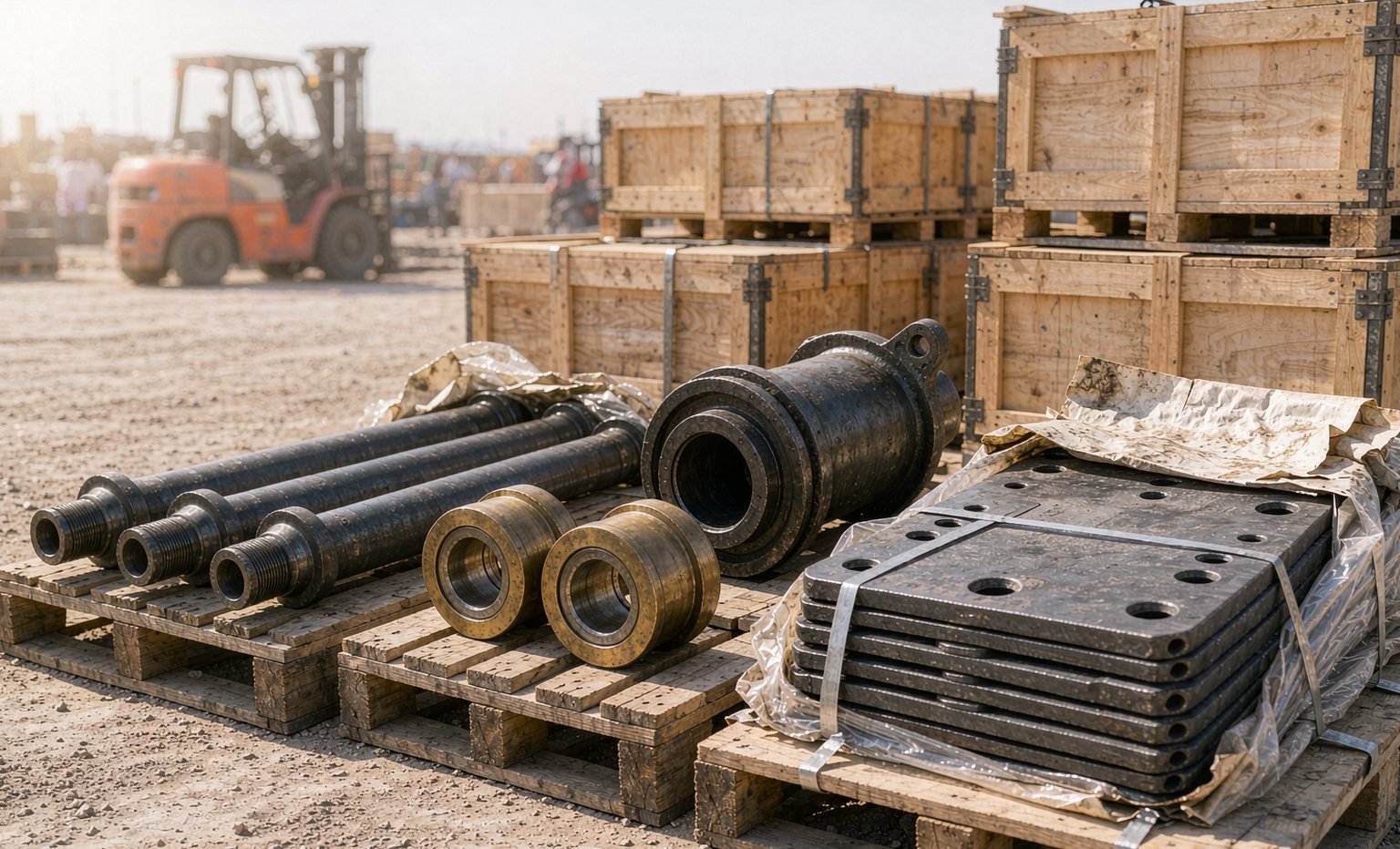
Heavy steel parts break their own packaging. A pallet of pins and bushings at several hundred kilograms, shipped loose in a crate built from thin board, will arrive as a pile of parts in a container with a collapsed box around them. Three rules cover most of it.
- Segregate by mass. Pins and bushings in one crate, wear plates in another, rollers braced individually. Do not let a 40 kg roller ride against a carton of seals.
- Brace, do not fill. Blocking and strapping to the crate floor stops movement; loose fill does not, and it compacts in transit.
- Treat the wood. Solid wood packaging for international shipment is normally required to meet ISPM 15, the FAO standard for wood packaging material, which means heat treatment or fumigation and a visible mark on the wood. Confirm the requirement with the importer's clearing agent before the crate is built, because untreated wood packaging can be refused or re-exported at the buyer's cost.
Grease-packed parts should be wrapped, not left open to the dust of a container floor, and machined journals should carry a protective coating that the buyer can remove without scraping the surface.
Documents and shipping terms
A commercial shipment of parts needs a commercial invoice, a packing list that matches it line by line, a certificate of origin, and a bill of lading or airway bill. Beyond those, the importing company's bank will normally require its own document set and a domiciliation file opened before the goods are shipped, and the customs broker will want the tariff classification agreed in advance. None of this is unusual, and all of it is the buyer's side of the transaction — but it has to be settled before the container is loaded, not after it arrives.
| Document | Who prepares it | What it has to get right |
|---|---|---|
| Commercial invoice | Supplier | Description, quantity, unit value and Incoterm stated consistently with the packing list |
| Packing list | Supplier | Line by line match with the invoice; crate numbers and gross weight per crate |
| Certificate of origin | Supplier or chamber of commerce | Origin declaration that the importer's bank and customs will accept |
| Bill of lading / AWB | Carrier | Consignee details exactly as the importer registered them |
| Material and hardness certificates | Supplier | Heat numbers traceable to the parts in the crate |
Incoterms matter more than they look. Under FOB the buyer carries the ocean freight and the risk from the moment the goods are on board; under CIF the seller arranges freight and insurance to the named port. For a first order, the practical question is who is clearing customs at the destination, because that party is the one who needs the documents in the right form and in time.
Algeria's main container gateways are Algiers, Oran, Skikda and Bejaia, and transit time and port dwell are the two variables that decide whether a sea shipment is the right answer. For a machine that is down and losing money, air freight on pins and bushings is often cheaper than the downtime, which is a decision about cost of stoppage rather than about freight rate.
Excavator parts Algeria: consolidation and a first order that moves
The mistake on a first order is breadth. A container filled with one of everything produces a warehouse of slow movers and no stock of the three items the fleet actually consumes monthly. A better first order is narrow and deep on the fast movers, with the slow movers bought as needed.
Ask the maintenance team for the last twelve months of consumption, not for a wish list. Rank by units consumed, not by unit cost, and stock to a reorder point that covers the sea transit plus a margin. If the transit is six weeks, the reorder point has to assume six weeks of consumption plus safety stock, and that number is the one that keeps machines working.
Consolidating from one supplier reduces the document and inspection burden and makes the packing coherent. It also makes it possible to hold a single quality standard across the whole order, which is difficult when pins come from one source and bushings from another with no agreed interference.
Quality evidence to ask for
For pins and bushings: a material certificate to EN 10204 3.1, hardness readings at three points along each journal, the case depth for induction hardened parts, and the measured bore of the bushing after pressing if it is supplied pre-fitted. For wear plates: the steel grade and the hardness, because a plate that is 200 HB is a plate that will dish in a week.
For undercarriage: the seal type, the hardness of the roller shell and the flange diameter measured, not nominal. A supplier who cannot provide these is not necessarily a bad supplier, but you have no way to tell a good batch from a bad one until it is on the machine.
A first-order checklist
- Measure the parts on the machine before writing the enquiry, and send the measurements.
- Rank the list by consumption over twelve months, not by what might be needed.
- Order pins and bushings as matched sets with a stated interference and an assembled clearance target.
- Confirm the wood packaging treatment and the document set with the importer's broker and bank.
- Agree the Incoterm and who clears customs before the goods leave.
- Ask for certificates and hardness records with the shipment, not after.
- Set the reorder point from transit time plus consumption, and review it after the first full cycle.
None of this is specific to Algeria. What is specific is the combination — abrasive ground, high ambient temperature, long sea transit and a document chain that has to be right the first time — and that combination rewards a buyer who orders by measurement and plans by consumption rather than by catalogue page.