Excavator parts Chile: desert abrasion, southern corrosion and the spares list that fits

Sourcing excavator parts Chile is not one problem, it is three, because the country's machine population works in conditions that have almost nothing in common. A copper mine at altitude in Antofagasta is dry, abrasive and UV-brutal. A construction fleet around Santiago works in a temperate valley with rain and clay. A forestry or earthworks operation in the south works in mud and constant moisture. The same twenty-tonne excavator wears out different parts in each of them, and a spares strategy that ignores the difference buys the wrong inventory.
The practical consequence is that a Chilean buyer should specify by failure mode rather than by catalogue. A pin that lasts two years in Santiago can be scrap in eight months in a dry, high-altitude pit where the dust is finer than talc, and a bushing that survives the north can corrode-fit itself into the boss in the wet south. Both are normal. Neither is a quality problem.
What the northern desert does to an excavator
The Atacama and the high-altitude pits around Calama and Antofagasta combine three conditions that accelerate wear independently and reinforce each other.
- Abrasive dust finer than the clearance it enters. Desert fines penetrate every seal that is not a positive barrier. Bucket pin joints, bushing bores and the chisel bush of a breaker all ingest it, and the wear rate is set by the dust, not by the load.
- High UV and ozone. Rubber in the north ages from the outside in. Wiper lips harden and crack before they wear out, so a seal that looks unworn can be useless. Nitrile parts that would last years in Europe fail in a season.
- Low air density at altitude. Cooling systems sized at sea level lose capacity at 3,000 m and above, and hydraulic oil runs hotter. Hot oil thins, film strength at the bushings drops, and every wear surface in the circuit speeds up.
None of those three is solved by buying a more expensive pin. They are solved by shorter inspection intervals, by seals in the right compound, and by treating oil temperature as a maintenance item rather than as an operator complaint.
Why excavator parts Chile fleets wear differently in the south
In the temperate zone the dominant mechanism changes from abrasion to corrosion and impact. Rain and clay pack around pins and hold moisture against the joint. A pin that is not greased on schedule will corrode in the bore, and a corroded pin seizes rather than wears, which turns a maintenance job into a cutting job.
The south adds mud. Mud is worse than rock for undercarriage because it packs between the track links and the bushings and prevents the pin from rotating as the chain articulates. A pin that cannot rotate wears on one face only and goes oval, and the chain then starts to run tight and jump sprocket teeth. Track chains in wet ground need the same grease discipline as pins, and they need it more often.
Coastal sites add salt, which attacks the same joints from the outside. The combination of salt air and standing water is the fastest route to a seized bucket pin that exists in normal operation.
Bucket pins and bushings: the cheapest wear item and the most expensive mistake
The pin and bush set is where most Chilean fleets lose money without noticing. A standard bucket has three pin joints, and each has a designed clearance between the pin and the bush. As the bush wears, the clearance opens, the load stops being distributed and starts being applied as an impact, and the wear rate rises. The curve is not linear: a joint that has doubled its clearance is wearing perhaps four times as fast as a new one.
What matters when ordering is dimensional, not nominal. Excavator bucket pins are commonly quoted by diameter — 40, 45, 50, 60, 70, 80 mm and upwards — but the diameter alone does not define the part. Length, the position of the retaining groove or the cross-hole, the chamfer, the surface hardness and the material all have to match. A 60 mm pin from one supplier will not necessarily fit a boss bored for another maker's 60 mm pin.
- Measure the boss bore with the old bush out. That reading sets the press-fit interference for the new bush, and a boss that is already oval will not hold a new bush straight.
- Measure the assembled clearance before stripping, so you know what you are correcting.
- Check the bucket ear plates for elongation. Worn ears let the pin cock, and a cocked pin destroys a new bush quickly.
- Match hardness to the application. A very hard pin in a soft bush transfers the wear to the bush; the pair has to be specified together.
The full bucket pin range is organised by diameter for exactly this reason, and the bucket bushing range carries the matching bores.
Ground engaging tools: where abrasion is measured in hours
In abrasive rock the teeth and adapters are consumed faster than any other part of the machine, and the consumption is not uniform. Tooth wear is a function of the rock, the cycle and the operator, and in the north it is common for a set of teeth to be the largest single line in the consumables budget.
The buying decision is not "which tooth is cheapest". It is which tooth system, because the adapter nose determines the family and changing family means changing adapters. Once the family is fixed, the variables are the point profile, the material and the fit quality. A tooth that fits its adapter loosely hammers on the nose and destroys the adapter, which is a weld-on repair rather than a pin-on replacement.
Wear plates on the bucket shell and the lip are the same argument at a larger scale. A worn lip is a fabrication job; a worn wear plate is a consumable. Fleets that run reversible or bolt-on wear protection on the underside and the lip edge extend bucket life substantially for a small fraction of a new bucket, and the decision is easy to justify on a machine that works abrasive ground all year.
Undercarriage: the part that decides whether the machine is worth repairing
Undercarriage is typically the second largest cost after fuel over a machine's life, and it is the cost that gets deferred. Track chain, rollers, idlers and sprockets wear as a system: a worn sprocket destroys a new chain, and a new sprocket on a stretched chain wears out in a fraction of its life.
Measure before deciding. Track pitch measured across four links and averaged gives the real chain wear figure; a chain beyond its wear limit will not sit correctly on new sprockets. Roller flange height and idler wear tell you whether the running gear is still guiding the chain or merely containing it. The rule that saves money is to replace the system as a system, or to accept that the new parts will be consumed early.
The excavator parts catalogue covers pins, bushings, GET and undercarriage components for the common tonnage classes.
The parts that fail on a calendar rather than on hours
Not every consumable is a wear item. Rubber components in the north fail because of UV and heat, and in the south because of moisture and ozone, and both failure modes ignore the hour meter. Hoses that have gone hard at the outer cover should be replaced on condition, not on a schedule copied from a European fleet. Hydraulic hoses that fail in service do more damage than the hose: a burst pressure line sprays hot oil and takes the machine out of service for a day, and a suction line that draws air aerates the oil and wears the pump.
The same logic applies to the oil itself. Dust that passes the breather ends up in the tank, and a high-hour machine in the desert should have its hydraulic oil sampled rather than assumed. Filter change intervals that suit a temperate site are usually too long for a site where the air is full of fines.
Documentation and shipping realities
Parts that arrive with the wrong paperwork cost more than parts that arrive late. Chilean imports need a commercial invoice and packing list whose descriptions match what is in the box, a consignee with a valid RUT, and a freight forwarder who has been told what the goods actually are rather than what they were called on the order.
Two practical points come up repeatedly. First, describe parts in Spanish or with a Spanish translation alongside the English description; a generic "machinery parts" line invites inspection and delay. Second, consolidate. A single shipment of pins, bushings, seals and GET is cheaper to clear than four small ones, and the consolidation is only possible if the order was planned as a kit rather than as a series of emergencies.
Building an excavator parts Chile spares list that fits the site
The fleet that runs best in Chile is not the one with the largest store. It is the one whose store matches its failure profile. A northern pit needs pins, bushings, wiper seals in a UV-stable compound and GET; it does not need a large stock of corrosion-resistant fasteners. A southern contractor needs pins, track components and paint, and will consume far fewer teeth.
A workable method is to record every unplanned part consumed for three months, by machine and by position, and to sort the list by frequency. The top ten items are the store. The next ten are the ones to hold one of. Everything else is a planned order. That exercise takes a clerk a day and usually cuts emergency freight dramatically, because the emergencies turn out to be predictable.
Comparing a Chilean failure profile with other markets
Chile is an abrasive-dust market with a corrosion edge on the coast and in the south. The Australian fleet breakdown describes a harder version of the same profile, with more abrasive ironstone and longer haul cycles. The Bangladesh notes describe the opposite extreme, where water, silt and salt dominate and corrosion outruns abrasion. Reading the two alongside each other is a quick way to see which of your own failure modes is climate-driven and which is application-driven.
What to send when you ask for a quotation
A quotation is only as good as the dimensions behind it. For pins and bushings, send the pin diameter, the overall length, the retaining feature position, the boss bore with the old bush removed, and the machine model. For GET, send the bucket model or the adapter part number and a photograph of the nose with the tooth off. For undercarriage, send the track pitch measurement, the link count and the roller or idler part number if it is legible.
Photographs with a rule or caliper in frame resolve most ambiguities faster than a paragraph of description. Two photographs — one of the part and one of the marking stamped on it — are usually enough for a supplier to confirm or correct the identification before anything ships.
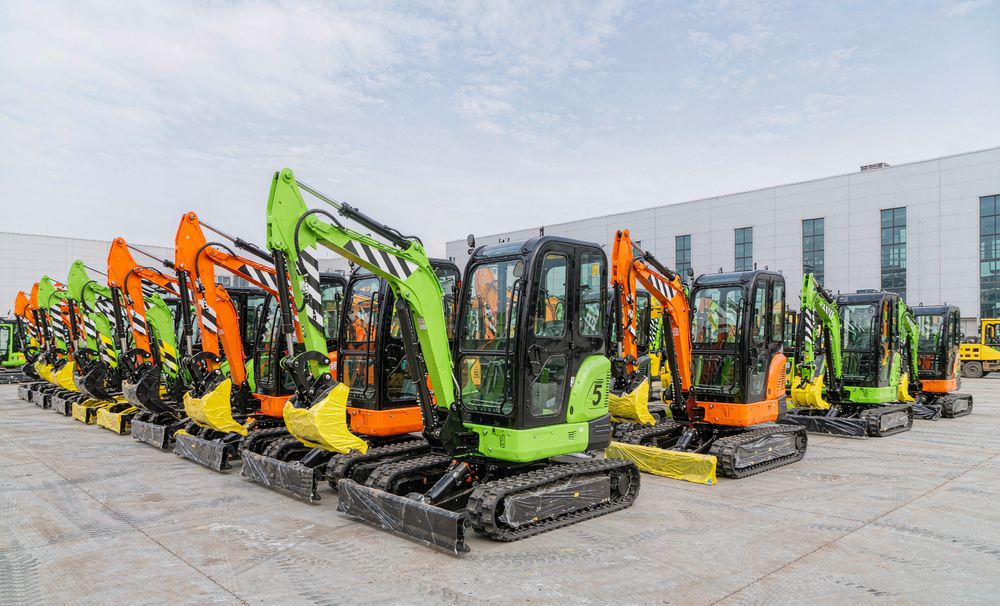
,000 went viral in Norway this autumn, and behind that video sits hard data: construction machinery exports reached US.373 billion in the first half of 2026, up 21.7 percent year on year according to the China Construction Machinery Association, with compact equipment and micro excavators driving the fastest growth.
What do the H1 2026 export numbers show?
The headline figures reported by Chinese state media in late October, drawn from industry association statistics: excavator exports exceeded domestic sales for the eighth consecutive month, and cumulative excavator exports passed 85,000 units in the first seven months of 2026, up more than 31 percent year on year. Exports to the European Union reached US.626 billion, up 28.9 percent. Industry forecasts put China's compact construction machinery sales for 2026 above 180,000 units, with micro excavators making up more than 60 percent of that, roughly 110,000 machines. Trade commentary attributes the shift to buyers outside the traditional channel: private owners, small farms and tradespeople in Europe and South America discovering these machines through social media and cross-border e-commerce rather than dealer networks.
Why does this matter to parts buyers?
Because every one of those machines is a compact wear-parts consumer. A 1 to 3 tonne excavator still runs bucket pins and bushings, teeth, track rollers and sprockets; it just runs them at smaller envelopes and tighter tolerances than a 20 tonne machine. The parts market for this segment behaves differently from the large-machine market in three ways:
- Volumes are high and per-unit margins are thin, so parts supply consolidates around the same Shandong manufacturing clusters that build the machines.
- Many compact machines are sold direct to first-time owners, so sourcing spare parts is often the owner's first experience with the brand. A parts page that does not answer "which pin fits my machine" loses that buyer instantly.
- Fleet-scale after-sales networks, the normal channel for 20 tonne iron, barely exist for micro machines, which pushes owners toward online parts suppliers and pushes suppliers toward clear part-number discipline.
What does this mean for a Shandong parts maker?
JALE Excavator Parts is a Shandong manufacturer of excavator wear parts, and it sits inside the same industrial cluster that is shipping these machines. Unlike most parts suppliers, it also builds its own compact range, including the JALE08, JALE10-1 and JALE12 mini excavators, so the fit between a small machine and its pins, bushings and undercarriage parts is designed rather than reverse-engineered.
Do compact machines need different parts discipline?
The wear parts are the same families, but the failure pattern is not. A micro excavator's pins and bushings are physically smaller, so a few tenths of a millimetre of wear is a larger share of the original clearance, and the symptoms, play at the bucket ear, grease that will not hold, a knocking sound on direction change, arrive sooner relative to machine hours. Owners who would never inspect a 20 tonne machine weekly can and should walk around a 1 tonne machine weekly: two grease strokes per pin, a visual check that the bucket ears have not bell-mouthed, and a feel for slop at the linkage. The parts themselves are cheap; the deciding factor is knowing the pin diameter and ear spacing before ordering, because a 25 mm and a 30 mm pin look identical in a photo.
One honest caveat: no association figures have been published for compact-segment parts demand specifically, so any claim about its size would be guesswork. What the export data does establish is the installed base: over 100,000 micro and compact machines a year are entering service, largely with owners who have no dealer relationship. Their pins, bushings and teeth will be replaced on wear, on the owner's budget, from whichever supplier answers first with the right dimensions. That is the market segment forming behind the headline number, and it buys the same discipline this site has always sold: correct part numbers, honest steel grades, and hardware that fits the first time.
,000 went viral in Norway this autumn, and behind that video sits hard data: construction machinery exports reached US.373 billion in the first half of 2026, up 21.7 percent year on year according to the China Construction Machinery Association, with compact equipment and micro excavators driving the fastest growth.
What do the H1 2026 export numbers show?
The headline figures reported by Chinese state media in late October, drawn from industry association statistics: excavator exports exceeded domestic sales for the eighth consecutive month, and cumulative excavator exports passed 85,000 units in the first seven months of 2026, up more than 31 percent year on year. Exports to the European Union reached US.626 billion, up 28.9 percent. Industry forecasts put China's compact construction machinery sales for 2026 above 180,000 units, with micro excavators making up more than 60 percent of that, roughly 110,000 machines. Trade commentary attributes the shift to buyers outside the traditional channel: private owners, small farms and tradespeople in Europe and South America discovering these machines through social media and cross-border e-commerce rather than dealer networks.
Why does this matter to parts buyers?
Because every one of those machines is a compact wear-parts consumer. A 1 to 3 tonne excavator still runs bucket pins and bushings, teeth, track rollers and sprockets; it just runs them at smaller envelopes and tighter tolerances than a 20 tonne machine. The parts market for this segment behaves differently from the large-machine market in three ways:
- Volumes are high and per-unit margins are thin, so parts supply consolidates around the same Shandong manufacturing clusters that build the machines.
- Many compact machines are sold direct to first-time owners, so sourcing spare parts is often the owner's first experience with the brand. A parts page that does not answer "which pin fits my machine" loses that buyer instantly.
- Fleet-scale after-sales networks, the normal channel for 20 tonne iron, barely exist for micro machines, which pushes owners toward online parts suppliers and pushes suppliers toward clear part-number discipline.
What does this mean for a Shandong parts maker?
JALE Excavator Parts is a Shandong manufacturer of excavator wear parts, and it sits inside the same industrial cluster that is shipping these machines. Unlike most parts suppliers, it also builds its own compact range, including the JALE08 and JALE12 mini excavators, so the fit between a small machine and its pins, bushings and undercarriage parts is designed rather than reverse-engineered.
Do compact machines need different parts discipline?
The wear parts are the same families, but the failure pattern is not. A micro excavator's pins and bushings are physically smaller, so a few tenths of a millimetre of wear is a larger share of the original clearance, and the symptoms, play at the bucket ear, grease that will not hold, a knocking sound on direction change, arrive sooner relative to machine hours. Owners who would never inspect a 20 tonne machine weekly can and should walk around a 1 tonne machine weekly: two grease strokes per pin, a visual check that the bucket ears have not bell-mouthed, and a feel for slop at the linkage. The parts themselves are cheap; the deciding factor is knowing the pin diameter and ear spacing before ordering, because a 25 mm and a 30 mm pin look identical in a photo.
One honest caveat: no association figures have been published for compact-segment parts demand specifically, so any claim about its size would be guesswork. What the export data does establish is the installed base: over 100,000 micro and compact machines a year are entering service, largely with owners who have no dealer relationship. Their pins, bushings and teeth will be replaced on wear, on the owner's budget, from whichever supplier answers first with the right dimensions. That is the market segment forming behind the headline number, and it buys the same discipline this site has always sold: correct part numbers, honest steel grades, and hardware that fits the first time.
.31 billion, up 47%, and to Latin America at US.03 billion, up 60.7%. Longer routes make schedule reliability worth more than a few days of inland saving, which is why the port and the carrier matter more than the canal itself.
What it means for a parts order in practice
Production time does not move. Machining, heat treatment and packing run at the same pace whichever port the container leaves from. What a shorter inland leg changes is the buffer a supplier needs between finishing an order and handing it to the carrier, and at the margin how much working capital sits in a container on a truck.
For the buyer, the response is unchanged: plan stock against ocean transit plus clearance, not against the inland leg, and ask for the port and the sailing date rather than a single lead-time number. The parts themselves — bucket pins and bushings, track chains, bucket teeth — are priced by steel grade and machining hours, not by which river they floated down.
.90 billion, up 13.9%; to Europe, US.59 billion, up 4.2%. The growth is elsewhere: Africa at US.31 billion, up 47%, and Latin America at US.03 billion, up 60.7%.
That regional split matters for spare-parts planning. Mature markets in Europe are growing slowly, while the fastest-growing destinations are markets where machines work long hours in abrasive conditions and where the dealer and service network is thinner — exactly the profile that generates high wear-parts consumption. Trade-press analysis attributes a large share of African excavator demand to mining, and mining duty is brutal on undercarriage and on ground-engaging tools.
What should buyers and distributors plan for?
Stock the models that are actually in the field, not the models in the press release. On the evidence of the last few years that means the mainstream 20–30 tonne classes and the household names built around them — PC200 and PC300 class machines, the 320 and 330 class, the EX200 class, the R210 class and the DX225 class — plus the undercarriage groups that fit them. Those are the machines absorbing pins, bushings and track components in volume.
Do not build stock around electric-specific parts yet. At 0.6% penetration there is no volume aftermarket, and the common parts on those machines are the same parts you already carry.
Finally, plan for the replacement cycle, not just the new-machine market. Chinese trade-press analysis puts the domestic replacement cycle at roughly eight years, and with domestic sales now rising on the back of equipment replacement and emission-standard upgrades, a large second and third-owner population of machines is coming into its maintenance-heavy phase. That is the cohort that buys the most wear parts per machine — and it is a diesel cohort.
