
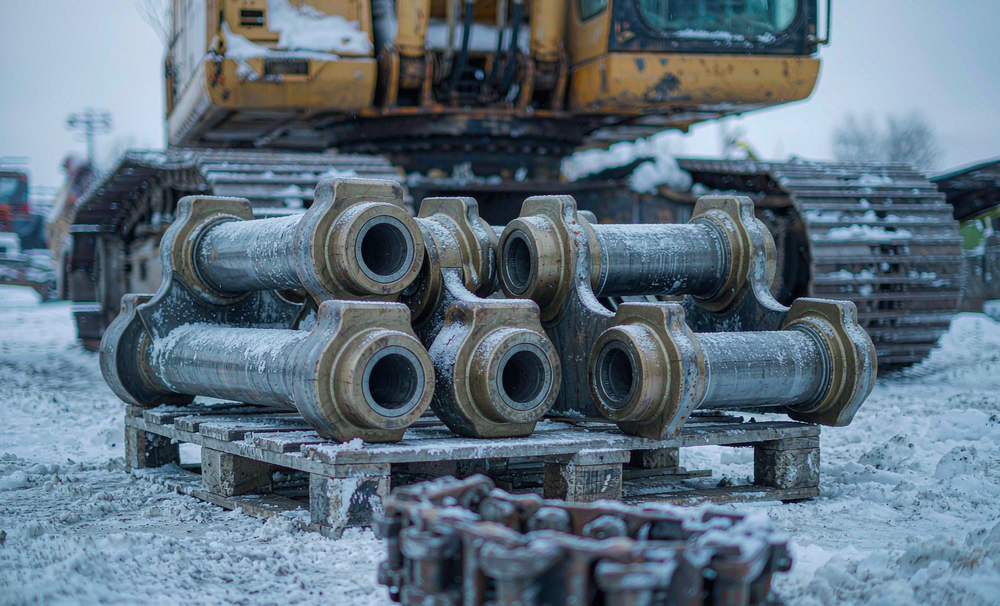
Below roughly −20 °C an excavator stops failing by wear and starts failing by fracture: pins crack at the grease hole, bosses crack beside the weld, and polyurethane seals lose the elasticity they need to follow the rod. In that range the parts specification and the warm-up routine matter more than the brand on the box.
Cold is not simply hot weather with a coat on. It changes the failure mode, and parts that were correct at 30 °C are not automatically correct at −30 °C.
Why do pins break in cold weather instead of wearing out?
Steel has a ductile-to-brittle transition: as temperature falls, the energy it can absorb before cracking drops sharply. A bucket pin in 40Cr or 42CrMo, induction hardened to about 50–55 HRC, that shrugs off impact at +20 °C can crack at −30 °C — and it cracks at the point of stress concentration, not at the point of maximum load.
Look at where cold-climate pin failures actually start: the grease hole, a circlip groove, a thread root, or a shoulder with a sharp radius. Each is a stress raiser, and hardened steel has little ductility left to blunt it.
What to specify: ask for Charpy impact values at your site's minimum temperature, not at room temperature. A certificate quoting 27 J at +20 °C tells you nothing about a machine working at −35 °C. Then radius the grease-hole edges, and do not weld brackets onto a loaded boss — the heat-affected zone is where the crack will run.
Do bushings behave differently in the cold?
The clearance you designed at +20 °C is not the clearance you get at −30 °C. A steel-backed bronze bushing and a hardened pin do not contract at the same rate, and on a small bore the interference can close enough to seize the joint on the first cold stroke.
Two checks before assembly. Measure pin and bushing diameters at ambient — if the parts arrived on a cold truck, let them sit at workshop temperature first, because calipers on cold steel read small. And check the grease: an NLGI 2 grease that is fine in summer can be stiff enough at −25 °C that the joint is effectively dry until the machine is warm.
What happens to PU and NBR seals at low temperature?
Standard polyurethane is usually rated to about −30 °C, and its useful limit in a rod seal is often reached before that: the lip hardens, stops following the rod, and the cylinder weeps on the first strokes of a cold morning. If the weep clears as the oil warms, the seal is telling you it is the wrong compound rather than worn out.
NBR generally has the better low-temperature behaviour of the two, and low-temperature NBR grades go lower again. Low-temperature PU compounds also exist. “Winter grade” is not a specification — ask for the datasheet range and the compound code, and compare it with the coldest start the machine will actually see.
What else fails first when the temperature drops?
- Hoses: the cover cracks when a cold hose is bent, and the crack becomes a leak path. Do not pull a stiff hose into position; warm it or wait.
- Rubber tracks on compact machines: the compound hardens and the drive lugs tear first.
- Track shoes and cutting edges: mild steel plates crack rather than bend, so a grade chosen for abrasion resistance alone is the wrong choice below −20 °C.
- Hydraulic oil: a grade that is correct at 40 °C ambient is thick at cold start. The check is the pump maker's minimum viscosity at start-up, not habit.
What should a cold-climate parts order specify?
- Impact test temperature on pins and any load-bearing casting, quoted in the certificate.
- Seal material, compound code and low-temperature limit, per position in the cylinder.
- Grease class and base-oil viscosity for the lowest expected ambient, not the workshop's default drum.
- Plate grade for bucket and edge wear parts, with impact toughness stated.
- Packing that survives a frozen container: condensation forms when parts stored outdoors are brought inside, and unprotected machined surfaces rust in a week.
How should a cold machine be started?
Idle for ten to fifteen minutes, then work the functions slowly through full strokes at low pressure with no load, then dig. Do not stall a function against relief pressure to warm it faster — that puts full pressure through cold, thick oil, and it is exactly when a rod seal or a hose fails. Breakers need more patience than cylinders: run them at low energy until the oil is warm.
Frequently asked questions
Is a standard pin acceptable if the site only occasionally sees −25 °C?
Occasional cold starts are where brittle fracture happens, because that is when the joint is dry, the load arrives suddenly and the steel is at its coldest. If the site reaches the transition range at all, specify for it.
Can I just use a thicker grease in winter?
No — the opposite. A stiffer grease does not reach the bearing surfaces when cold. Go one NLGI grade softer than your summer grease and check the base-oil viscosity.
Do seals need changing before winter?
Only if they are already marginal. A seal that weeps at −20 °C but not at +10 °C is at its compound limit, and it will not improve as the season goes on.
Cold-climate parts are the same shapes as warm-climate parts with a different paper trail. If you are stocking for a northern or high-altitude site, send the minimum ambient temperature with the part numbers and the specification can be matched to it.