
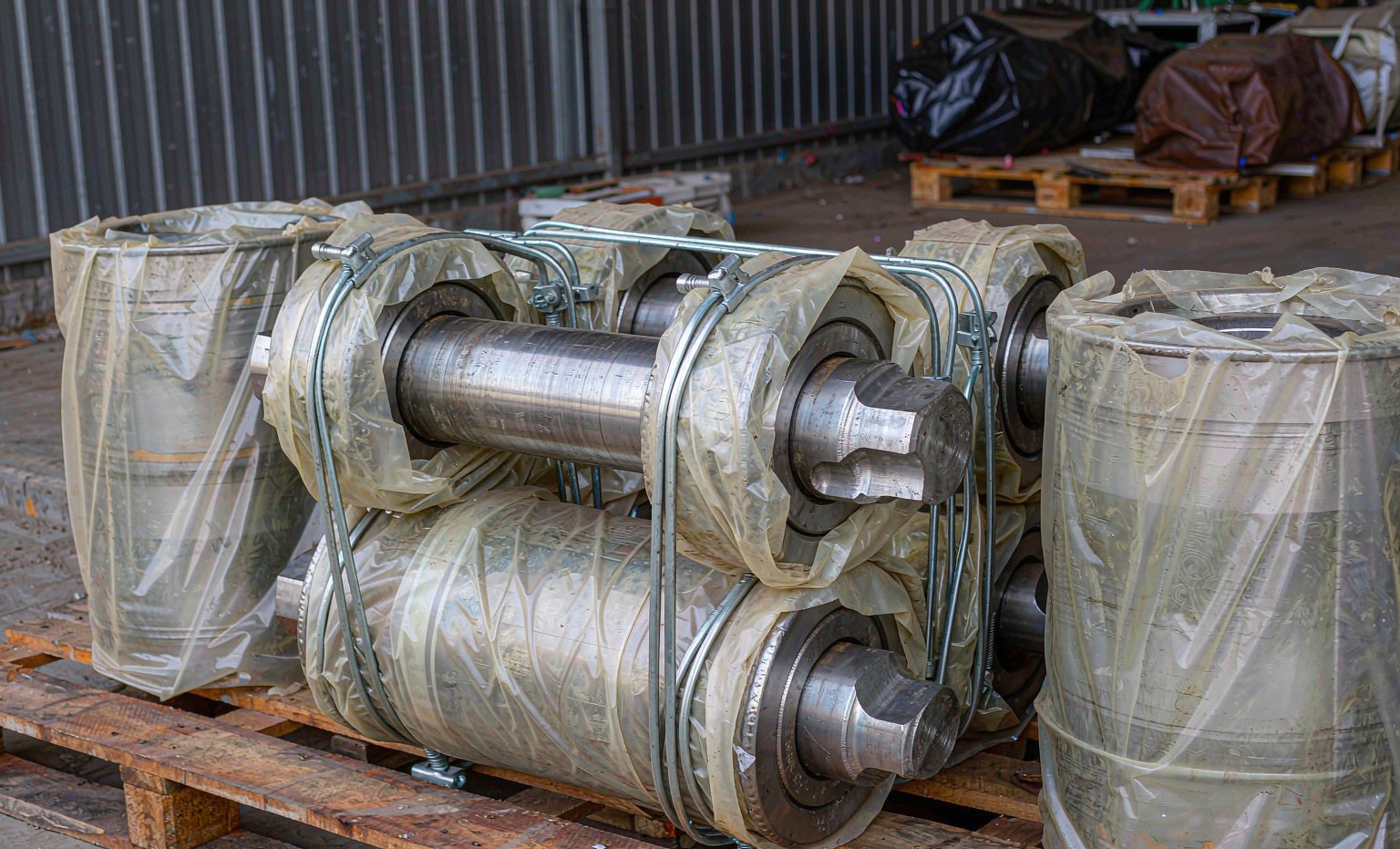
Excavator parts are heavy machined steel, so what decides whether a shipment arrives usable is corrosion protection first and packing strength second; documentation is the third. For humid destinations in Southeast Asia and the Gulf we wrap machined surfaces in VCI film with desiccant, and for the long, multi-handling routes to South America and Africa the priority shifts to pallet strength and strapping.
Why does export packing matter more for steel parts?
Bare machined steel starts to rust as soon as it meets humid air, and a container crossing the tropics is a humid environment. A pin that arrives with surface rust is not scrap, but it has to be cleaned and inspected before it can be fitted, and a bushing with corrosion in the bore is a real problem. The cost of prevention is a few cents of film and desiccant per part; the cost of a rejected or re-worked container is a different order of magnitude.
How are pins, bushings and teeth packed?
- Machined surfaces are oiled and wrapped in VCI (vapour corrosion inhibitor) film.
- Parts are strapped to pallets rather than loaded loose, so they cannot shift inside the container.
- Wood packaging is heat-treated and marked to ISPM 15, which most destination countries require.
- Heavy items are distributed so that no single pallet is overloaded, and containers are lashed so the load cannot move in heavy weather.
What documents accompany an export shipment?
A commercial invoice, a packing list, the bill of lading, and a certificate of origin where the destination has a trade agreement with China. Material certificates are supplied on request. The invoice states the HS code — for excavator parts this is normally within heading 8431, commonly 8431.49 — because the code is what determines duty at the other end.
What differs by destination region?
The parts are the same; the packing priorities are not.
- Southeast Asia — short sea transit but high humidity, so VCI film and desiccant do most of the work. Buyers in ASEAN markets can also use the ASEAN–China trade agreement's preferential origin form, so the certificate of origin is worth arranging in advance.
- Middle East and the Gulf — high coastal humidity and heat, and parts often sit outdoors after arrival, so the packing has to tolerate storage as well as transit.
- Africa — longer transit and more handling, often through more than one port, so pallet strength and strapping take priority over packing density.
- South America — the longest routes from China, usually with transshipment, so pallets are built for double handling and the wrap is sealed against spray.
How should a buyer specify packing in the PO?
State it rather than assuming it: VCI or oiled protection, pallet type and maximum weight, ISPM 15 marking, the shipping marks you want on each pallet, and whether the load must arrive container-ready or able to be split. A packing specification on the purchase order is the difference between a shipment that can be booked straight into your store and one that has to be repacked on arrival.
What about small orders and air freight?
Not every shipment fills a container. For urgent single parts, or for a first trial order before a volume commitment, air freight changes the packing priorities again. The goods are handled more often, and they sit in unpressurised holds where temperature and humidity swing hard between tarmac and altitude, so machined surfaces are wrapped individually rather than as one pallet load. Cartons are sized to standard pallet footprints so they can be consolidated on arrival. The documentation is the same as for sea freight except that an air waybill replaces the bill of lading, and the packing list has to match the carton markings exactly, because customs will open the consignment when the two do not agree.
What is worth checking on arrival?
Count the pallets against the packing list, check that the strapping is intact, look for rust breakthrough on the first pallet opened, and measure one part of each dimension against the drawing. Doing that on arrival makes a problem a conversation with the supplier rather than a discovery in the workshop three months later. Our ranges for these shipments are listed under bucket pins, bucket bushings, bucket teeth and undercarriage parts.