
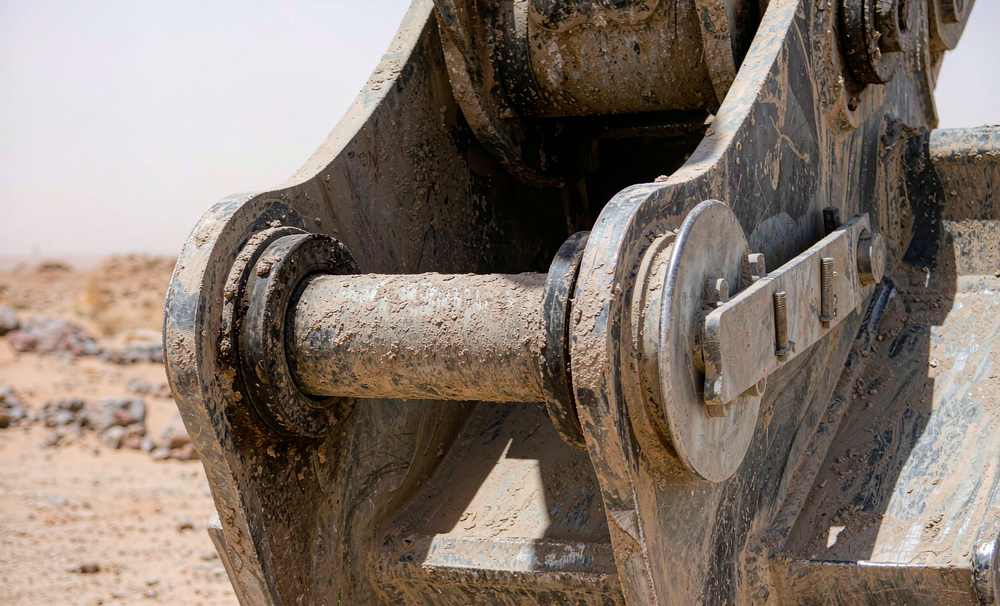
For a machine working at 45 °C in blowing sand, the parts that fail first are not the ones carrying the highest load. They are the grease-lubricated joints and the sealed components: bucket pins and bushings, track rollers, idlers and the bucket linkage. Heat thins the grease out of the joint and dust replaces it, and the two together wear a pin out in a fraction of the hours it would last on a temperate site.
What actually fails first on a hot, dusty machine?
Three, in this order.
- Grease leaving the joint. A lithium-soap grease with a low dropping point softens and bleeds base oil once the pin area sits in direct sun at 60 °C or more. What is left is soap and no lubricant.
- Dust entering behind it. Once the grease film is gone the clearance in a pin joint acts as a pump. Fine sand and dust are pulled in on every cycle and lap the pin and bushing like grinding paste.
- Seals hardening. Standard nitrile (NBR) O-rings harden and take a compression set faster at sustained heat, which is how a track roller starts weeping oil without any impact damage.
All three are a specification and interval problem.
Which grease should you run, and how often?
Use an NLGI No. 2 grease with a lithium-complex thickener rather than a simple lithium-soap grease. A lithium-complex grease typically carries a dropping point around 260 °C against roughly 180 °C for a conventional lithium grease, and it resists oil bleed better at sustained heat. Where the site also sees water, a calcium-sulfonate grease is worth considering for its water washout resistance.
Interval matters more than brand. On a desert site, halve the manual greasing interval you would use in a temperate climate, and grease at the end of the shift rather than the start, so the joint cools with fresh grease in it instead of sitting hot and dry overnight. If the machine has an automatic lubrication system, check the metering valves at every service: a blocked line on one bucket pin is invisible until the pin is already scored.
Which bushings and pins should you specify?
Ask for a bushing with a grease distribution feature rather than a plain bore. A spiral or helical groove machined into the bore carries grease along the length of the bushing instead of leaving it in one band at the grease hole, which is what a joint needs when heat and dust are flushing it. Our spiral groove steel bushing uses that layout.
On the pin, specify a carburised or induction-hardened surface in the region of 50–55 HRC with a case deep enough to survive the service interval, and a tough core. 20CrMnTi is a common carburising grade for this duty and 40Cr a common through-hardening grade; either can be correct, but the hardness specification on the drawing is what you are actually buying. A pin that is hard all the way through can snap at the retaining groove, which is why case-hardening is usual for bucket pins.
Check the retaining arrangement too. Bolt-and-nut retention with a proper washer face, or a machined groove with a hard retaining plate, holds better in heat than a drilled pin with a split pin that corrodes and drops out. Our bucket pins and bushings range covers both styles.
What changes in the undercarriage?
Dust packing is the main enemy. Material builds up between the roller flanges and the link rails, and every kilometre travelled grinds it against the seal faces. Two choices help: specify rollers and idlers with a floating seal group rather than a simple lip seal, and avoid pressure-washing at the seal line, because high pressure drives grit past the lip. Use lower pressure at an oblique angle.
Track tension also needs attention. Steel expands with temperature, so a chain tensioned correctly at dawn on a cold machine can be over-tight by mid-afternoon. Set tension in the conditions the machine actually works in, after a shift rather than before one. Our track rollers and front idlers use sealed lubricated assemblies, but no seal survives a chain run over-tight at 50 °C.
What about bucket teeth and cutting edges?
Dry sand is abrasive but not impact-heavy, so a standard chisel or general-purpose tooth with good wear life is usually the better buy. The exception is embedded rock or slag, where a heavier, tougher tooth earns its cost. Check the adapter fit rather than the tooth alone: a worn pocket lets the tooth rock, and a rocking tooth loses its pin and then the tooth. See the bucket teeth range for the standard profiles.
What should you check when the parts arrive?
- Measure pin diameter at three points along the shank and at 90° to each other. Out-of-round is a sign of a poorly ground pin.
- Measure bushing bore and confirm the specified clearance, not just the nominal size.
- Check that the grease hole and groove are clear and that no shot or swarf sits in the bore.
- Look at the seal lip on rollers and idlers: a torn or nicked lip will leak in the first hundred hours.
- Confirm the part number and machine model on the label against your own record, not the invoice description.
A short goods-in inspection is cheaper than a field failure, and it is the only point at which a supplier is held to the drawing.
What belongs on the purchase order
Write the ambient temperature range and the dust conditions on the order. Specify the grease type, the bushing groove, the pin surface hardness and case depth, the seal type and the retention method. A supplier who can quote against those specifics understands the application; one who only quotes a part number is guessing. For a Middle East, North African or South American site, tell us the model, ambient range and duty and we will quote the pin, bushing and undercarriage specification to match.