
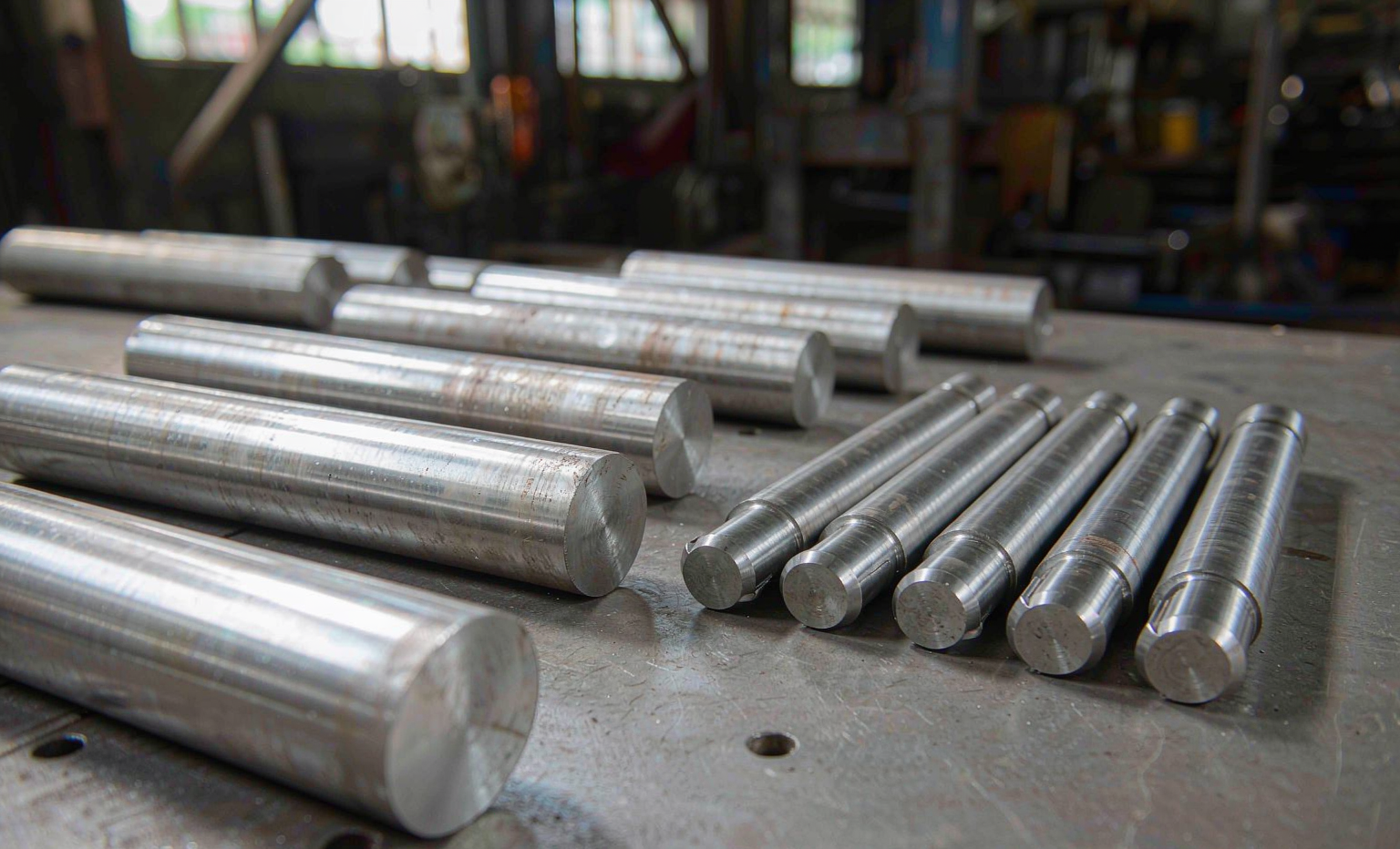
Most excavator bucket pins are made from a medium-carbon alloy steel — 40Cr or 42CrMo in the Chinese designation, equivalent to AISI 5140 and AISI 4140 / 42CrMo4 — then induction hardened so the wear surface reaches roughly 50–58 HRC while the core stays tough enough to absorb shock. The bushing is normally the softer half of the pair, in 20CrMnTi, 40Cr or bronze, because it is cheaper to replace than the bucket boss it sits in. The grade and the heat treatment, not the price, decide whether the joint wears predictably or cracks at the groove.
Which steel grades are used for excavator bucket pins?
Four grades cover almost everything sold worldwide. They differ in hardenability, core toughness and price:
- 45# carbon steel. Around 0.45% carbon. Machinable, cheap, and adequate for lightly loaded pins on mini excavators and utility attachments. It cannot be through-hardened deeply, so it wears faster under abrasive load.
- 40Cr. The workhorse grade for 5–20 tonne machines. Good hardenability, takes an induction-hardened case well, and holds a sensible balance of hardness and toughness at moderate cost.
- 42CrMo. Higher strength and better fatigue resistance than 40Cr. This is what you want on 20–45 tonne machines, in rock, and anywhere a breaker or ripper is hammering the joint. It resists the bending and shock that snap cheaper pins.
- 20CrMnTi. A carburising grade — hard case, very tough core. Common for bushings and for pins that take impact rather than pure abrasion.
Bronze bushings appear in some designs, usually where shock load and the risk of a seized steel-on-steel joint matter more than absolute wear life. They are not an upgrade in an abrasive environment.
Why does case depth matter more than the headline hardness number?
Two pins can both be sold as "52 HRC" and behave completely differently, because the number only describes the surface. What matters is how deep the hard layer goes — typically a case depth in the 1.5–3 mm range after induction hardening.
Too shallow, and the pin wears through the case quickly, after which the soft core disappears at an accelerating rate. Too hard and too deep, and the pin becomes brittle: it spalls or cracks at the retaining groove, which is the thinnest, most stressed section. A supplier who can quote hardness but not case depth is quoting half a specification.
Why is the bushing usually softer than the pin?
Because the bushing is the part designed to be sacrificed. In a bucket joint, one surface has to give, and it is far cheaper to press out a bushing than to line-bore and weld a bucket boss. The usual arrangement is a hardened pin running in a bushing several points softer, so wear is predictable and the replacement is a two-part job.
This is also why pin and bushing should be replaced as a pair. Fitting a new hardened pin against a worn bushing just transfers the load onto a small area of the old bore and destroys both.
How can you check the grade without a laboratory?
- Ask for the material certificate. A mill certificate or material test report, traceable to a heat number, is the only real proof of grade. It is a normal document and a manufacturer should be able to produce it.
- Ask for the hardness and case depth record for the batch. Not a generic datasheet — the record for the parts you are buying.
- Look for stamped identification. Many factories mark the grade or a heat number on the pin end or the bushing face. If it is there, the material is traceable; if nothing is marked, nothing can be verified later.
- Compare the machining. Alloy steel in the 40Cr/42CrMo family machines to a cleaner, brighter finish than low-carbon stock, but machining marks alone never prove a grade — they only rule out the roughest material.
What should be on the purchase order?
- Pin diameter with tolerance, overall length, groove position and groove width.
- Surface hardness target, case depth range, and core hardness where the application is shock-loaded.
- Material grade, stated explicitly rather than as "alloy steel".
- Bushing bore and outside diameter, length, and the intended interference fit for the boss.
- Surface finish — black oxide, oiled, zinc plated or chrome — because it changes corrosion life and how the pin releases after months in the ground.
The full range is listed under excavator bucket pins and bucket bushings, with the raw bar stock shown in the steel bar section. If you are reordering against a machine rather than a drawing, measure the old pin, note the groove, and send both numbers — a pin manufacturer can confirm the grade and heat treatment against that before anything is cut.