
An excavator sprocket is worn when its teeth have lost height and taken a hook shape; a track chain is worn when its pitch has stretched. To tell which one is the problem, measure chain pitch across five links and compare it with the chain's original specification, then gauge the sprocket teeth against a new sprocket of the same part number. Whichever measurement is past its limit is the one to replace - and if both are worn, replacing only one will destroy the other within a few hundred hours.
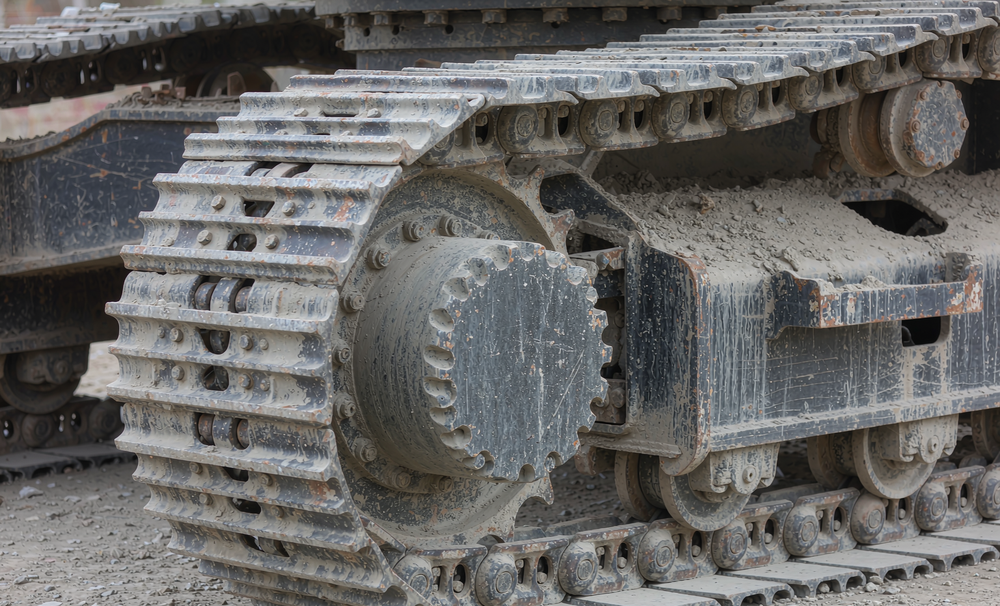
Why do a sprocket and its chain wear out together?
They are a matched pair, like a gear and its rack. As the chain pins and bushings wear, the effective pitch of the chain grows, so each link no longer sits exactly in the sprocket valley. The chain then rides up the flank of the tooth instead of seating at the root, and that riding up is what wears the tooth. A stretched chain chews a good sprocket; a hooked sprocket stretches a good chain. This is why undercarriage replacement almost always costs more than the single part that first showed the symptom.
How do you measure track chain pitch?
Pitch is the distance from the centre of one pin to the centre of the next. Measuring a single pitch with a tape is inaccurate, because the wear is distributed across every joint. The workshop method is to measure across a group and divide:
- Clean the chain and pick a section on the top run that has not been recently repaired.
- Measure from the outside edge of the first pin to the outside edge of the sixth pin (five pitches). Take the reading in millimetres with a steel rule or a pitch gauge.
- Divide by five. That is the current average pitch. Compare it with the original pitch for the chain.
- Repeat at two or three places along the chain, because a chain can wear unevenly if one side has spent its life on the drive.
A commonly used workshop limit is around three per cent elongation on chain pitch. Past that, the chain no longer meshes correctly and sprocket wear accelerates sharply. Note that a hot chain measures longer than a cold one; measure with the machine parked and the undercarriage at normal temperature.
How do you judge the sprocket itself?
- Tooth height. Compare against a new sprocket of the same part number, or use the manufacturer's tooth-height gauge if one exists. Lost tooth height means it is finished.
- Tooth shape. A worn tooth becomes hooked in the direction of rotation, with a sharp lip on the driving face. A hooked tooth will not release the chain cleanly.
- Valley depth and rim. Check the root of the valley for a step, and the rim for cracks or for bolts that have started to loosen or elongate their holes.
- Even wear. Uneven wear across the teeth usually points to a misaligned track frame, a failing final drive or a badly tensioned chain rather than a bad sprocket.
What is a quick field check when you have no gauge?
With the machine parked and the chain tensioned normally, look at where the chain sits in the sprocket valley. On a healthy pair the link bushings sit low, close to the root of the valley. If the bushings are visibly riding high on the flanks of the teeth, the chain has stretched beyond the point where it still seats, and both parts are on their way out. A second field check is noise: a worn pair makes a distinct clatter as the chain leaves the sprocket, which gets worse as tension is taken up.
What else should be checked at the same time?
Sprocket and chain rarely fail alone. While the machine is up on blocks, check the rest of the undercarriage in the same session: track rollers for seal leakage, flat spots and play; the front idlers for a worn rim and a leaking seal; carrier rollers for seizure; and track shoe bolts for stretch and looseness. Track tension is worth a check too - an over-tensioned chain is one of the most common causes of premature pin and bushing wear.
Should you replace the sprocket with the chain?
In most cases yes, if the chain is being replaced at or near its elongation limit and the sprocket is the original matched pair. Fitting a new track chain onto a worn excavator sprocket loads the new chain unevenly and typically shortens its life substantially. The reverse also holds: a new sprocket on a stretched chain wears its teeth quickly and runs noisily.
For buyers working out a budget, the useful comparison is cost per hour rather than cost per part. A track chain assembly and matching sprocket fitted together as a pair usually works out cheaper over the next few thousand hours than replacing the cheaper item alone, twice. The same logic applies to pins and bushings on the bucket linkage, which are also a matched pair.