
A dark wet ring at the joint between a track roller body and its end collar means the face seal has failed and the roller is losing its oil charge. It will not seal itself again, and a roller run dry will seize, flat-spot and start dragging the track chain with it, so the only real decision is whether it comes off now or at the next scheduled stop.
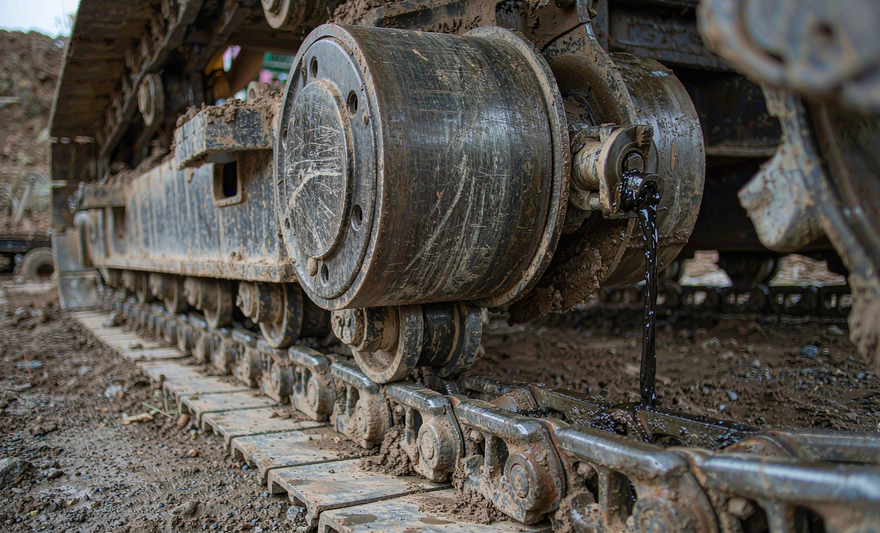
What does an oil leak at a track roller actually mean?
Most rollers on a crawler excavator are sealed, oil-lubricated units. Each one carries a small charge of oil, a few hundred millilitres on a 20-tonne class machine, which lubricates the shaft bearings and carries heat out of the roller body. The oil is retained at each end by a pair of hardened metal face rings pressed together by rubber toric rings: one ring turns with the roller shell, the other sits static in the collar. The two lapped faces are the seal.
When the rubber loses its tension, or grit works its way between the faces, oil escapes outwards and water and dust go inwards. The roller does not fail because it is overloaded. It fails because the seal gap opened. The rings are pressed into the shell and collar, so the seal is not a field service item.
How do you check a roller in two minutes on site?
Wipe the roller down first. Oil mixed with dust looks like mud, and wet clay will fool you. Clean it, then work through these in order:
- The seal line. Look at the joint where the roller shell meets each end collar. A thin, dark, continuous wet line is a leak. A radial streak thrown outwards onto the shell is a leak that has been running for a while.
- The fill plug. Oil weeping past the plug on the end face looks exactly like a seal leak and is a five-minute fix: new sealing washer, correct torque, done. Rule it out before you condemn the roller.
- Vertical play. Bar the roller up against the track frame and watch the gap. Any visible movement means the bearing has already lost material and the roller is on its way out.
- Temperature. After an hour of work, compare each roller against its neighbours with a thermal gun. A roller running meaningfully hotter than the rest of the side is low on oil or carrying load it should not be.
- Rotation. With the track raised and turned slowly by hand, a roller that rumbles, feels notchy or refuses to turn is finished regardless of how much oil is in it.
Check the flange, not just the seal
The flange is the raised lip that keeps the chain centred on the roller. Once it has worn to a sharp edge, or the chain has started polishing the roller body beside it, the roller is done even if it is still full of oil. A worn flange lets the chain climb and wander, side-loading the seal that is already leaking. Single-flange and double-flange rollers are not interchangeable on the same side of the undercarriage, so check which one you are looking at before ordering.
Why do roller seals fail earlier than owners expect?
Load is rarely the cause. Contamination usually is. Machines working in slurry, mud or repeated washdown push abrasive paste into the seal gap every time the roller turns, lapping the faces flat well before design life. Over-tensioned tracks multiply the load on every roller and idler on the side. A worn sprocket or stretched chain sets up vibration that hammers the seal faces. Rollers that stand in water corrode at the ring faces. A roller that has seized and is being dragged along flattens its shell and takes the bushings around it with it.
Can you just top up the oil and keep going?
On a roller leaking at the plug or plug washer, yes. On a roller leaking at the face seal, no: you cannot keep oil in a failed seal, ingress has already begun, and a top-up buys days at best. Not every roller is oil-filled either; some are grease-filled for life, and adding oil does nothing useful. Confirm the type in the parts book first.
When is a roller beyond repair?
A roller is scrap when it has seized, flat-spotted, lost its flange, developed visible vertical play, or run dry. There is no rebuild worth doing on a pressed roller at aftermarket prices. What matters more is the decision around it: if one roller on a side is leaking, inspect the whole side, because seals on one machine usually fail within a short window. Two or three leaking rollers on one side is a signal to plan the set rather than keep changing singles. Reuse mounting bolts only if the threads are clean; a bolt that has run loose will wallow the mounting face and ruin the frame.
What does a dry roller actually cost you?
A seized roller stops turning, the chain slides over it, the shell flats, and every link passing that point takes a shock load instead of a rolling one. The bill then moves from one roller to a track group, plus the downtime to fit it. That is the argument for checking seal lines at every service rather than waiting for a noise.
What to specify when you order replacements
Order by machine serial number, not by model name alone, because roller specification changes within a model series. Confirm three things before ordering: flange configuration, mounting bolt pattern and spacing, and whether the roller is oil- or grease-filled to match the rest of the side. For the range of sizes available, see our track roller range, the double flange rollers used where the chain needs lateral control, and a typical sized unit such as the Komatsu PC200-6 track roller. Carrier rollers on the upper run wear on a different cycle and are worth inspecting in the same pass.