
Excavator track tension is set by measuring the sag in the top span of the chain, and on most 20-tonne class machines the correct figure is roughly 25–40 mm. Too tight loads the final drive and crushes the pin and bushing seals; too loose lets the chain climb the sprocket teeth and come off under load.
How do you prepare the machine for a tension check?
The measurement only means something if the machine is in the state the manual assumes.
- Park on level, firm ground, not on a slope or soft fill.
- Travel forward about one machine length so the slack settles into the top span, then stop with a track pin directly above the front carrier roller.
- Lower the attachment to the ground, stop the engine and leave the controls in neutral.
- Measure cold. Steel chain grows as it warms up, so a track set to spec when hot will be over-tight when cold.
How do you measure track sag correctly?
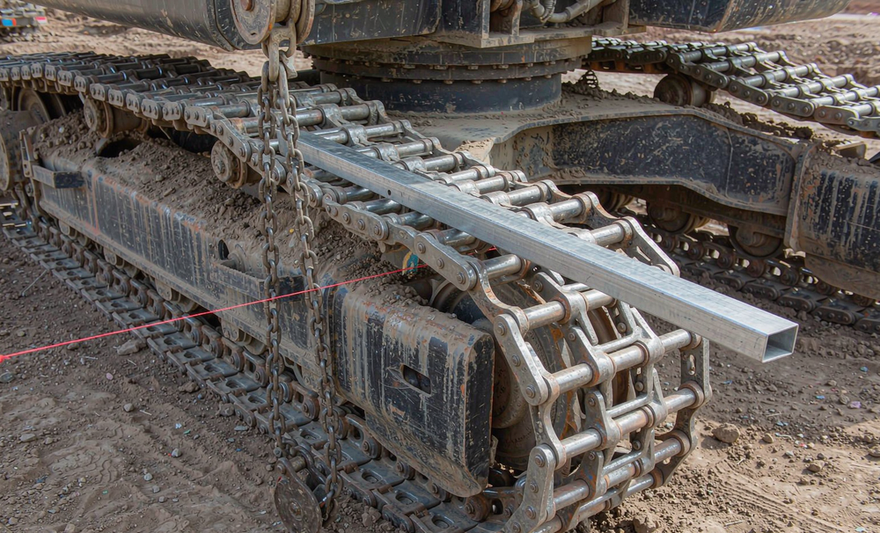
Lay a straightedge across the grouser tips from the front carrier roller to the idler, then measure vertically at the midpoint down to the lowest point of the chain. Read the number where the chain actually hangs, not where the straightedge sits.
Published figures differ by machine class and are usually given as minimum, target and maximum. In the undercarriage guides published by the major OEMs, a 20-tonne class excavator typically runs about 25 / 32.5 / 40 mm, and a 30-tonne class machine about 40 / 47.5 / 55 mm. As a cross-check, the target usually lands at 1–1.5% of the track length between sprocket and idler.
Measure both sides and write the numbers down. A difference of more than about 5 mm between left and right usually means one adjuster is losing grease, or one side is working harder than the other.
Why you must not mix the two measuring methods
The other common method swings the house 90°, uses the boom to lift one track clear of the ground and measures from the bottom of the track frame to the top of the shoe. That figure is a frame-to-shoe clearance and reads much larger than top-span sag. Both methods are valid; the numbers are not interchangeable, and comparing one against the other is how tracks end up badly over-tightened. Use the method your manual specifies and stay with it.
How do you adjust the tension?
Tension is set by a grease cylinder inside the track frame. Pumping grease through the fitting pushes the idler forward and tightens the chain; bleeding grease through the relief valve slackens it.
- Use NLGI #2 lithium grease unless the manual says otherwise.
- To loosen, open the relief valve no more than about one turn, stand to the side and wear gloves and eye protection. Grease in a track adjuster is under extreme pressure and a grease injection injury is a medical emergency.
- After adjusting, travel 10–20 m forward and reverse to equalise tension along the chain, then measure again and retighten the valve to the specified torque.
- If the track will not hold tension and grease weeps from the adjuster valve, the adjuster cylinder seal has failed. If the adjuster is seized, replace it — do not apply heat, which destroys the seal and can burst trapped grease.
When should the track run looser than the book?
In mud and sticky clay, packed material fills the link gaps and effectively shortens the chain, so tension rises without anyone touching the adjuster. Cleaning the undercarriage at the end of a shift is part of tension control, and in wet ground it is normal to run slightly looser than the dry-ground figure. Loose sand and gravel behave the same way. Rock and demolition work is the opposite case: the chain has to stay on the sprocket under impact, so do not run slack there.
What does the wrong tension actually cost?
- Too tight: accelerated pin and bushing wear, rounded sprocket teeth, roller and idler seal failure, extra load on the final drive bearings, and more fuel burned to move the machine.
- Too loose: the chain climbs the sprocket teeth and jumps, shoe bolts work loose, the chain slaps the track frame, and the track can derail in a turn.
The undercarriage is usually the largest single maintenance cost on a tracked excavator, and tension is the one adjustment that moves all of it at once.
What else should you check while you are under there?
- Idler flange: a flange worn thin is the usual reason a correctly tensioned track still derails. Check the front idler for a sharp or stepped flange.
- Sprocket teeth: a hooked or pointed profile means the chain has been running loose, or the sprocket is finished.
- Roller and idler treads: flat spots and leaking seals point to a failed roller, not a tension problem.
- Link height and pitch: most makers publish a wear limit as a percentage of original pitch, commonly in the low single digits. A track chain past that limit cannot be tensioned correctly, however much grease you pump in.
- Shoe bolt torque: check after the first 50 hours on a new chain, and after any derailment. Replacing stretched track shoe bolts and nuts is cheaper than retrieving a shoe from a travel route.
New chains seat in and slacken during the first few hundred hours, so recheck tension at 50 hours and again at the next service. After that, a check at every 250-hour service is usually enough, plus an extra one whenever ground conditions change.