
Grease excavator pins and bushings every 8 to 10 working hours under normal conditions, and shorten that interval in mud, water, rock, demolition or hammer work. The interval is only half the answer, though - what actually decides joint life is whether fresh grease reaches the bearing surface and pushes contamination out of the joint instead of sitting behind the seal.
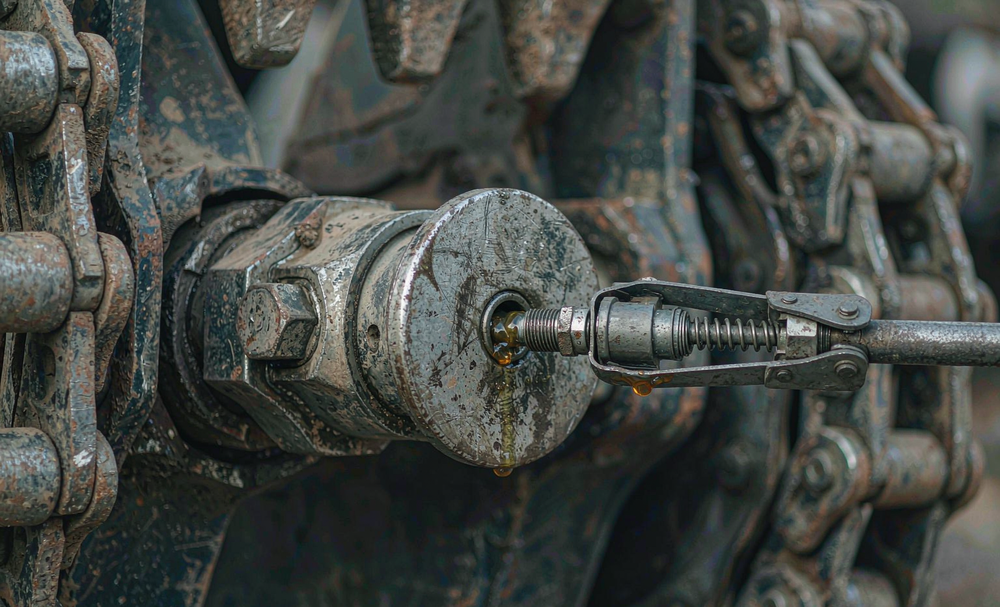
Why does greasing decide how long a pin and bushing last?
A pin and bushing are a plain bearing. The grease film is the bearing surface; the steel and the bronze are only there to hold it. Lose the film and the joint runs metal-to-metal, which generates local heat, micro-welding and surface spalling, and the wear rate climbs sharply from there. Grease does a second job as well: every pump flushes abrasive out of the joint, which is why the old grease has to leave for the new grease to do anything.
The material pair matters to this. A bronze bushing is intended to be the sacrificial half of the joint and tolerates a missed greasing for a while. A hardened steel bushing has higher load capacity but almost no tolerance for a dry joint - without a film it can gall and seize onto the pin, and then the pin, the bushing and sometimes the boss are all scrap.
What interval is right, and when should it be shorter?
Most manufacturer schedules land on 8-10 hours for attachment pivots, which in practice means every shift. Shorten it when:
- the machine is working in mud, water or sand;
- it is on rock, slag, quarry or demolition work;
- a hydraulic breaker is mounted - vibration loads the linkage joints as well as the chisel;
- the machine has just been washed, or has been standing in water;
- the same joint has already been replaced once.
The reverse is not true. Clean, dry landscaping work does not justify stretching the interval far beyond the schedule, because the joint sits ungreased between shifts either way.
How do you know the grease actually got in?
- Wipe the fitting before you couple the gun. Grit pushed into the gallery during greasing is a genuine cause of pin scoring.
- Watch the joint, not the gun. Fresh grease should appear at the joint edges or past the dust seal. If grease comes straight back out at the fitting, it is bypassing the gallery rather than entering the bearing.
- Reposition the attachment between strokes where you can. Curling or extending the bucket shifts load off the pin and lets grease spread across the full bearing surface instead of one side of it.
- There is no correct number of strokes. The end point is fresh grease at the purge point, not a count.
What does a fitting that will not take grease mean?
Work through it in order:
- Replace the fitting. It is the cheapest component in the joint and the most common blockage.
- If the fitting is clear, the gallery behind it is probably packed with hardened old grease - which means the joint has been starved for some time.
- Many pins are drilled with their own grease passage. If that is blocked, the pin has to come out to be cleaned.
- If grease escapes around the seal as pressure builds, or the joint takes grease but stays loose, the bushing is worn or oval and the grease is running straight through the clearance.
Do not solve this with more pressure. Forcing a powered gun against a blocked gallery is how seals get blown out of a joint that was otherwise serviceable.
One qualification: not every roller on the machine wants grease. Track rollers and carrier rollers are generally sealed and lubricated for life. If there is no fitting, there is nothing to grease, and adding grease to a sealed roller only pushes the seal out. Check before you pump.
Which grease should you use?
An NLGI 2 lithium-complex or lithium EP grease covers the majority of excavator pivot points and is the safest default for a mixed fleet. For high-shock joints - bucket linkage in rock, breaker-mounted linkage, quick couplers - a molybdenum disulphide (MoS2) fortified grease holds up better when the film is momentarily crushed.
Three practical rules: do not mix thickener types, because lithium, calcium and polyurea greases can soften each other when mixed in the same joint; match water washout resistance to the job if the machine works in water; and in cold conditions an NLGI 1 grease flows into the gallery more readily than NLGI 2.
What else shortens a joint's life?
Greasing is the biggest lever, but operator habit is the second. Prying sideways with the bucket, using it as a hammer, digging with the bucket twisted and slewing with a loaded bucket all load the pin in directions it was not designed for, and a loose joint gets looser because every movement becomes a shock load.
Dust seals are the third. A torn wiper or dust boot lets abrasive straight onto the bearing surface, and no greasing schedule compensates for that. When you replace pins and bushings, replace the seals and shims at the same time and measure the bore for ovality - new parts pressed into a worn bore is a short-term repair.
Planning the job
JALE supplies excavator bucket pins, bucket bushings and bucket link assemblies, plus undercarriage parts for the sealed rollers that do not take grease. Order the pin, bushing, dust seals, shims and retaining bolts together: the hardware is a small share of the invoice and a common reason for a second teardown a month later.