
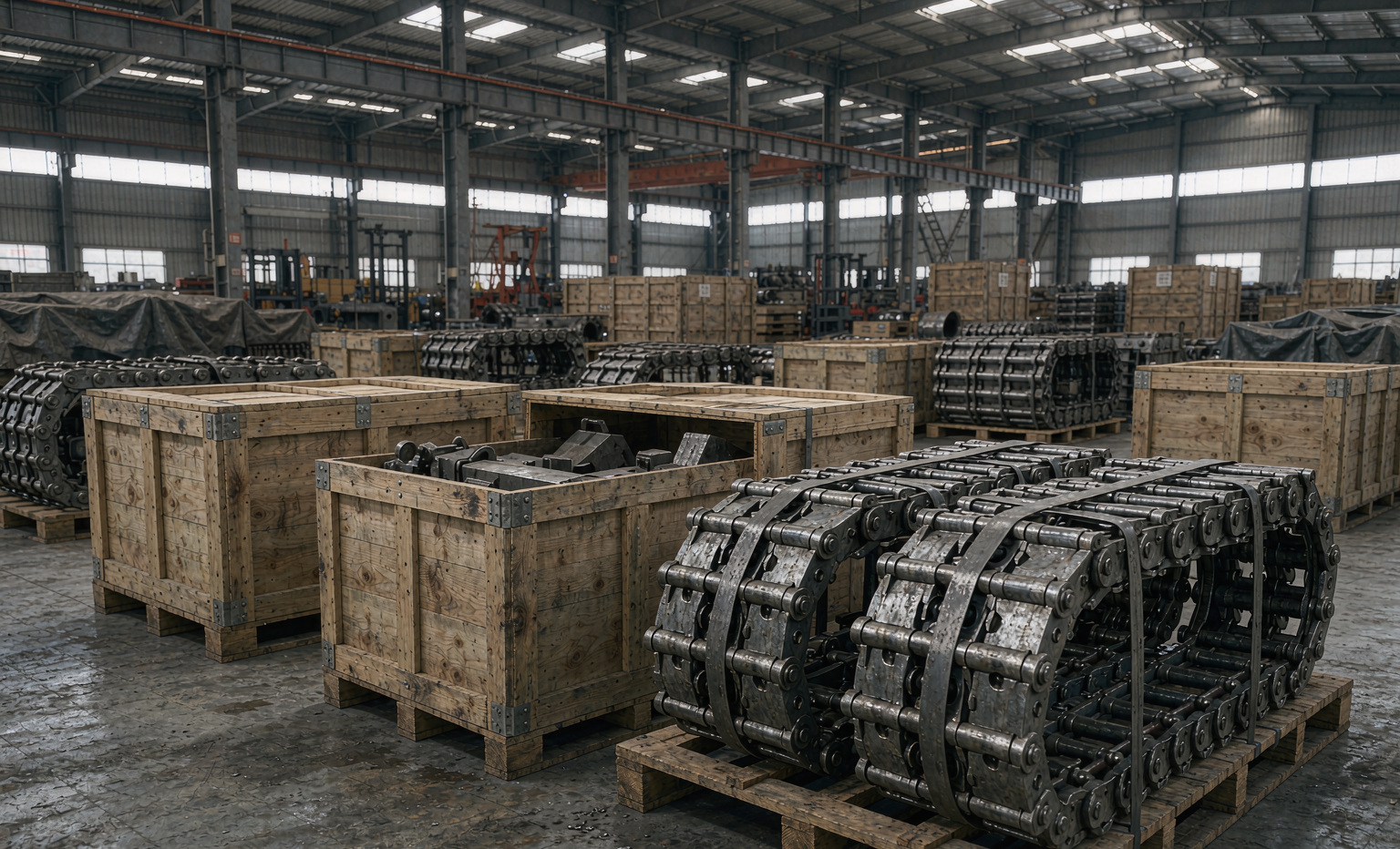
Heavy steel parts travelling by sea freight pass through weeks of humidity, several port handling cycles and a customs inspection at each end. Packing is not packaging here — it is what stands between a correctly manufactured part and a rusty, bent return. This is how export packing for excavator parts is done properly.
Match the Packing to the Component
There is no single correct answer, because tracks, pins and teeth fail differently in transit.
| Component | Typical packing | Main risk |
|---|---|---|
| Track chains and links | Steel-strapped bundles or open-top steel crates | Rust in the pin bores, bundle collapse |
| Bucket pins and bushings | Wooden cases with internal dividers, or steel drums | Abrasion between parts, mixed sizes |
| Bucket teeth and adapters | Wooden cases, heavy-gauge or plywood | Tip damage, loss of small retainers |
| Rollers and idlers | Wooden cases with each unit blocked and braced | Seal damage from impact |
| Large buckets | Nested and strapped, or steel-framed pallets | Distortion, damage to other cargo |
| Hydraulic seals and small parts | Sealed bags in cartons with desiccant | Moisture, contamination, loss |
Corrosion Protection Is the Main Job
Steel parts leaving a factory with a clean, bare surface will start rusting the moment they meet sea air. The standard protective measures are:
- Rust-preventive oil or grease film on machined surfaces — pin diameters, bushing bores and mating faces.
- Vapour-phase corrosion inhibitor film or paper inside sealed enclosures for parts that must stay clean.
- Desiccant bags inside sealed cases, sized to the enclosed volume, not just dropped in.
- Moisture-barrier wrapping for long sea voyages and humid destinations.
- Painted or waxed exterior surfaces on large steel fabrications, with machined areas masked off.
Documents That Prevent Delays
A correctly packed shipment still stalls at customs if the paperwork does not match. The set normally required:
- Commercial invoice — description, quantity, unit price, total value, and the correct HS code for each line.
- Packing list — itemised by case, with weights and dimensions per case.
- Bill of lading or airway bill — the carrier's document, matched to the packing list.
- Certificate of origin where a preferential tariff or a buyer's requirement applies.
- Material or test certificates where the part is specified by grade.
- Fumigation certificate for any solid-wood packing, or a declaration of heat-treated wood.
Container Loading and Weight Distribution
Heavy parts are loaded low and centred. A container full of track chains loaded unevenly can shift in heavy weather and damage both the cargo and the container. Blocking and bracing between items prevents movement, and steel strapping to the container floor with proper lashing points is standard for very heavy units. Total weight must stay inside the container's payload limit and, for road legs, inside local axle limits at the destination.
Choosing the Shipping Method
- Sea freight, FCL — the default for heavy undercarriage and buckets. Cheapest per tonne, slowest, needs good corrosion protection.
- Sea freight, LCL — for smaller orders. Handle the risk that your goods are consolidated with other cargo and handled more times.
- Air freight — for urgent small parts. Costly for heavy items but short transit, so less corrosion exposure.
- Courier — for samples and small, high-value components such as seals.
A Practical Checklist Before Dispatch
- Confirm the packing method against the component type and destination climate.
- Apply corrosion protection to every machined surface.
- Size desiccant to the enclosed volume.
- Block and brace inside the case so nothing moves.
- Mark cases with the part number, quantity and handling symbols.
- Verify the invoice, packing list and bill of lading agree line for line.
- Confirm the HS codes and any certificate of origin requirements.
- Photograph the packed cases before they leave, as evidence of condition.
- Send the buyer the packing list and photographs ahead of arrival.
Why This Matters on Heavy Parts
A rusted pin bore or a bent roller means the part arrives unusable, and the dispute that follows costs more than the packing would have. In a market where buyers compare suppliers mostly on price, packing quality is one of the few things that separates a supplier who understands the total delivered cost from one who only understands the ex-works price.
JALE Excavator Parts packs and ships bucket pins, bushings, bucket teeth, undercarriage and breaker parts from Shandong, China to buyers in the Middle East, Southeast Asia, Africa, South America and Europe. We provide the full export document set with each shipment and can arrange FCL, LCL or air freight depending on the order. See our news pages for more on our order handling, and our bucket pin range for the components most often shipped by air on urgent orders.