
A wear-parts order moves through six stages: enquiry and fitment confirmation, drawing or sample check, production, inspection against the agreed specification, export packing and marking, then shipment and documents. The stage buyers most often skip — confirming the dimensions against a drawing before production — is the one that decides whether the container arrives usable or becomes a negotiation.
Stage 1 — What should an enquiry contain?
An enquiry that can be quoted without a follow-up question contains: the machine make and model, the OEM part number if it is legible, the dimensions you measured, a photograph of the old part, the quantity, and the destination port. Missing dimensions are the single largest cause of delay, because a supplier cannot safely guess between two sizes that look identical in a photo.
Stage 2 — The drawing or sample check
Before production, the part should be confirmed against either the OEM drawing, a measurement of a physical sample, or a dimensional sketch approved by both sides. For a bucket pin that means diameter with tolerance, overall length, groove position and width, and the material and heat treatment. For a bushing it means bore, outside diameter, length and the intended interference fit. For a tooth it means the adapter family, locking pin diameter and nose width.
This step is cheap and the next one is not. Once a batch has been heat treated, a dimension that was wrong at the drawing stage is a scrap pile rather than a correction.
Stage 3 — Production and heat treatment
The sequence for a machined wear part is normally: cut bar to length, turn or machine to drawing, drill and cut the retaining groove, heat treat, then finish. Heat treatment is the control point that decides whether the batch is worth anything — induction hardening for pins, or carburising for components that need a hard case over a tough core.
What matters to a buyer is not the description of the process but the record that comes out of it: hardness and case depth readings for the batch, tied to the batch rather than to a generic product datasheet.
Stage 4 — Inspection before packing
Inspection should be dimensional against the confirmed drawing, plus hardness verification, plus a visual and thread check where relevant. For a first order with a new supplier, buyers commonly add a pre-shipment inspection by a third party, or ask for photographs of the batch laid out with the measuring instruments visible. Both are reasonable requests and neither should be controversial.
A dimensional report and a hardness record issued against the order number are the two documents worth insisting on, because they are what you fall back on if a part does not fit six weeks later.
Stage 5 — Export packing and marking
Steel wear parts are dense and they rust. The usual approach:
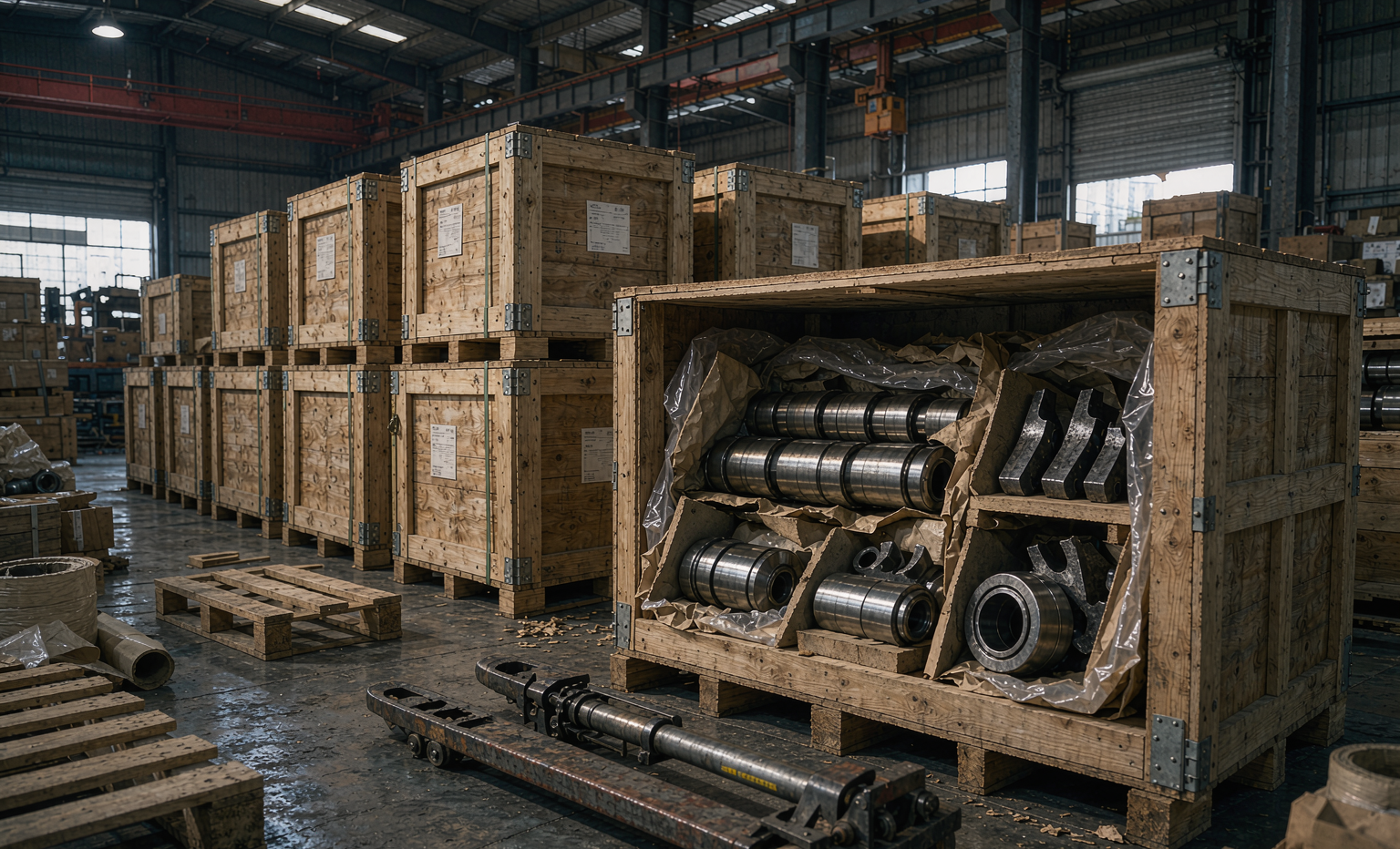
- Pins, bushings and machined parts are oiled or coated, wrapped, and packed in cartons or in the case of heavy items directly into braced plywood cases.
- Internal bracing matters more than case thickness. A 900 kg case of pins that shifts in transit arrives with damaged threads and bent retaining grooves.
- Timber packing that enters international trade normally has to comply with ISPM 15, which means heat-treated or fumigated wood carrying the phytosanitary mark. Ask for confirmation before shipment if your customs authority enforces it.
- Marking should carry the shipping marks, part numbers, quantities and destination, and mixed cartons should be labelled part number by part number so a distributor can put stock away without opening every box.
Stage 6 — Documents and shipment
The standard set is a commercial invoice, a packing list, the bill of lading or a telex release, and a certificate of origin where the destination's tariff treatment requires one. HS classification is the buyer's responsibility in the end, because codes for pins, bucket teeth, bushings and undercarriage components differ and change; confirm the code with your own customs broker rather than accepting one on trust.
Lead time depends on quantity and on whether the item is a stock line or made to drawing. Ask for it in writing, in days from deposit, before the deposit is paid — that single line removes most disputes later.
What to send us to start
Send the part numbers or measurements, a photograph of the worn part, the machine model, the quantity and the destination port, and the enquiry can be answered against a drawing instead of a guess. Sizes that are commonly stocked are listed in the bucket pins and bushing sections, with undercarriage items under undercarriage parts.