
A bucket wear plate is chosen by matching hardness to the kind of wear the bucket floor actually sees, keeping the plate close in thickness to the steel it protects, and checking the weight you are adding to the attachment. For most mixed digging on a 20-tonne class machine, a 400–450 HB plate around 8–12 mm thick is the sensible default; reserve 500 HB for floors that see sliding abrasion with little impact.
What does a bucket wear plate actually do?
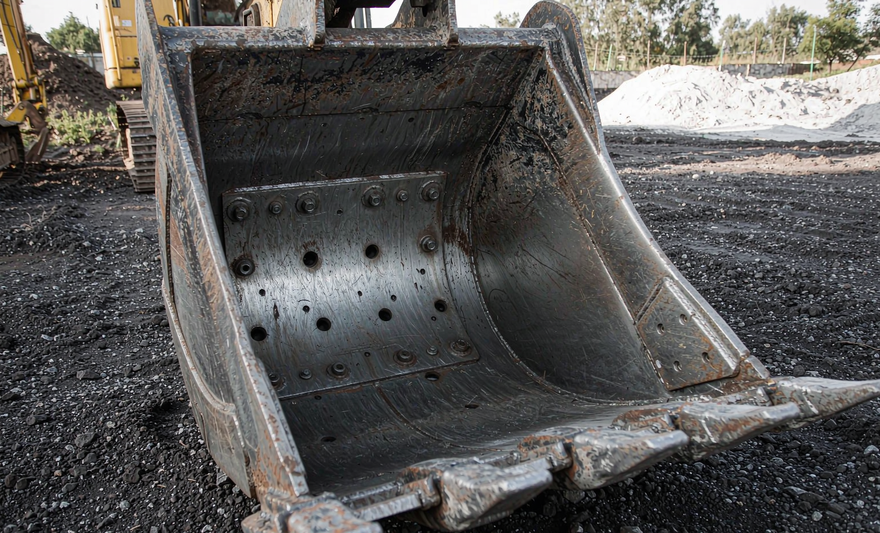
A liner is a sacrificial layer bolted or welded over the bucket shell so that abrasive ground attacks the plate instead of the parent steel. It does not make the bucket stronger. It moves the wear point forward in time, so the shell and the weld seams around the lip survive long enough to be worth repairing.
That distinction matters. If the bucket is cracking at the lip or the ear welds, a wear plate will not fix it. If the floor is thinning and you are welding patches every few months, a liner is the cheaper answer.
Which hardness grade should you specify?
Wear plate is sold by nominal Brinell hardness, tested to ISO 6506-1. Three grades cover almost all bucket work:
- 400 HB — typically 370–430 HBW. The toughest of the common grades, easiest to weld and drill, and the right choice where blasted rock or boulders drop into the bucket.
- 450 HB — typically 425–475 HBW. The middle grade, and the usual pick for contractors who dig soil one week and load quarry muck the next.
- 500 HB — typically 470–530 HBW at moderate thickness. Best wear resistance, lowest impact toughness. Sand, gravel and crushed aggregate reward it; a rock face punishes it.
The trade-off is real. Charpy impact energy falls as hardness climbs, and steel mills publish that drop in their own data sheets. Steelmakers' wear models also put the step from 400 to 500 HB at roughly 80–100% more wear life in pure sliding abrasion — which is why a harder plate can be thinner for the same service life, and why quoting a single “AR450” figure for the whole bucket tells you nothing about the floor versus the edge.
One trap: a “450” stamp on an unbranded plate does not promise through-hardness. A properly quenched and tempered plate holds a core hardness close to its surface value, so it keeps resisting wear as it thins. Ask for the mill certificate and the guaranteed hardness range at the thickness you are buying, not a single headline number.
How thick should the plate be?
There is no universal number; any supplier who quotes one without seeing the bucket is guessing. Three things decide it:
- The parent plate. A liner much thicker than the floor it covers adds weight and stiffness without adding proportional life. Measure the shell first.
- The ground. Sharp, abrasive stone eats plate faster than soft loam, so the same machine may need two different specifications on two sites.
- The grade. A 500 HB plate can be thinner than a 400 HB plate for the same wear life.
Also check clearance. Added thickness at the heel changes ground clearance and can foul the lip or the quick coupler. Offer the plate up before you weld anything.
How much weight does a liner add?
Steel is about 7,850 kg per cubic metre, which works out to roughly 7.85 kg for every square metre of plate per millimetre of thickness. A 10 mm liner over 2 m² of floor adds about 157 kg. Every one of those kilos is lifted on every cycle and comes off the payload, so it is worth doing the arithmetic before choosing the thickest plate that fits.
On a 20-tonne class excavator, 150 kg is tolerable; on a 5-tonne mini it is not.
Where do buckets wear out first?
Spend protection where the metal actually goes:
- The floor, forward of the lip. Continuous sliding abrasion. Usually the first area to need a liner.
- The lip and heel. Highest load, highest wear. This is cutting edge territory rather than liner territory, and the two belong together.
- The side plates below and behind the side cutter. Often overlooked, and thin side plates distort the bucket mouth.
- The wing area. Narrow trenches concentrate wear here.
A straight edge and an ultrasonic thickness gauge settle the argument in ten minutes. Measure the shell at six points, write the numbers down, and compare them with the next inspection rather than a guess.
What should you send with an enquiry?
A usable enquiry carries the machine brand and model, the bucket part number if it is legible, the plate dimensions in millimetres, and whether the item is flat, formed or drilled. If the liner is bolted, include the hole pattern and countersink angle, because a plate with the wrong hole spacing is scrap. Photographs of the worn area from two angles save a week of email.
For a welded liner, tell the supplier the grade you intend to fit. Harder plate needs a qualified procedure and, above roughly 20 mm, preheat. Mild-steel consumables and no preheat are normal for 400 HB at moderate thickness; 500 HB at 30 mm is a different job.
How do you check the plate on arrival?
Three checks, five minutes: verify the mill certificate matches the grade and heat number, measure thickness with a calliper at three points per plate, and check flatness on a bench. Then compare the hole pattern to the bucket before you commit to welding. A plate that arrives at 8 mm when you ordered 10 is a claim you can only make on the day it lands.
If you are also replacing ground engaging tools, match the bucket teeth and tooth pins to the same wear interval, so the bucket comes out of service once rather than three times. The bucket assembly as a whole is only as good as its weakest wear surface.