
Choose track shoes by the ground the machine actually works on, then take the narrowest width that stops it sinking. The widest shoe in the parts book is rarely the right answer: on rock it cracks across the bolt line, and on any surface it adds turning scrub that wears the pins and bushings in the chain.
What do excavator track shoes actually do?
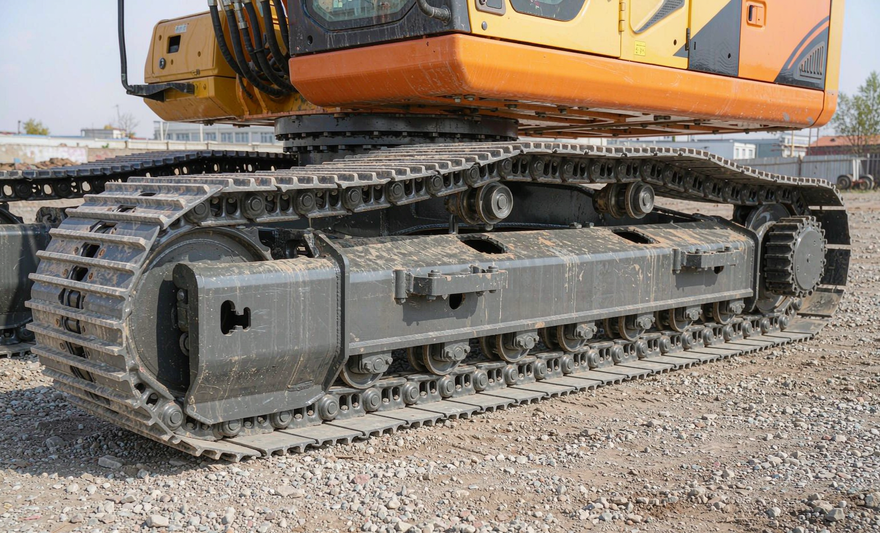
They are the only part of a 20-tonne machine that touches the ground. The shoe carries weight, generates traction, spreads load and shields the chain from direct abrasion. All four jobs are set by three variables: width, grouser profile, and the bolt pattern that ties the shoe to the link. Get the pattern wrong and the shoe will not bolt up at all. Get width or profile wrong and it fits perfectly, then quietly wears out everything around it.
How do you calculate the right shoe width?
Width is a ground pressure sum, not a catalogue preference. Ground pressure is operating weight divided by the total contact area of both tracks. Take the machine's operating weight, not its bare weight, then work out the footprint of the shoes currently fitted. Compare the result with what the ground will carry where the machine spends its shifts.
The number that matters is the worst ground, not the average. A machine that works a dry bench all summer and a mud floor after rain needs flotation for the mud, or it will trench its own path in October and lose the traction the width was supposed to give it.
Why is a wider shoe often worse?
Every extra centimetre of width increases the bending moment across the shoe, the load on the bolts, and the stress on links, rollers and idlers. On hard or broken ground the outer edge of an over-wide shoe is unsupported, so the shoe bends and eventually cracks across the bolt line. During a turn the outer edge of a wide shoe travels further than the inner edge and scrubs, which is the dominant wear mechanism on loading shovels that pivot constantly. Wider shoes also add weight that every roller has to carry, thousands of times a shift.
Which grouser pattern suits which job?
- Triple grouser is the excavator default. Three lower bars share load, turn smoothly and give good all-round traction. It is the right starting point for general construction and mixed ground.
- Single grouser is the dozer standard: the tall bar penetrates and pushes. On a machine that turns under load it is a liability, because the bar resists lateral movement and tears at the surface.
- Double grouser sits between the two and is common on loaders and older dozers.
- Centre-punched shoes have a hole in the middle so sticky clay is squeezed out instead of packing between shoe and sprocket, which is a real cause of over-tension.
- Clipped grouser shoes have trimmed bar corners for work over asphalt and concrete, where a full-width bar would scar the surface.
- Swamp or low-ground-pressure shoes are extra wide, and only worth it on peat, marsh and very soft fill. They trade undercarriage life for flotation.
Which dimensions have to match before a shoe will fit?
Track pitch, bolt hole spacing, bolt hole diameter, plate thickness, overall width, grouser height and the mounting pattern. Two shoes of identical width can have different hole spacing, so width alone confirms nothing. Measure the existing shoe and photograph the link mounting face, because a photo of the wear pattern tells a supplier more than a model name.
Should you reuse the bolts?
No. Reused track shoe bolts have already lost clamp force, and loose bolts are the most common reason a new set of shoes comes back off. Fit new bolts and nuts with the shoes, torque to the figure in the manual, and re-torque after the first 50 hours, then at every scheduled service. Shoes bed in, so the initial torque drops measurably in the first week. A loose bolt ruins the link long before it ruins the shoe, and the link costs several times as much.
Does hardening matter more than brand?
Yes, and it is the one specification buyers forget to ask for. A through-hardened shoe keeps its hardness as the grouser wears down, because the whole section is treated. A surface-hardened shoe has a hard skin over a softer core, so once the skin is gone the wear rate climbs. Ask for the hardness figure and the heat treatment record with the batch, and treat a supplier who cannot produce either as a risk on the rest of the order.
What should go on the request for quotation?
- Machine make, model and serial number.
- Existing shoe part number, if legible.
- Current width, grouser type and number of shoes per side.
- Bolt hole spacing and diameter, measured, not assumed.
- The ground the machine works on and whether it turns under load.
That list is enough to quote without a second round of questions. For the range we produce, see the track shoe range and a typical sized unit such as the CAT70 track shoe. Order the track shoe bolts and nuts with the set rather than reusing the old ones, and check the track rollers in the same pass, since a shoe change is the cheapest moment to catch a worn roller before it takes the chain with it.