
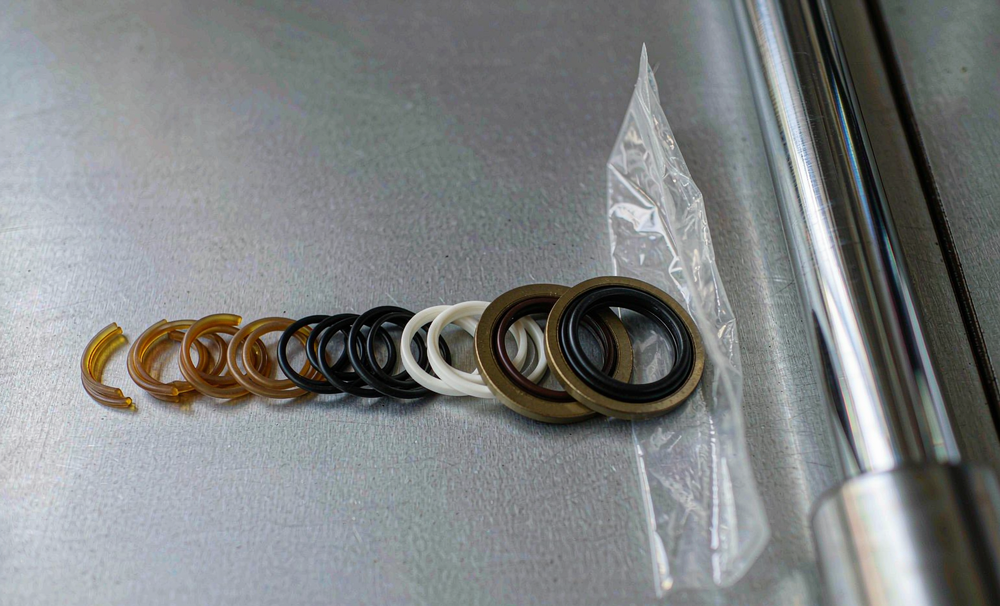
The material decides the seal's job, not the machine brand: polyurethane (PU) for rod, wiper and piston seals on standard excavator duty, nitrile (NBR) for O-rings, static joints and low-pressure return lines, and PTFE — normally with an NBR or FKM energiser — where pressure is high or the temperature runs past 100 °C. Size gets a seal into the right groove; material decides whether it is still sealing a thousand hours later.
Most premature failures blamed on a bad batch are a material mismatch: right dimensions, right groove, wrong compound for the pressure, the temperature or the fluid.
What does each seal material actually do well?
Polyurethane (PU) — the workhorse for moving seals
PU is the default for reciprocating seals on excavator cylinders. It is tough, typically 90–95 Shore A, with abrasion resistance several times that of NBR and enough tear strength to survive pressure spikes without nibbling at the lip. Extrusion resistance is good to roughly 400 bar in a correct groove with a backup ring.
Its limits are heat and water: standard PU is rated to about 80–90 °C continuous, some grades to 110 °C, and it hydrolyses in water-based or water-glycol fluid. A machine steam-cleaned and left wet, or a site running fire-resistant fluid, is a PU failure waiting to happen.
NBR — still the right answer in the right place
NBR is cheap, resists mineral oil well, and has a wider useful temperature band than standard PU, roughly −30 to +100 °C. It is correct for O-rings, gland and port static seals, energisers inside PTFE step seals, and low-pressure return lines. What it is not good at is a high-pressure dynamic lip: it extrudes into the gland gap and comes out with a chewed edge.
PTFE — high pressure, high temperature, low friction
PTFE has a friction coefficient around 0.04, no stick-slip, and a range from −40 to +200 °C; in a step seal it will hold 500–700 bar. The trade-off is that it has almost no elasticity of its own, so it needs an elastomer energiser to keep the lip loaded and a finely machined groove. Thin, cheap PTFE rings crack at the lip on installation, which is why so many “PTFE seals leak from new”.
FKM — for the hot end of the machine
Where the cylinder sits close to the engine or exhaust, FKM holds above 200 °C and resists phosphate-ester fluid that would destroy NBR. It costs more per piece; the case for it is a failure that costs a shift, not a saving on the kit.
Which material goes in which position?
- Wiper / scraper: PU. Its job is abrasion, not pressure.
- Rod seal: PU U-cup for standard duty; PTFE step seal for high pressure or high temperature.
- Buffer ring: PTFE, or reinforced PU on shock-loaded cylinders.
- Piston seal: PU compact seal, or PTFE with an energiser above 400 bar.
- Guide and wear rings: phenolic resin or PTFE-bronze, never rubber.
- Static O-rings: NBR, with a PTFE backup where the gap is large.
How do you find out what temperature the seal really sees?
Measure it, do not estimate it. Hydraulic oil in a working excavator commonly sits at 60–80 °C, and passes 100 °C when the cooler is blocked, the ambient is 45 °C, or the machine spends its shift on a breaker. Point an infrared thermometer at the cylinder barrel and the return line after a full shift under load, not at idle in the yard.
Then read the failed seal. A lip that is hard, glossy and cracked rather than worn smooth has been cooked — so the material was under-rated or the cooling circuit is failing, and usually you need to fix both.
How do you identify an unknown seal's material?
Colour and feel get you most of the way. PU is often amber or translucent and feels hard and slightly waxy. NBR is dull black and softer. PTFE is white, cold to the touch and does not spring back when folded. A durometer settles it: NBR reads 70–90 Shore A, PU reads 90–95.
Do not judge a seal by a single dimension either — the same 60 mm rod seal exists in three compounds that behave completely differently.
What are the most common material mistakes?
- PU specified into a water-glycol or fire-resistant system, where it swells and softens.
- NBR used as a high-pressure rod seal, where it extrudes into the gap.
- PTFE fitted without an energiser, or into a rough groove, so it never follows the rod.
- A seal installed dry, or a new kit fitted to a scored rod — the rod re-cuts the lip in a few hundred hours and the seal gets the blame.
Does a worn pin change the seal decision?
Yes, indirectly and often. A worn cylinder pin or a collapsed arm bushing lets the rod run off-centre, and an off-centre rod loads one side of the seal lip continuously. That shows up as a leak on one side of the gland and a seal worn thin in one arc. Replacing the seal without addressing the joint buys a few months. Check clearance at the cylinder pin and arm bushing at the same time you rebuild the cylinder.
Frequently asked questions
Is a harder seal always better?
No. A harder compound resists extrusion but conforms less to a slightly worn rod, so it weeps. Match hardness to surface finish and pressure.
Can one kit mix materials?
It normally must. A typical excavator cylinder kit pairs a PU rod seal and wiper with a PTFE buffer, NBR static O-rings and phenolic guide rings. A kit that is all one compound is a kit designed for price.
If you are rebuilding cylinders alongside the bucket pins that caused the side load, send rod diameter, bore, groove dimensions and measured oil temperature — the material follows from those four numbers.