
Identify an excavator cylinder seal kit by the hydraulic component it fits and by the cylinder's own numbers, not by the machine model. The model is only a starting point: the boom, arm and bucket cylinders of the same machine can each take a different kit, and a production break inside one model can change the cylinder altogether.
Why is the machine model not enough to pick a seal kit?
One excavator designation can be built with different cylinders depending on production year, serial range, regional specification and attachment configuration. A machine that has already been repaired may carry a replacement or aftermarket cylinder that no longer matches the original parts book. "A seal kit for a PC200" is therefore ambiguous; "bucket cylinder seal kit for a PC200-7, cylinder assembly number X, machine serial Y" is not.
The position matters as much as the model. Boom, arm and bucket cylinders use different sealing arrangements, and travel motors, swing systems, centre joints and track adjusters are a different family again. Those must not be ordered as ordinary cylinder kits.
What should you collect before you ask for a price?
- Manufacturer and the complete model designation, including every suffix.
- Machine serial number or PIN.
- The exact cylinder position: boom, arm, bucket, blade, centre joint or track adjuster.
- The OEM seal kit number, or the cylinder assembly number if the kit number is missing.
- Rod diameter and cylinder bore.
- Gland type - screw-in, bolted or wire-ring retained, because the kit differs.
- Whether the cylinder is original, rebuilt or aftermarket.
- A photograph of the machine plate and of the old seals laid out in the order they came out.
How do you measure a cylinder when the part numbers are gone?
Measure the rod on an unworn section, away from where the lip runs, and read the tube bore with a bore gauge. Groove widths and depths matter as much as the diameters - a seal that fits the groove but has the wrong section thickness will fail under pressure rather than in the workshop.
Do not assume that a machine built to inch dimensions uses inch seals. Komatsu cylinders in the PC200 class take a 180 mm bore seal, and a supplier quoting a nominal inch size for those machines is quoting the wrong part. Measurement also means isolating the system and releasing stored pressure first; that is a workshop job for a qualified hydraulic technician, not something to attempt on a pressurised cylinder in the field.
What is inside a complete seal kit?
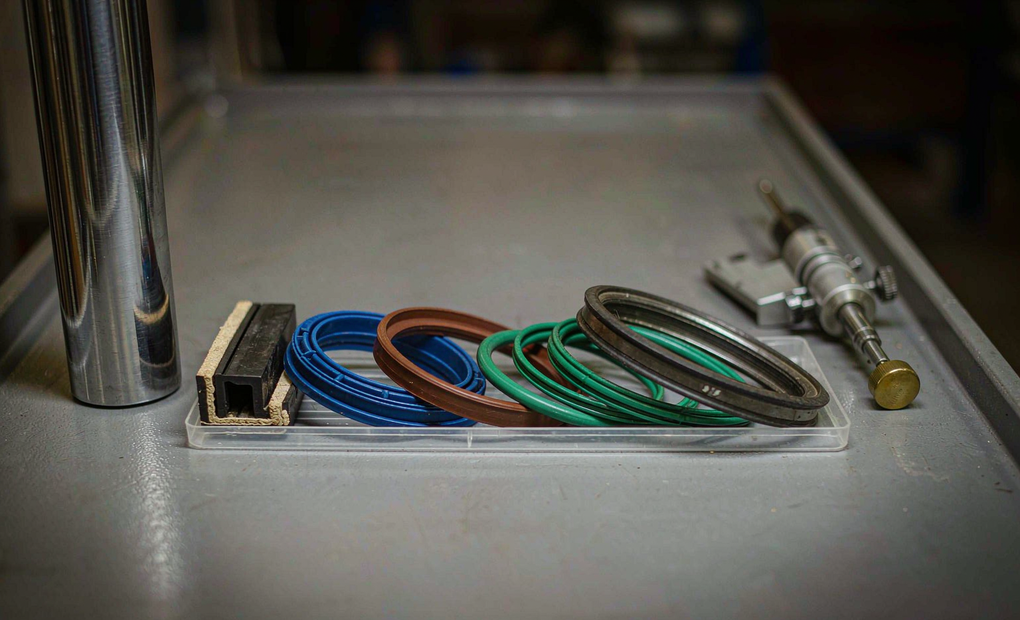
A complete hydraulic cylinder kit normally contains the rod seal, the rod wiper or dust seal, a buffer seal, the piston seal, piston wear or guide rings, gland O-rings and backup rings, and the static seals for the assembly. The exact contents follow the cylinder design.
Why buy them as a set rather than piece by piece: leakage is rarely caused by one seal alone. When a rod seal fails, the wiper that let the dirt in is usually worn too, and the wear ring that supports the rod is often past its limit. A supplier who quotes only a rod seal leaves you doing the job twice.
Which seal material do you need?
- NBR (nitrile) - the default for mineral hydraulic oil at moderate temperature.
- PU (polyurethane) - better abrasion resistance, common in rod seals and wipers on machines working in mud, sand and rock.
- FKM (fluorocarbon) - for high-temperature positions.
- PTFE - used in piston seal assemblies and energiser combinations where low friction matters more than resilience.
One trap worth knowing: biodegradable hydraulic fluids attack standard nitrile. If a machine runs an environmentally acceptable fluid, specify polyurethane or FKM instead.
What a seal kit will not fix
A kit restores a cylinder whose seals have aged, hardened and started to weep. It does not repair a damaged rod. Run a fingertip and a straight edge along the rod where the lip runs: any ridge you can feel, or any missing chrome, will grind a new seal out within days and put the machine back in the workshop. Contamination behaves the same way - metal from a failing pump reaches the cylinder and destroys new seals in a fraction of their normal life. If the same position has failed twice, check rod straightness and oil cleanliness before ordering another kit.
Where this sits in a rebuild
Cylinder work rarely happens alone. A weeping bucket cylinder usually comes off a joint whose pins and bushings are also due, so the sensible order covers the kit, the pin and the bushing together. JALE supplies excavator hydraulic parts and excavator hydraulic cylinder parts alongside bucket cylinder pins and the wider excavator bucket pin range, so the pivot and the seal are matched in one order rather than two.
What should be on the enquiry?
Send the cylinder position, the full model, the serial number, the bore and rod diameters, and a photograph of the old seals in sequence. That is normally enough to confirm the correct kit without a second round of questions.