
You match an excavator bucket tooth to the adapter, not to the machine. The adapter family — J200, J250, J300, J350, J400 — is set by two measurements you can take with a caliper on the bucket: the locking pin diameter and the width of the adapter nose. Once you have those two numbers, choosing the tooth stops being guesswork.
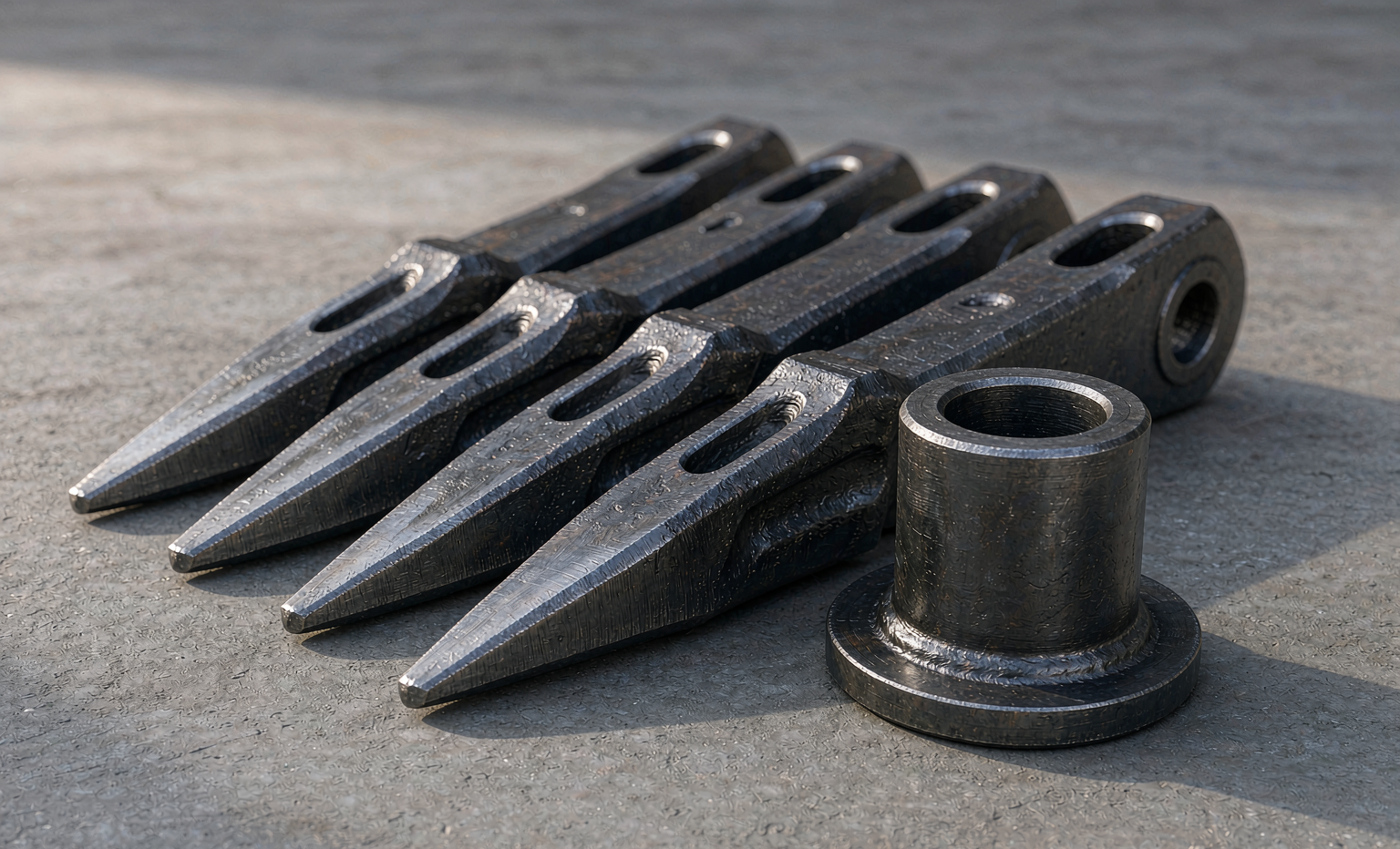
Why does ordering a tooth by machine model go wrong?
Because the bucket is not part of the machine order in the way people assume. The same 20-tonne excavator arrives with different buckets depending on the customer, the dealer and the application. Field-fitted adapters, rebuilt buckets and third-party attachments all mean a machine model alone cannot tell you which tooth fits.
The adapter is welded to the bucket lip and stays there. It is the expensive, slow-to-change half of the assembly. Buyers who order teeth by machine model and end up with a loose or forced fit are usually damaging the adapter, not the tooth.
What measurements identify the adapter family?
Two, both taken with a vernier caliper after cleaning the adapter:
- Locking pin diameter. The pin that secures the tooth. Measure the pin shank, not the hole, if the pin is still serviceable.
- Adapter nose width. The widest point of the nose where the tooth pocket slides on.
Typical figures for the common J-series families are shown below. Treat these as identification ranges, and confirm against the machine or attachment manual before ordering.
- J200 — approximately 11 mm pin, 40 mm nose. Compact excavators, roughly 5–10 t.
- J250 — approximately 14 mm pin, 50 mm nose. Roughly 10–15 t.
- J300 — approximately 19 mm pin, 60 mm nose. Roughly 15–20 t.
- J350 — approximately 19 mm pin, 70 mm nose. Roughly 20–25 t.
- J400 — approximately 22 mm pin, 80 mm nose. Roughly 25–30 t.
Note how J300 and J350 share a pin diameter. That is why measuring the pin alone is not enough — the nose width is the measurement that separates them.
Which tooth profile should you fit?
Profile is an application decision, not a price decision. A general-purpose tapered tooth in hard rock wears to the adapter quickly; a blunt rock tooth in soft clay adds penetration resistance and burns fuel. As a rule:
- Standard tapered point for soil, loam and sand — the default if you dig mixed ground.
- Penetration or tiger point for hard-packed clay and frozen ground, where a sharp narrow point is what actually gets you through.
- Rock or heavy-duty reinforced for granite, limestone and demolition debris, where the body needs to survive impact more than it needs to be sharp.
- Wide or flat heavy-abrasion for sand and gravel loading, where abrasion is the dominant wear mode.
The range is listed in excavator bucket teeth and in the bucket tooth section of the catalogue.
What material and hardness should you ask for?
Quality teeth are forged from low-alloy steel such as 40Cr or 42CrMo, or cast from an alloy like 30CrMnSi, then heat-treated. A common specification for the wear surface is roughly 48–52 HRC. Below that range, abrasion wins and the tooth wears out in days rather than weeks; above it, the material becomes brittle and tends to crack when it hits rock.
Ask for the hardness test result for the batch you are buying. A supplier who cannot produce one is telling you something.
What about the locking system — vertical pin, horizontal pin or bolt-on?
J-series and most K-style systems use a vertical flex pin driven through the top of the tooth. It is fast to change in the field, but the pin hole packs with dirt in wet conditions and needs cleaning out before removal. Horizontal-pin systems retain better under extreme side load and suit mining and quarry work, at a higher tooth price and with narrower aftermarket availability. Bolt-on teeth need no welded adapter at all, which is why they dominate on skid steers, compact loaders and backhoes — but bolts need torque checks and bolt-on teeth are not a rock solution.
What should be on the purchase order?
- Adapter family or, better, the OEM part number if it is legible on the casting.
- The pin diameter and nose width you measured, in millimetres.
- Tooth profile and quantity.
- Machine make, model, and serial number where you have it.
- A photograph of the worn adapter and the old tooth, from the side and from underneath.
If the adapter itself is worn, bucket teeth adapters are a separate purchase and a welding job. A tooth cannot fix a worn nose — it will simply sit loose and wear the new tooth faster. For compact machines, J200 bucket teeth are the usual starting point.
Send those five items and any supplier that manufactures to specification can confirm fitment before the order ships, rather than after the container arrives.