
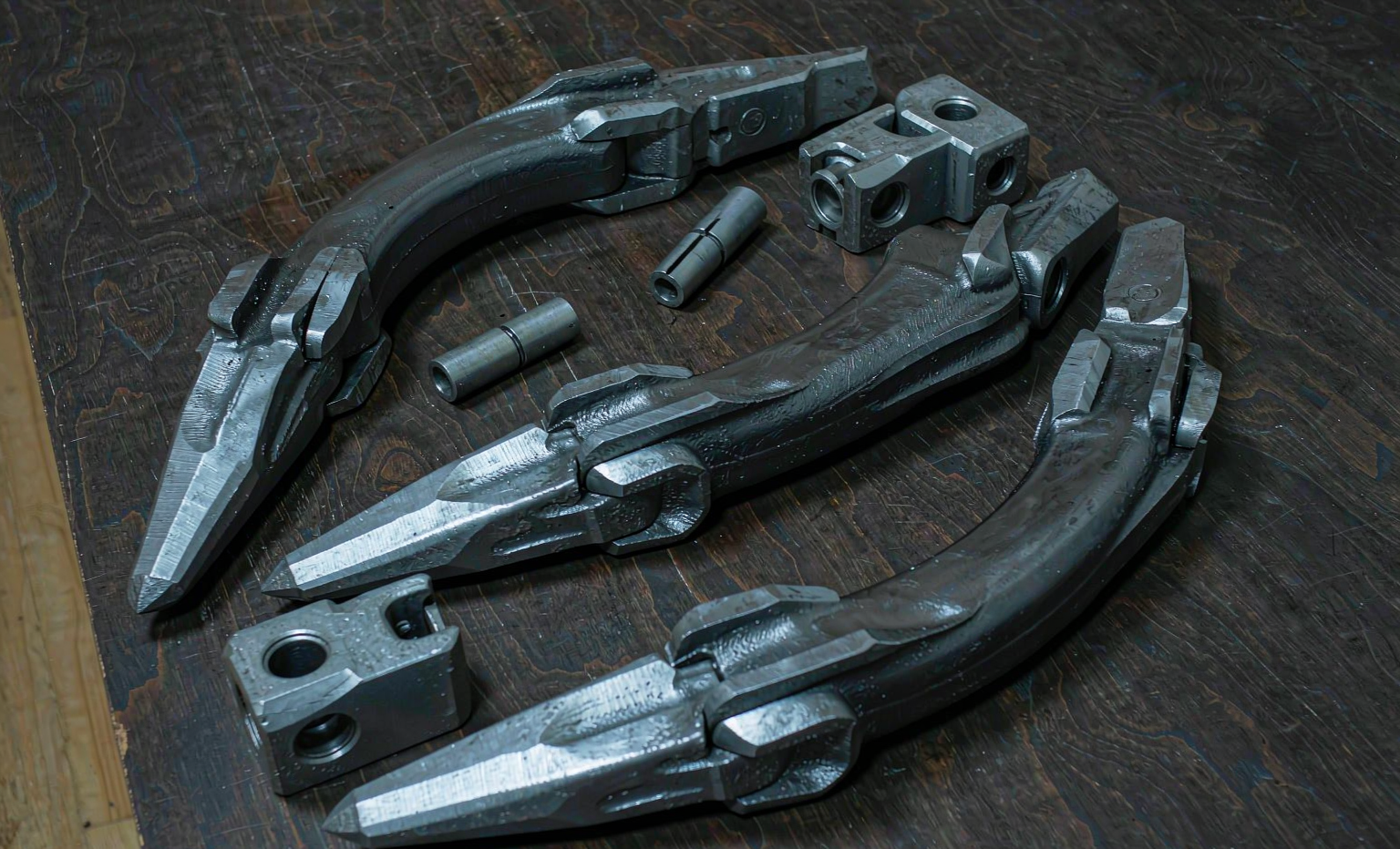
A bucket tooth that comes off in the trench is not just a lost part. It stops production while someone finds it, it can damage a crusher downstream, and if it comes off at the wrong moment it is a safety incident. Almost every premature tooth loss traces back to a mismatched tooth and adapter combination. Here is how to get the match right.
Identify the Tooth System First
Bucket teeth are not interchangeable across systems. Each manufacturer uses a tooth and adapter interface with its own geometry and locking method. Before you order anything, identify which system your bucket uses. The usual ways are the tooth part number stamped on the tooth, the shape of the adapter nose, and the type of locking pin or retainer.
The common systems you will encounter:
- J-series profile teeth — a widely used shape, sized by number, with a pin or flexpin lock. Long established and widely copied across aftermarket suppliers.
- Weld-on adapter systems — the adapter is welded to the bucket edge and the tooth, or a tooth and cutting edge, bolts or pins onto it. Common on smaller and mid-size buckets, and common in aftermarket supply.
- Flush-mount and bolt-on systems — the tooth sits flush with the adapter and is held by bolts.
- Chisel, twin-tiger and penetration-type tips — narrower profiles for hard or compacted ground.
What to Measure on the Adapter
If the adapter is already on the bucket, measure it rather than guessing from the machine model.
- Nose width and height at the point the tooth slides on.
- Nose length from the shoulder to the tip.
- Pin hole diameter and its position along the nose.
- Retainer groove dimensions, if the system uses a groove.
- Adapter part number if any marking remains.
- Tooth part number from a still-serviceable tooth on the bucket.
Measuring a worn adapter is unreliable for a different reason: abrasion changes the nose profile, so a tooth that fits a worn adapter may not fit a new one. Measure a new adapter where possible, or replace the adapter at the same time.
The Common Matching Mistakes
| Mistake | Result | How to avoid it |
|---|---|---|
| Buying by machine model alone | Wrong system — tooth will not lock | Identify the tooth system from the adapter, not the machine |
| Reusing a worn pin or flexpin | Tooth works loose and is lost | Always fit a new retainer with a new tooth |
| Fitting a tooth to a worn adapter nose | Excessive play, rapid wear, tooth loss | Replace adapter or measure a new one |
| Mixing tooth systems on one bucket | Uneven wear, one tooth takes the load | Keep one system across the whole edge |
| Using a penetration tip in abrasive rock | Tip wears out in hours | Match tip profile to ground condition |
| Hammering a tooth on dry | Damaged pin bore, cracked tooth | Clean the nose and fit by hand or with a soft mallet |
Matching the Tooth to the Ground
The tooth system is only half the decision. The profile should follow the material. In soft ground, a wide, blunt tooth gives better bucket fill and lasts longer. In hard, compacted or frozen ground, a narrower penetration tip concentrates the force and actually reduces the load on the tooth because the machine breaks the material rather than tearing at it. In highly abrasive rock, a heavier tungsten-carbide-tipped tooth pays for itself many times over against a plain steel one.
For matching hardware, the JALE pin and bushing range covers the retaining pins and the linkage components that have to match the same dimensions, and our bucket bushing range covers the wear points behind the cutting edge.
Buying Teeth That Actually Fit
The reliable approach is to give the supplier a photograph of the adapter, the tooth part number, and the measured nose dimensions. A supplier who can work from those three things will supply a tooth that fits. A supplier who only asks for the machine model is guessing. JALE Excavator Parts manufactures bucket teeth, adapters, pins and bushings for the common tooth systems and exports worldwide, and our news section covers sizing and compatibility questions in more depth.