
A quick coupler fits a bucket when three measurements match: the pin diameter, the distance between the pin centres, and the clear width between the bucket ears. Two couplers can share a pin size and still be completely incompatible, so the pin diameter alone never settles the question. Measure all three on the bucket, on the coupler and, if you can, ask the supplier to confirm against the coupler's own drawing before you commit.
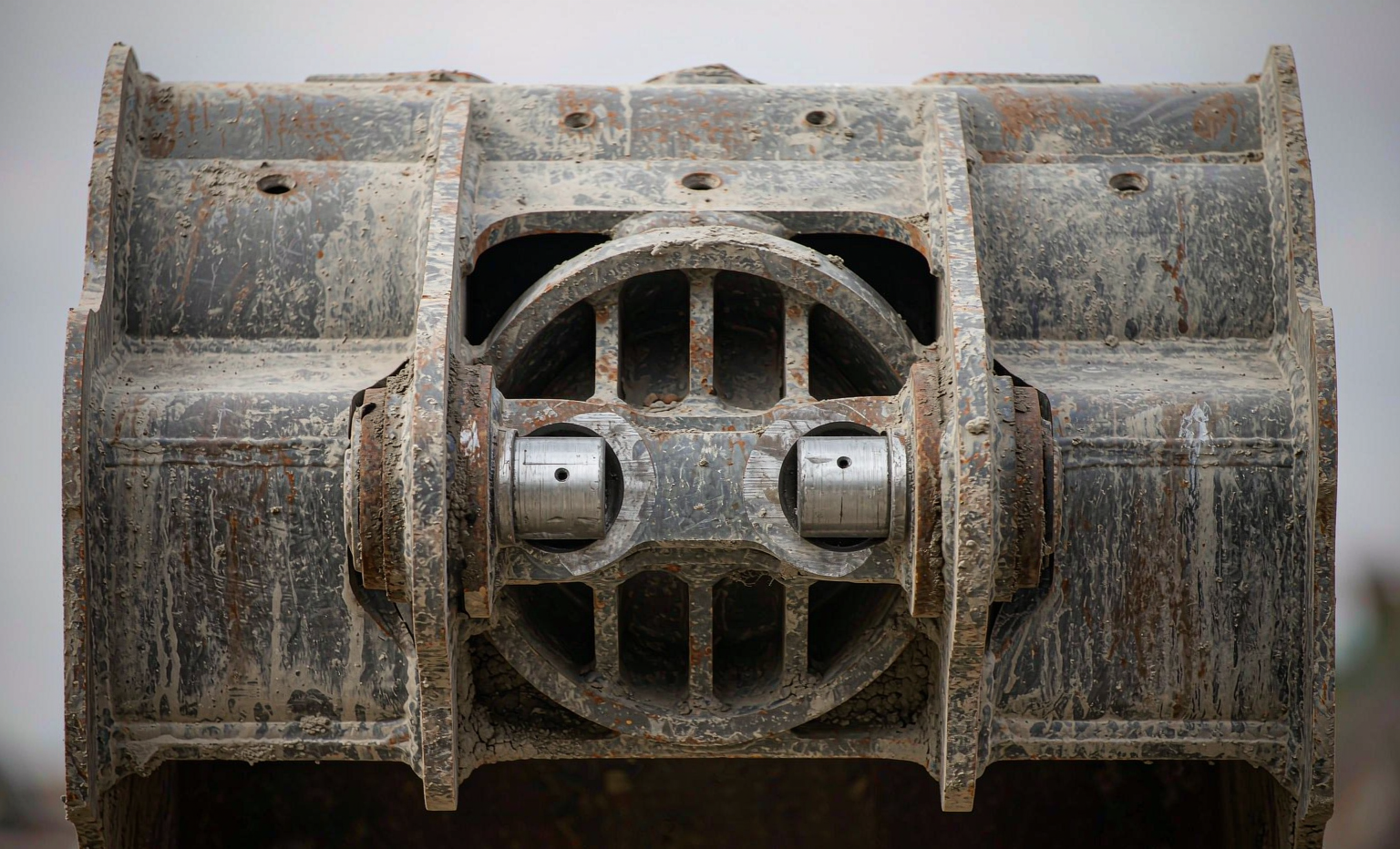
What is an S-type coupler, and which buckets fit it?
S-type is the most common general-purpose system outside Europe. It is a symmetric, pin-grabbing design, and the size designations — S40, S45, S50, S60, S70 and larger — are named after the pin diameter they are built around. An S60 coupler is designed for roughly 60 mm pins, an S45 for roughly 45 mm pins.
Because the naming follows the pin, S-type couplers are easy to specify but easy to mis-buy: an S60 coupler and an S60 bucket from different makers should share a pin diameter, and the pin centres and widths should also agree, but that is a dimensional standard rather than a guarantee. Always confirm pin centres as well.
What is a CW coupler and how does it differ?
CW is the European system, common on machines working in Germany, Austria, Switzerland, the Benelux and Scandinavia, and increasingly seen on imported European machines elsewhere. Its designations — CW05, CW10, CW20, CW30, CW40 — are size classes, not pin diameters. A CW10 uses a different pin size and a different pin-centre geometry to an S-type coupler of similar capacity.
The practical consequence is simple: CW and S-type buckets are not interchangeable. A distributor holding one system's buckets for a fleet running the other will find they do not fit, no matter how close the machine size is.
What is a pin grabber, and where does it fit in?
A pin grabber, or universal coupler, grips the bucket's existing pins instead of requiring coupler-specific ears. That makes it useful for mixed fleets and hired attachments, because the bucket does not have to be modified. Two conditions have to be met: the bucket's pin centres must fall inside the coupler's grip range, and the pins must be in good condition, because a grabber holds the pins themselves rather than a machined bore.
How do you measure a bucket for a coupler?
- Clean the pin bosses and the pins. Packed soil and grease are the most common cause of a measurement being 2–3 mm out.
- Measure both pin diameters. They are often different — a larger rear pin and a smaller front pin is normal on many buckets, and assuming they match is a classic mistake.
- Measure pin centre to pin centre, with the bucket sitting flat and both pins seated. This is the measurement that most often decides fitment.
- Measure the clear inside width between the bucket ears, and the outside width across the ears. The coupler has to sit between the ears with enough room to pick up.
- Record how the pins are retained — bolt through a groove, roll pin, or ring — because the retainer must survive being gripped.
What are the compatibility traps?
- Worn pins. A grabber needs the pin to be close to nominal size. A pin worn down by 1–2 mm gives the coupler nothing to bite, so the bucket sits loose and hammers the coupler jaws. Replace the pins before fitting, not after.
- Same size class, different geometry. Two 20-tonne couplers from different systems can carry the same pin diameter and different pin centres. Machine class is a starting point, not a specification.
- Build height. A coupler and a tilting or rotating head add height between the arm and the bucket, which costs break-out force at the tip and can put the bucket into the machine's own tracks at full curl. Check the geometry, not just the pins.
- Pin-on buckets. Converting a pin-on bucket to quick attach means welding new ears with the correct pin centres — a fabrication job on a jig, not a field weld. A bucket welded to the wrong centres is scrap for that coupler.
What should you send a supplier?
Send photographs of the bucket from the side and from the rear, both pin diameters, the pin centre distance, the ear width, the machine make and model, and the brand and model of any coupler already in use. With those numbers, a quick coupler can be matched to the bucket, or a pin-on bucket conversion set up with the right bucket ears. If you would rather keep the original bucket untouched, an excavator pin grabber coupler avoids the welding altogether — provided the existing bucket pins are still to size.