
A bucket pin is identified by more than its diameter. To replace one correctly you need the outside diameter, the overall length, the working length between the shoulders, the shoulder dimensions and the position of the retaining hole or groove. Measure the old pin at three points along its working length with a caliper that reads to 0.01 mm, and use the least-worn section as your best guide to the original size.
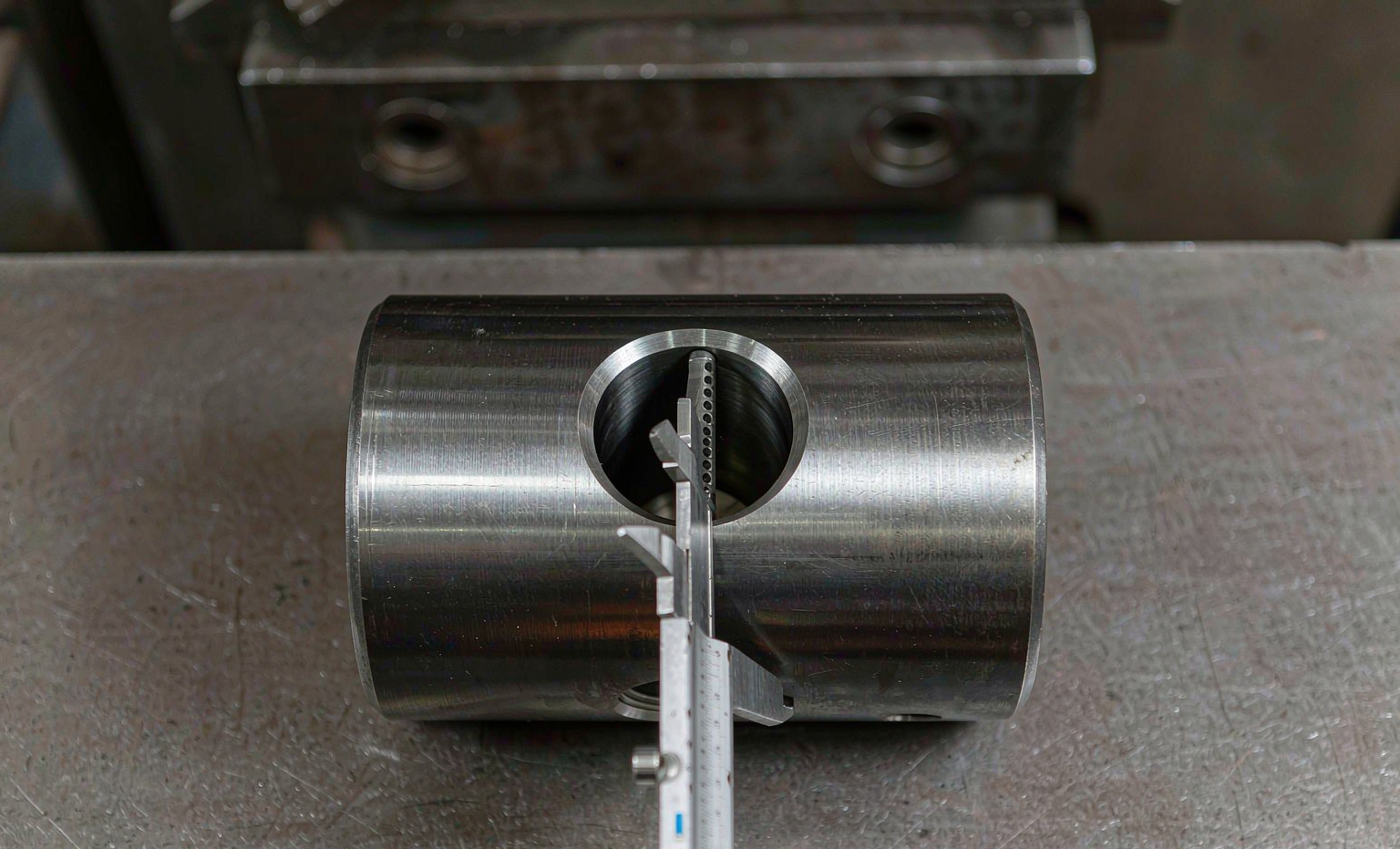
What measurements do I need to replace a bucket pin?
- Outside diameter at the working surface.
- Overall length, end to end.
- Working length — the distance between the shoulders that sit inside the bucket ears.
- Shoulder diameter and shoulder length.
- Head or flange thickness, if the pin has one.
- Retaining-hole diameter, and the distance from the pin end to that hole.
- Grease-hole position, if the pin is drilled.
- Retaining style — bolt hole, keeper plate, snap ring or end cap.
How do I measure a worn pin accurately?
Clean the grease and dirt off the pin first. Grease fills the wear groove and hides it, and it is the wear groove you are trying to find. Then measure the diameter in three places: near each end and in the middle of the working length. A worn pin rarely wears evenly; the middle usually wears fastest because that is where the load is carried. If the surface is grooved, take the reading on the highest, least-worn part, because that is closest to the original machined diameter.
Record taper as well as diameter. A pin that measures 49.85 mm at one end and 49.60 mm at the other is not simply “worn” — it has been running misaligned, and that usually means the bushing, and possibly the boss behind it, are worn too. Note the position on the machine as well: a bucket-to-link pin, a bucket-to-stick pin and a cylinder pin are different parts even when the diameters are similar.
Why aren't diameter and length enough?
Two pins can both measure 100 mm × 750 mm and still not be interchangeable. One may carry a bolt hole while the other uses a keeper plate. The grease passages may be drilled in different positions. The usable length between the shoulders can differ, so a pin that fits the bore still will not clamp the bucket correctly. When a supplier asks only for diameter and length, expect a fitment question later.
What steel and surface treatment should I expect?
Bucket pins are commonly machined from medium-carbon and alloy steels such as 40Cr (roughly equivalent to AISI 5140) and 42CrMo (AISI 4140), then induction-hardened on the working surface to resist galling and indentation. The core stays tougher than the case, which is what lets the pin take impact without snapping. Ask a supplier what grade and treatment they use: a pin that is soft all the way through will deform in service, and one that is hard all the way through becomes brittle.
How do I check the bushing at the same time?
Pins and bushings wear as a pair, so measure both before ordering. Measure the bushing internal diameter, outside diameter, length, oil-hole position and any flange or groove. A new pin fitted into a worn bushing will not last — the extra clearance lets the joint hammer and wear accelerates. If the bushing is oval, the boss behind it is usually on its way too, and that is a far more expensive repair than a bush.
What should I send when ordering a bucket pin?
- Machine brand, exact model and serial number.
- The pin's position on the machine.
- All the measurements above, in millimetres.
- The retaining style, and whether the old retaining hardware is reusable.
- Clear photographs of the pin, its ends and its retaining arrangement.
- Quantity, and the working condition — rock, demolition or general earthmoving.
If the original part number is still readable on any document, or on the part itself, send that too. A part number is more precise than any measurement, because it stays valid even when the old part is worn. You can see the range we produce in the bucket pins category, including 45 mm bucket pins and other standard diameters, with the matching bucket bushings and a set view under excavator pins.