
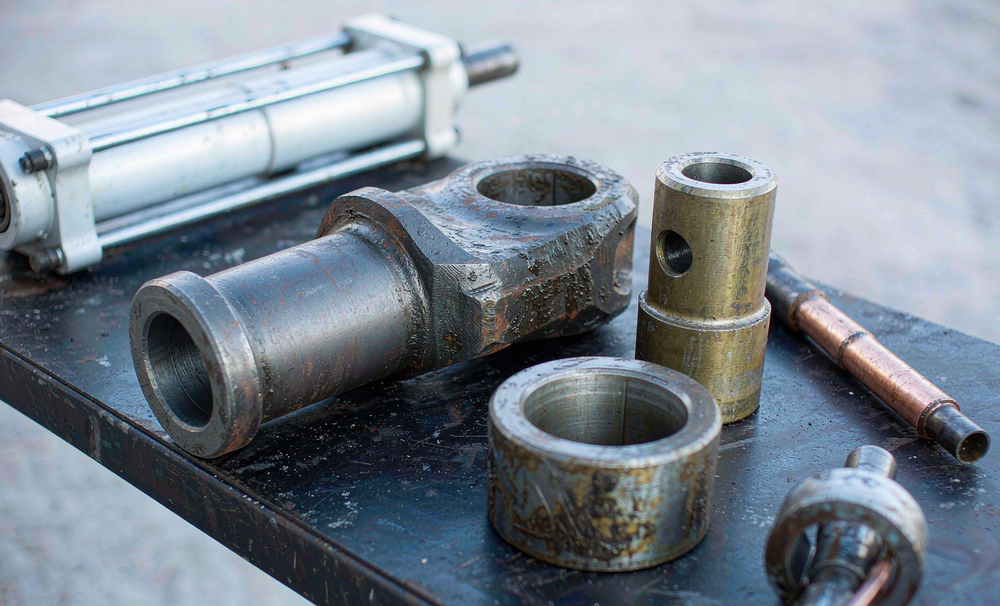
A seized pin comes out by steady push, not by hitting it. Support the assembly, release every piece of retaining hardware, soak the joint, heat the boss rather than the pin, and drive it out with a hydraulic puller or a press through a soft drift — hammering the pin end mushrooms it and turns one evening's work into a line-boring job.
Why do excavator pins seize in the first place?
Almost every seized pin starts as a lubrication failure. When grease stops reaching the working surface, the pin and bushing go into dry friction, the surface picks up, and the joint begins to gall — metal welding itself from one surface to the other in patches. Two other things finish the job: water getting past a perished dust seal rusts the pin into the bore, and pins that never rotate are the worst offenders, because a boom foot pin that has worked one attachment for years takes grease into one spot but never purges it round the full circumference.
What must you check before applying any force?
Retaining hardware, every time. Excavator linkage pins are held in by any of: a bolt threaded into the pin end, a circlip or snap ring, a lock plate bolted over the boss, a set screw, a dowel, or a small taper pin. A bent puller is almost always caused by one circlip nobody looked for. Confirm too that the pin is not a taper pin — those come out one way only, and pushing from the wrong end wedges them tighter.
How do you take the load off the joint?
Park on hard, level ground, set the bucket down and block it, and release residual hydraulic pressure before anyone goes near the linkage. Support whatever will move when the pin lets go, and do not press a pin out with the machine's own hydraulics: it feels like free force and it is how linkage arms get bent.
How do you clean and soak the joint?
Scrape and wire-brush the crud off both ends of the pin and around the boss, then use solvent — grit left in place gets pushed into the bore ahead of the pin. Apply penetrating oil into the seam at both ends and leave it overnight; capillary action needs time, and ten minutes is not soaking. If the pin has a square, hex or cross-drilled end, try to rotate it: even a degree of rotation breaks the rust film.
Where do you apply heat, and where must you not?
Heat the boss and the ear plate, not the pin. You are expanding the bore so the interference relaxes and the rust breaks down, and that only works if the heat goes into the surrounding steel. Keep it modest — around 150–200 °C on the ear plate is plenty, and a temperature crayon is worth the price of knowing. Use a large nozzle, keep the flame moving, and never aim it at the pin's bearing surface.
Excavator pins are typically made from a medium-carbon or alloy steel, case-hardened or induction-hardened on the outer surface while the core stays tough. Soften that hardened skin with a careless flame and you have a pin that will wear out in weeks, and a worn pin destroys the far more expensive bore it sits in. Keep water off a hot bore for the same reason: a fast quench can crack it.
How do you actually push the pin out?
The best tool is a bucket pin removal tool — a hydraulic pin puller, meaning a hollow ram with a drawbar and nut that applies tens of tonnes evenly and axially. It gives steady force with no shock load, and lets you stop, re-soak and add more heat if the pin stalls. Second best is a screw press or a puller kit with a reaction plate on the boss, not the casting.
If you are driving it out, use a bronze or soft-alloy drift rather than a steel punch, so the drift sacrifices itself instead of mushrooming the pin end. If a hammer is needed, use a heavy flat-faced hammer, square to the pin axis, on the soft drift — and never strike a pin whose protruding end is shorter than its own diameter. If the pin moves and then locks, stop: that is usually a worn step or a burr catching, so re-soak, add heat, and push again.
What if the pin is rusted in solid?
Cut it: cut through the pin between the bosses on both sides of the part you are freeing, then press the stubs out. A reciprocating saw with a carbide blade will get through most pins; a torch works if you shield the bore with wet rags and a heat sink and keep the cut inside the gap. The cut must never touch the bore surface.
What damage does a heavy-handed removal cause?
Four failures, in order of cost. A mushroomed pin end is cheap, because the pin was scrap anyway. A scored bore means a bushing that will not seat properly. An ovalised bore, beyond roughly 0.5 mm out of round, means a new bushing will neither fit nor last and the bore needs line boring. A cracked ear plate or boss from shock loading is a fabrication job.
How do you stop the next pin seizing?
Grease until fresh grease purges past the seal, at the manual's interval and more often in wet, dusty, coastal or high-hour conditions. Replace the dust seals every time you fit a new pin — they are the cheapest part in the joint and the direct cause of most corrosion. Fit excavator bucket pins and bushings as a matched pair, with the bucket bushing pressed in to the correct interference and the pin harder than the sacrificial bushing, and check the arm bushes in the same linkage while the machine is apart. Then work the linkage through its full travel regularly, so grease carries round the whole circumference instead of sitting in one place.