
A worn bucket pin or bushing announces itself as play at the joint, and the fastest way to confirm it is to lift the bucket clear of the ground, rock it with a pry bar, and then measure the radial gap between pin and bushing with a feeler gauge. If that radial clearance is past roughly 1.5 mm, the bushing's hardened layer is largely gone and the pair should be replaced before the pin eye starts to ovalise.
What are the early warning signs?
- Rattling or knocking at the bucket linkage while digging, most obvious on breakout.
- Metal dust mixed into the grease around the seal at the joint.
- Grease escaping quickly from one side of the joint, or refusing to come out of the far side.
- The bucket sitting visibly off-centre, or difficulty holding a grade you used to hold easily.
- Uneven wear on the bucket ears, showing as a bright polished patch on one side.
None of these on their own tells you whether the pin, the bushing or the pin eye is at fault. Measure before you order anything — replacing only one half of a worn pair is the most common and most expensive mistake in this job.
How do you measure clearance without dismantling?
- Park the machine on flat, hard ground. Set the boom and arm roughly parallel to the ground and lower the bucket until it hangs 10–20 cm clear.
- Shut the engine down and release residual hydraulic pressure before anyone puts a hand near the joint.
- Clean the dirt and old grease away from the end of the pin and from the dust seal. You cannot measure through grit.
- Insert a feeler gauge into the gap between pin and bushing on the unloaded side of the joint — the gap opens on the side away from the digging force.
- Repeat at several positions around the joint. Wear is rarely even, and a single reading can be misleading.
For reference, a new or freshly rebuilt joint typically runs 0.2–0.5 mm radial clearance. Around 1.5 mm the bushing's hardened surface layer is close to gone. At 2.0 mm and above, continued operation is hammering the pin eyes and the repair stops being a parts purchase and becomes a welding and line-boring job. Always check the machine's own service manual, because accepted limits differ between models and applications.
How do you measure the parts themselves once they are out?
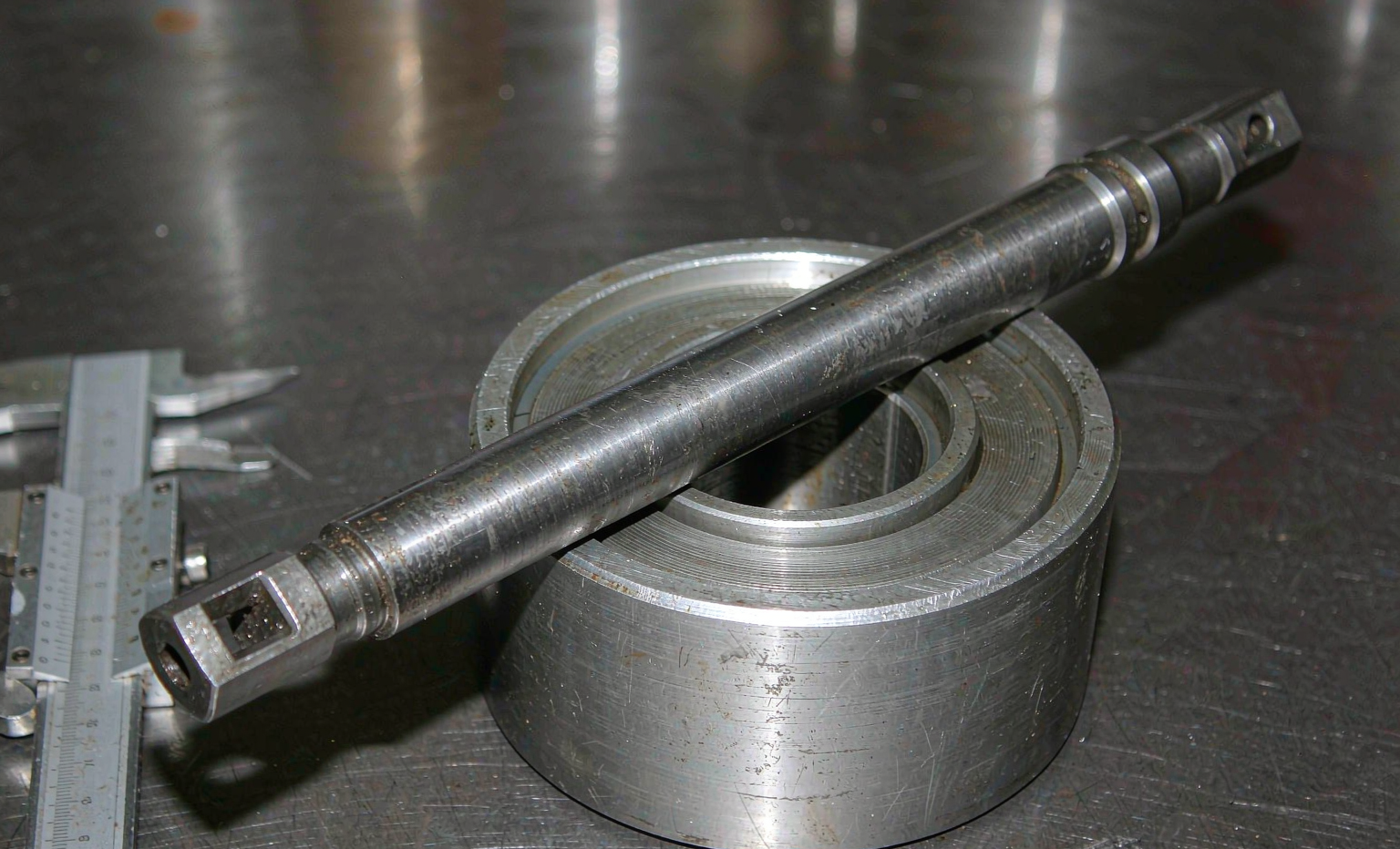
- Pin. Use a caliper to measure the diameter across the worn contact band and compare it with an unworn section near the end. A diameter loss of more than about 0.5 mm is a replacement, not a repair.
- Bushing. Use an inside micrometer to check the bore diameter and roundness. An oval bore that still measures close to nominal on the long axis is still scrap.
- Pin eye (boss). The critical one. If the structural eye has worn oval by more than roughly 0.5 mm, new pins and bushings will rattle in it from day one. That bore needs weld overlay and line boring before new parts go in.
Why is replacing only the pin a false economy?
Because the pin and the bushing wear as a pair. A new pin dropped into a worn bushing has a large clearance from the first stroke, so it moves and hammers, and it will mark the bushing and itself within a short period of running. The same logic applies the other way: a new bushing on a waisted pin loses its clearance just as fast. Order them together, in matched sets.
What makes pins and bushings wear out early?
- Lubrication. The joint needs the specified grease at the specified interval, applied until fresh grease purges past the seal. A blocked grease nipple is a pin failure scheduled in advance.
- Dust seals and rings. A missing or perished seal lets grit into the joint, and grit is the actual cutting tool here.
- Misalignment. Bent pins, distorted bucket ears or a worn linkage push the load onto one edge of the bushing.
- Operating style. Constant twisting and side-loading with the bucket, rather than digging in line with the machine, concentrates load on a narrow band of the bushing.
How do you keep a record that actually helps?
For each joint, log the machine hours at installation, the measured clearance at installation, and the clearance at each service. That single line per joint tells you which positions wear fast on your machines and lets you plan replacement into a scheduled service instead of a breakdown. It also gives you real evidence on whether a supplier's parts are lasting as long as claimed.
What should you specify when ordering replacements?
- Pin: diameter, overall length, retaining type (bolt, split pin, or pin-and-collar), and whether it is a bucket, arm, boom, link or cylinder pin.
- Bushing: outside diameter, inside diameter, length, flange or plain, oil-hole and groove position.
- Machine make, model and serial number, plus a photograph of the old parts next to a rule.
Sizes commonly held in our catalogue start at 25 mm and run upward — see bucket pins, bucket bushings and the combined pins and bushings range. A published dimensional reference also helps when the OEM number has been ground off or painted over: our bucket pin sizes page lists the common references by diameter and application.