
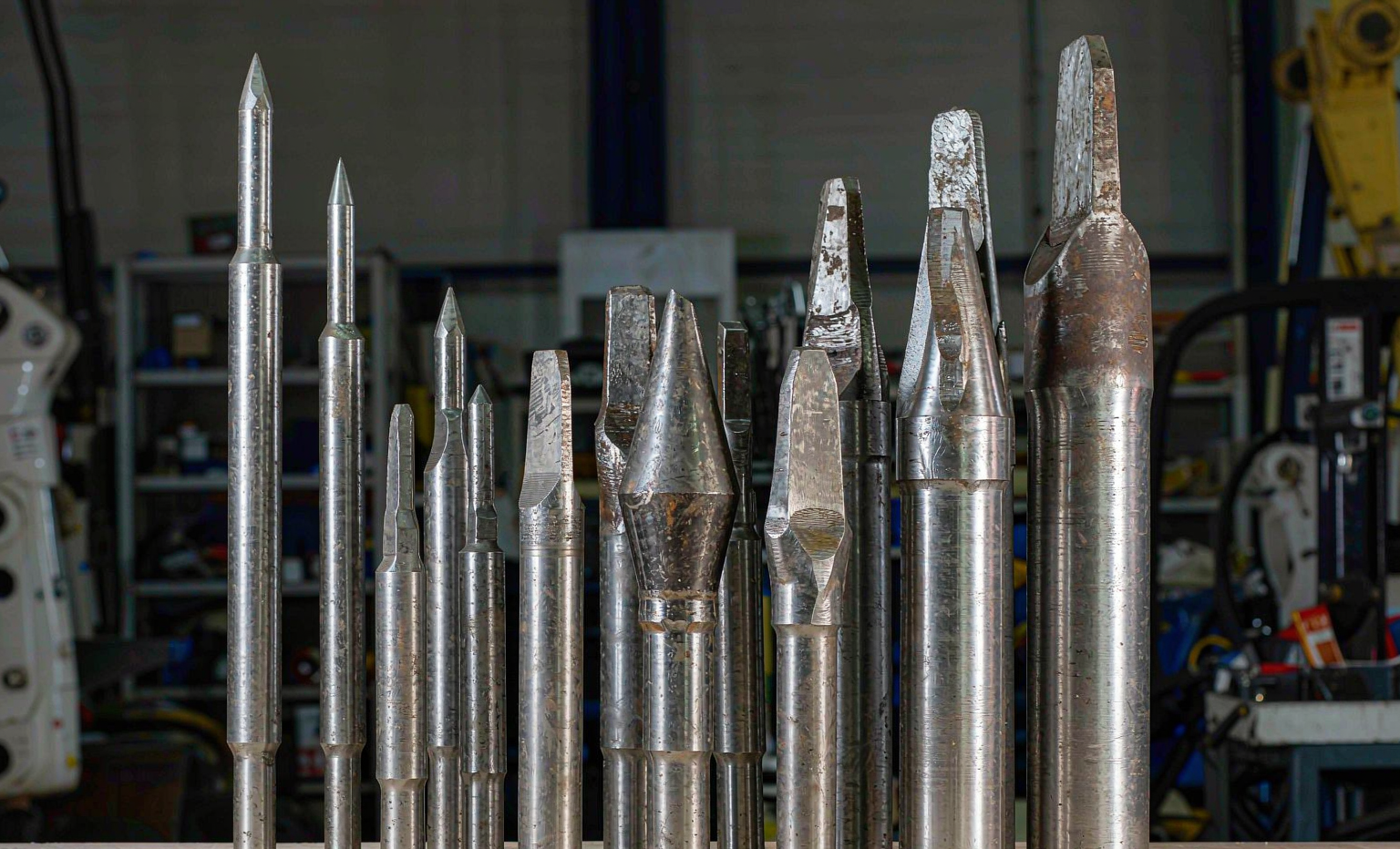
A blunt or mushroomed breaker chisel is the single most common reason a hydraulic breaker stops earning its keep. The tool stops transferring energy into the rock and starts transferring it into the breaker body, which is how a cheap-looking wear item turns into an expensive repair. This guide gives you the measurements and visual checks that tell you when a chisel is finished.
What Actually Wears on a Breaker Chisel
Three zones wear independently, and a chisel can be scrap because of any one of them.
The working tip
The tip takes the direct impact and rounds off over time. A sharp chisel concentrates force into a small area and fractures rock; a rounded one spreads the force and produces dust instead of breakage. Once the tip radius has grown past roughly 3–5 mm on a typical chisel, breaking efficiency drops noticeably. On a moil point the tip should stay reasonably pointed; on a flat or blunt chisel, the working face should remain flat and square to the axis.
The shank and retaining area
The shank sits in the breaker's front head and is held by the retainer pin or collar. Impact cycles hammer the shank boss against the retainer, which peens and deforms the shank shoulders. Once the shoulders are battered enough that the chisel no longer seats squarely, the tool will not stay aligned and it starts wearing the front head itself. That is the expensive failure — bushings and front heads cost many times more than a chisel.
The shank diameter
The shank is a sliding fit and wears steadily. Measure it with a vernier across the unworn diameter, then compare to the nominal. A shank worn by roughly 1 mm is generally at the point where the clearance in the front bushing is too great and further running will damage the bushing. Check the spec sheet for your breaker model — allowable wear varies by size.
The Checks in Order
- Look at the tip. Rounded, chipped or rolled over means poor energy transfer.
- Check for mushrooming. A flared, mushroomed shank end will jam in the bushing and must be dressed or scrapped.
- Measure shank diameter with a vernier at the unworn section and at the worn section. Compare against the wear limit.
- Inspect the shoulders for peening and deformation from the retainer.
- Look for cracks along the shank, especially at the transition from shank to body. A cracked chisel can shatter.
- Check for overheating discolouration — blue or straw colouring means the tool was run too hot for too long, which softens it.
- Fit test. With the breaker laid down, the chisel should slide freely in the bushing with minimal side play.
Wear Limits at a Glance
| Check | Acceptable | Replace |
|---|---|---|
| Tip radius | Under ~3 mm | Over ~5 mm, or chipped |
| Shank diameter loss | Under 0.5 mm | 1 mm or more |
| Shank shoulders | Square, minimal peening | Battered, will not seat square |
| Mushrooming | None | Any visible flare |
| Cracks | None | Any crack — scrap immediately |
| Discolouration | None | Straw or blue tint |
The Consequence of Running a Worn Chisel
Operators often keep running a dull chisel because it still "works" — the machine still pounds. The real cost is elsewhere. A dull chisel bounces, so the impact energy goes into the front head, the bushings and the retaining pin instead of the rock. That is why breakers with neglected chisels arrive with worn front heads and cracked retaining pins, and why the repair bill is ten to twenty times the price of a tool. If you want to keep wear parts like pins and bushings in good shape, our guide on bucket bushings covers the same logic for the digging end of the machine.
How to Make a Chisel Last Longer
Keep the chisel greased at the shank as the manual requires — most breaker failures from wear start with a dry or contaminated shank. Do not use the tool as a lever or a pry bar; side loads are what crack shanks. Match the chisel type to the material: a moil point is for hard, brittle rock, a flat chisel for softer or layered material. And check the front bushing when you change a chisel, because a worn bushing accelerates shank wear from that point on.
For breaker tooling matched to your machine and application, JALE Excavator Parts supplies chisels, bushings and retaining hardware for common breaker models, and our news pages cover wear-part maintenance in more detail.