
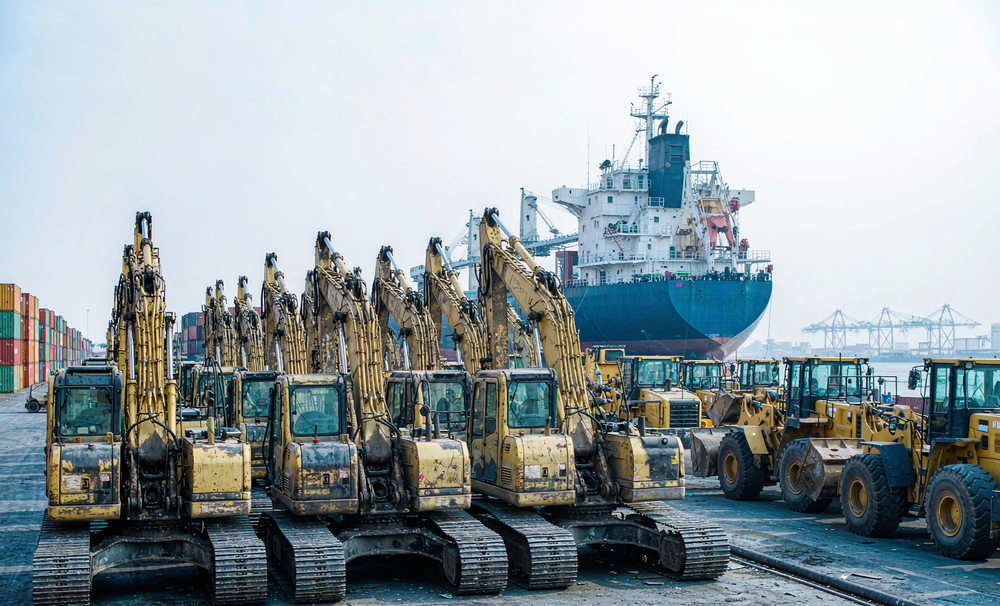
Changsha Customs reported on 21 October 2026 that Hunan province exported CNY 32.39 billion of construction machinery in January–September, up 26.5% year on year, with Saudi Arabia, Indonesia and Russia as the three largest single markets. The total is less interesting to a parts supplier than the split beneath it: exports to Africa rose 66.5% and to Latin America 48.1%, which is where new fleets with thin local parts depth are being placed.
What did the customs data actually show?
The headline numbers, as published:
- Total construction machinery exports: CNY 32.39 billion, +26.5%.
- Exports to Belt and Road countries: CNY 26.16 billion, +27.5%, or 80.8% of the total.
- Top three single markets: Saudi Arabia CNY 2.20 billion, Indonesia CNY 2.17 billion, Russia CNY 2.16 billion.
- ASEAN CNY 5.91 billion, +33.3%; Africa CNY 5.12 billion, +66.5%; Latin America CNY 4.56 billion, +48.1%.
- European Union +38.1%; North America +66%.
- Bulldozers, excavators and road rollers combined: CNY 9.14 billion, +53%.
- Special-purpose motor vehicles: CNY 9.83 billion, +14.6%.
Changsha accounted for CNY 29.36 billion of the provincial total, over 90%, with Loudi at CNY 1.54 billion and Changde at CNY 870 million.
Why do Saudi Arabia, Indonesia and Russia lead?
All three are large, price-sensitive markets with active construction programmes and a preference for machinery that can be serviced without waiting weeks for a European dealer. Saudi Arabia's Vision 2030 pipeline — NEOM, Jeddah Central, Riyadh high-rise and housing — is a multi-year equipment demand story rather than a single order. Indonesia's mining and plantation infrastructure work runs continuous hours on abrasive ground. Russia has absorbed a large volume of Chinese machinery since 2022 and now has a fleet base that needs consumables.
Customs also noted a shipment of 18 construction hoists from Zoomlion to Saudi Arabia, specified for wind-blown sand, salt spray and high temperature. That specification detail is the useful signal: equipment going into these markets is being adapted to the ground conditions, and the wear parts should follow the same logic.
What does fast growth in Africa and Latin America mean for parts?
This is the part that matters commercially. A machine sold into a market with an established dealer network comes with a parts channel attached. A machine sold into a market growing at 66% a year often does not. The first consumable cycle — bucket teeth, pins, bushings, track shoes — arrives 1,000 to 3,000 hours after delivery, and it arrives whether or not anyone built a warehouse.
That gap is the opening for an exporter who can ship a mixed pallet rather than a container of one part number. It also explains why enquiries from West Africa and Brazil increasingly ask for consolidated orders covering several machines and several wear items at once, rather than single-line quotations.
Where does this leave a Shandong parts exporter?
Hunan's numbers are complete machines and they are one province's numbers. They are a proxy for direction, not a description of our order book, and it is worth being plain about that. Shandong's export profile is weighted differently — more components, fewer finished machines.
What transfers is the geography. If new machines are landing in Riyadh, Jakarta, Lagos and São Paulo, then excavator parts demand follows within a season or two, and it follows the machine mix. A market taking large tracked excavators needs track chains and track shoes. A market taking mid-size machines for trenching and utility work needs bucket teeth, pins and bushings in volume.
The practical response is not to chase the headline. It is to keep stock depth in the fast-moving consumables for the machine classes that dominate those markets, and to be honest with buyers about lead times when a mixed order spans several product families.
What should a buyer watch in Q4 2026?
Two things. First, freight: rates on Asia–Africa and Asia–South America lanes have been volatile, and a 26.5% export growth rate on this volume puts pressure on container availability out of Chinese ports in the fourth quarter. Second, raw material: plate and bar prices feed directly into pin, bushing and wear-part quotations, and a quote held for 90 days in a rising market is a quote the supplier will regret.
For buyers planning 2027 stock, the sensible move is to place the wear-parts order early and confirm the specification in writing — dimensions, material grade, hardness range — rather than to wait for a price that is unlikely to fall. Machines are moving; the parts demand is already booked, whether or not it has been ordered yet.