
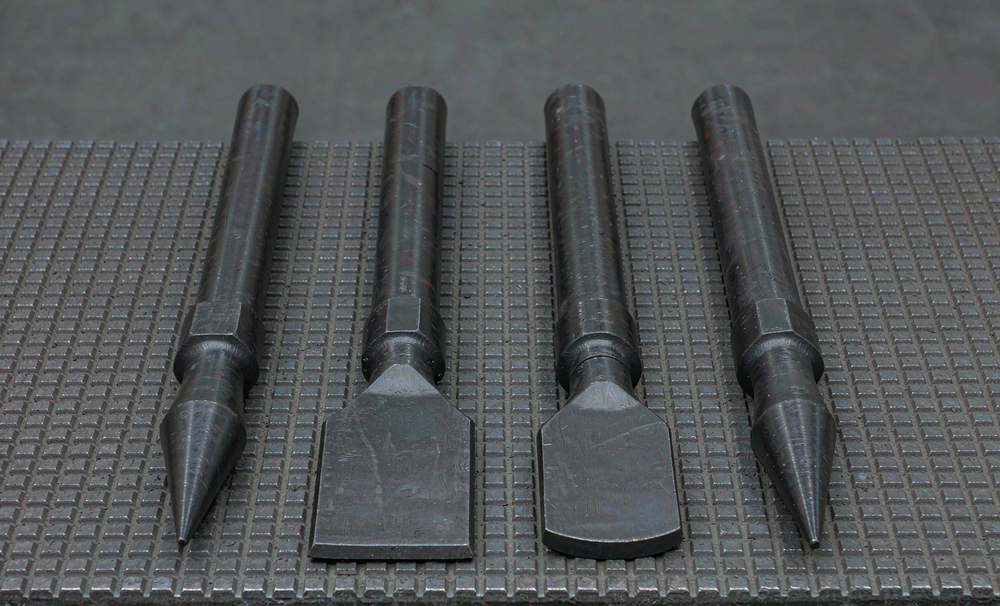
Pick the breaker tool by how the energy needs to enter the material: a moil point concentrates impact into a tiny contact area for hard, brittle rock; a flat chisel spreads it along a line for trenching and layered ground; a blunt tool spreads it over a face for secondary breaking and crushing. Energy delivered in the wrong shape is energy wasted, and it loads the tool shank and lower bushing at angles they were never designed for.
Which tool for which ground?
- Moil point (conical). Hard, brittle, unfractured rock — granite, basalt, limestone — plus frozen ground and lightly reinforced concrete. The tapered tip generates very high stress at a small point and starts a tensile fracture that propagates outward. In soft or plastic material the point simply punches in without fracturing anything around it, so the energy is absorbed instead of transmitted.
- Flat or wide chisel. Trenching, splitting layered rock such as shale and slate, cutting along a joint or crack, removing concrete floors and pavements. The blade concentrates stress along a line, which is what you want when the material already has a plane of weakness. Orient the blade perpendicular to the split you want, or you will waste the blow and deflect the tool.
- Blunt tool. Secondary breaking of oversized boulders, slabbing out concrete, hard rock where penetration is impractical. The flat face compresses and shatters rather than piercing. Because it stays on the surface instead of digging in, it also reduces the risk of blank firing — the unloaded recoil that hammers the retaining pin and the machine.
- Cone or pyramid point. A compromise between the moil and the blunt: medium-hard rock, moderately reinforced concrete, quarry work where you want controlled fragmentation without the deflection risk of a sharp point.
Why does the wrong tool damage the breaker?
Two failure modes dominate. The first is lateral loading. A moil point that deflects off rebar, or that gets used as a pry bar to shift a stuck boulder, applies a bending load the chisel and lower bushing were never designed to carry. That is the classic route to a snapped shank or a scored bushing bore. The second is blank firing: striking with the tool unsupported, which sends the piston's energy straight back through the tool and into the retainer.
The working rules are straightforward. Keep the impact travelling along the axis of the tool. Support the tool against the material before you trigger the breaker. If the material is not breaking, reposition rather than hammering the same point, because staying put just builds heat and tool wear without removing rock.
When is a breaker chisel worn out?
Wear limits vary by breaker size and by what the tool is asked to do, so the manufacturer's chart governs. As field guidance:
- Moil point. The tip rounds off with use. Once the tip has worn to a blunt radius, the tool behaves like a badly shaped blunt tool — you lose penetration and the energy transfer gets worse, not better.
- Blunt tool. The face wears unevenly into a concave or irregular profile. Significant unevenness across the face, or heavily rounded edges, is the signal.
- Any tool. Mushrooming or deformation at the upper striking end, cracking at the shank, or a retaining groove that no longer holds the tool securely. A tool that will not sit positively in the breaker is a safety problem before it is a productivity one.
Wear is not limited to the tool. Seals, pistons, retainers, wear bushings and through bolts are all consumables, and they set the real running cost of the attachment. Keep a log of tool tip condition, shank length and the date of each seal change, and you will know within a couple of cycles how long a tool actually lasts on your ground rather than guessing.
What do you check before ordering a replacement?
Two tools can look almost identical and still not interchange. Confirm the breaker manufacturer and exact model, the tool diameter, the total length, the shank profile — hex, round with groove, or round with drive pin holes — the upper striking end shape, and the retention method, whether that is through bolts, a retainer bar or a locking ring. Then confirm the tolerances the socket will accept.
Send the model and the old part's measurements and the supplier can match it without a guessing game. Our breaker parts range covers tools and consumables, and two common references are listed with their machine application: the through bolt for the F-2235 / HB-15G hammer and the breaker tool drill rod. If you are running a coupler machine, also check the H-link condition, because attachment slack often gets blamed on the breaker when the linkage is the real source.