
A pin-on tooth slides over an adapter welded to the bucket lip and is locked by a retainer, so it comes off in minutes with a drift and a hammer. A weld-on tooth is welded directly to the lip and has to be cut off, and a bolt-on tooth or adapter is fastened through the lip with plow bolts. Which one you should specify depends on lip thickness, machine class, and whether the tooth will ever be changed away from a workshop.
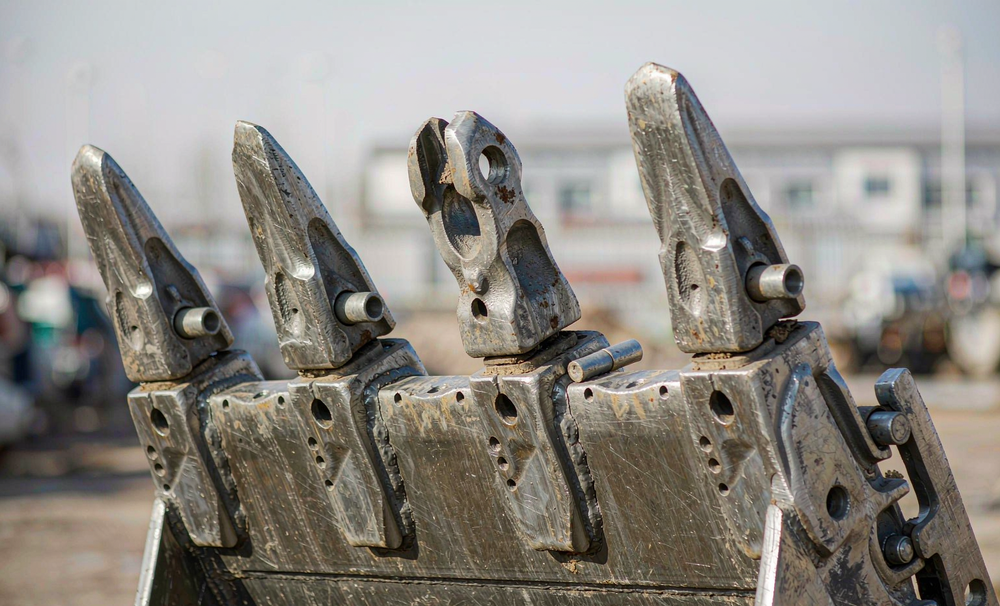
What is the actual difference between the three systems?
- Pin-on. A cast or forged adapter, often called a nose, is welded to the lip. The tooth fits over it and is held by a retainer: a flex pin with a rubber core, a roll pin, or a cross-pin driven horizontally through the tooth and nose. Common from about 8 tonnes upward.
- Weld-on. No adapter. The tooth itself, or a weld-on nose, is welded straight onto the lip. Standard on mini excavators, backhoe and loader buckets, and on lips too thin to carry an adapter.
- Bolt-on. The adapter or the cutting edge is bolted through the lip. Used where the lip cannot or should not be welded, and on buckets where the whole edge is a replaceable bolt-on assembly.
When should you specify pin-on teeth?
For any production excavator, pin-on is the default, and the reason is labour rather than price. Teeth wear out several times over the life of an adapter, and every change on a weld-on system means cutting, grinding, preheating and re-welding on the machine. Pin-on moves that work into a factory weld once, then reduces every later change to a retainer and a drift.
The retainer choice matters more than most buyers expect. A flex pin tolerates shock and stays seated; a plain roll pin can walk out under vibration; a bolt and nut is the fastest to fit and the most likely to loosen. Using the wrong retainer for the application is one of the most common reasons a tooth ends up in the muck pile with half a nose still attached to it.
When is weld-on the better choice?
Weld-on wins where there is no room for an adapter. On a mini excavator or backhoe loader the lip may be too thin to weld a nose to without distorting the edge, and tooth loads are low enough for a direct weld. It also wins on custom shapes, corners and wear pads that no standard adapter covers, and it is the cheapest option per tooth at the counter.
It is expensive per change, though, and it carries a risk buyers underestimate. Welding onto a hardened or heat-treated lip without the right preheat and a low-hydrogen procedure can crack the lip, and a cracked lip is a bucket rebuild rather than a tooth change. If your workshop cannot control preheat and cooling, weld-on teeth on a large bucket are a false economy.
Where do bolt-on teeth and edges make sense?
Bolt-on systems belong on loader buckets, skid steers and any lip that cannot be welded, and they are genuinely useful on remote sites where there is no welding plant within reach. They also let a contractor replace a whole cutting edge rather than rebuild a worn one. The trade-off is hardware: bolt heads and plow bolts are themselves wear parts, they shear, and a bolt that has worked loose will wallow its hole until the edge no longer sits flat. Bolt torque belongs on the service checklist, not in the drawer marked later.
How do you tell which system a bucket already uses?
Look at the joint rather than the tooth. If there is a separate cast adapter welded to the lip and the tooth slides over it, the system is pin-on. If the tooth is welded with a visible bead around its base, it is weld-on. If you can see bolt heads on the inside face of the bucket and nuts or washers on the outside, it is bolt-on.
Then read the numbers: tooth and adapter carry separate part numbers, and neither implies the other. Tooth series such as J200, J250, J300, J350, J400 and J450 map broadly to machine class and lip thickness, and a J300 tooth will not fit a J250 adapter no matter how close the two look on a bench. Measure the adapter nose width and the pin hole diameter before ordering, and quote the adapter number along with the tooth number.
Which system costs less over the life of the bucket?
Compare labour, not sticker price. Pin-on carries the highest up-front cost because you buy the adapter as well as the tooth, and the lowest cost per change afterwards. Weld-on is cheapest to buy and most expensive to change, with the added risk to the lip. Bolt-on sits in the middle, with bolt hardware as a recurring line item and a wear point in its own right. For a machine that changes teeth three or four times a year, the pin-on premium is recovered on the first two changes.
What do buyers get wrong most often?
- Ordering by machine model only, with no adapter number, then finding the tooth will not seat.
- Mixing retainer types on one bucket, which changes how the teeth load against each other.
- Running a tooth until the adapter nose wears. Once the nose shows a step, or the pin hole has gone oval, a new tooth will fit loose and break early. Condemn the adapter at that point.
- Ignoring corner teeth, which take far more abrasion than the centre teeth on the same lip and are usually the first to go.
Our bucket teeth range covers pin-on, weld-on and cross-pin configurations, including series-specific fitments such as CAT J200 teeth and heavy-duty points like the 1U3352PT tooth. Retainers and pins are listed separately under bucket teeth pins, which is worth checking before you assume a bucket arrives complete.