
China’s Pinglu Canal opened to navigation in September 2026, giving southwest China a direct sea route to the Beibu Gulf through Qinzhou and cutting inland transport costs for exporters in Liuzhou by roughly 15–18% and transit time by 7–10 days, according to Xinhua. For an overseas buyer of excavator parts, the change lands on the inland leg of a shipment, not on the ocean freight rate.
What actually opened?
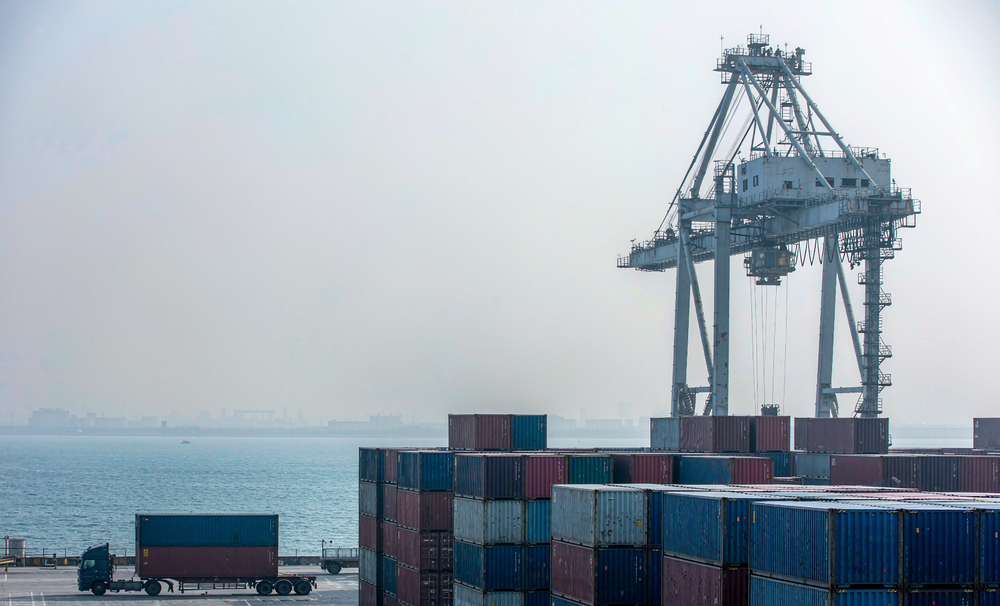
The canal runs 134.2 km from Nanning, the capital of Guangxi, to the Beibu Gulf, reaching the sea at Qinzhou Port. It gives a large part of southwest China its shortest maritime outlet; until now much of that cargo went overland to ports in Guangdong.
Xinhua reported in mid-October that LiuGong, which builds excavators in Liuzhou, plans to route more exports through Qinzhou. The company’s own estimate, quoted in that report, is a 15–18% reduction in inland transport cost and 7–10 days off transit time compared with the Guangdong route. The same report put Liuzhou’s railway port at 17,000 TEU for January to September 2026, 22 times its total for the whole of 2025, and said a one-stop customs process has cut about 48 hours per shipment.
Why the inland leg matters more for parts than for machines
A 40ft container of bucket pins, bushings and teeth reaches its weight limit long before it fills its volume. Inland trucking and rail are charged per container and per kilometre, so that leg is a fixed cost that does not shrink when the cargo is dense and valuable.
Parts orders also tend to be smaller and more frequent than machine orders. A dealer restocking two tonnes of bushings pays for the same container move as one shipping a full load of machines. A percentage cut in inland cost therefore reaches a parts buyer’s landed cost more directly than it reaches a machine buyer’s.
What the canal does not change
It is not a discount on ocean freight. Container rates are set by capacity and demand on the trade lane, and a new inland waterway does not lower the price of a slot from China to Jebel Ali, Lagos or Santos.
It is also geographically specific. A supplier based in Shandong ships through Qingdao, roughly 2,000 km north of the canal, and that route is unaffected. Buyers should treat any logistics advantage claimed from a project in another province with caution. What a buyer can reasonably ask for is the port of loading, in writing, on the proforma invoice — “China port” is not a routing.
What should a buyer ask about routing?
- The named port of loading, on the quotation.
- Whether the price is FOB or CIF, and which leg each covers.
- Port-to-port transit days against door-to-door transit days; the difference is usually the inland leg plus clearance.
- Whether the supplier consolidates LCL cargo or ships full containers, because consolidation adds a week or more.
These four answers explain more of a quoted lead time than the size of the factory does.
Why this is part of a wider shift
Chinese excavator exports reached 109,744 units in January to September 2026, up 30.4% year on year and, for the first time, more than domestic sales, according to China Construction Machinery Association figures. More machines leaving the country means more parts flowing through the same ports, and more competition between gateways for that cargo.
The destination mix is moving as well. Customs data for January to August 2026 put excavator exports to Africa at US