
For most of 2026 the construction equipment headlines have belonged to electrification. Meanwhile a quieter argument has been running through courtrooms and service bays over a question that affects your workshop far more directly than any battery pack: who is allowed to repair the machine, and with whose parts.
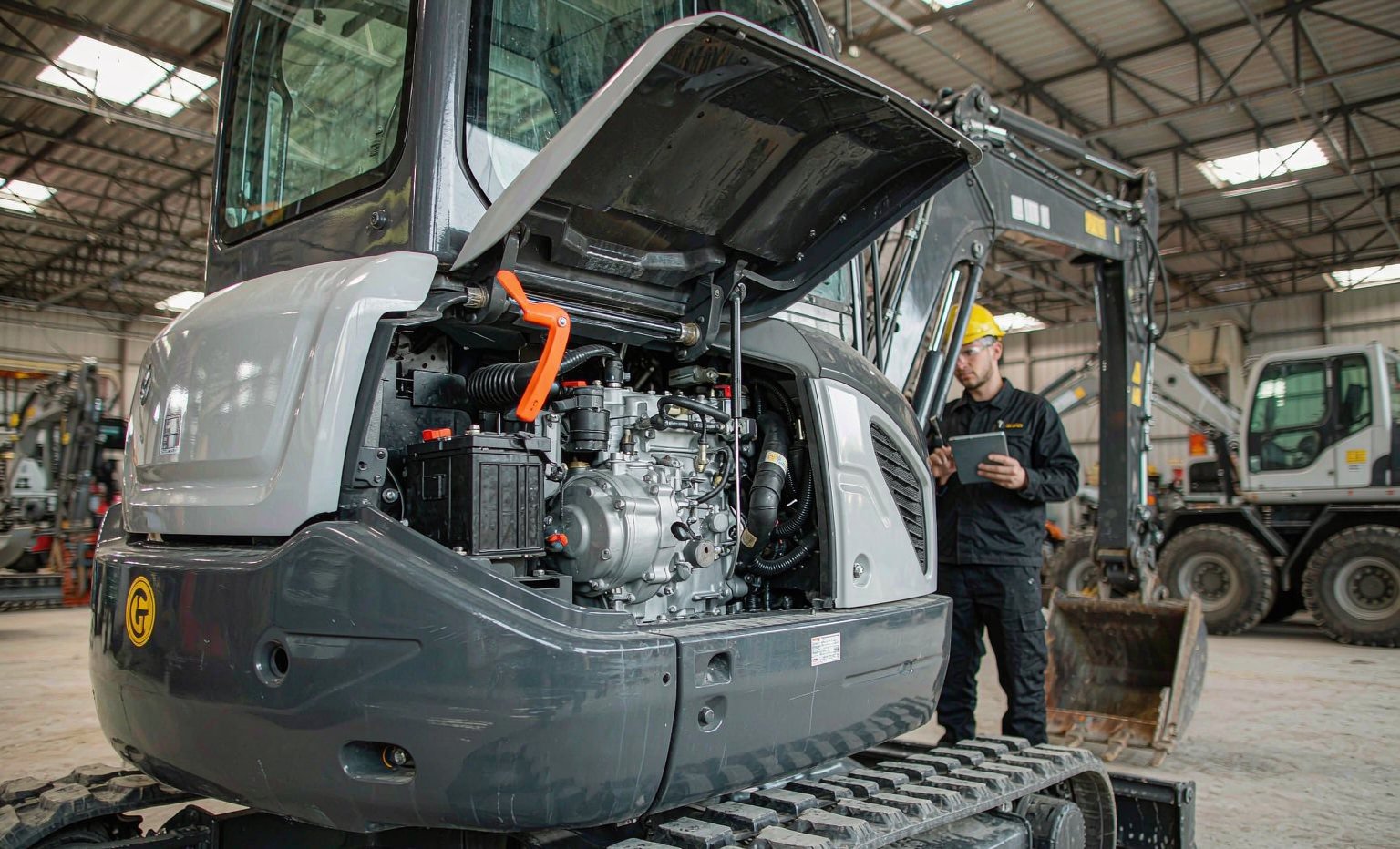
The 2026 case, in plain terms
In 2026 John Deere was once again in the defendant's seat. Following the agricultural equipment lawsuits that made right to repair a mainstream topic, a new case targeting restrictions on construction and forestry equipment repair was filed in the United States. The dispute is narrow and practical: does an owner have the right to repair a machine themselves, or to hand it to an independent workshop, rather than being routed through the authorised dealer network?
It is not an isolated case. The movement has been spreading from farm machinery into construction equipment, and the complaints are consistent whoever the manufacturer is: equipment owners report that the repair chain is effectively monopolised through software locks, restricted parts supply and limited access to diagnostic tools.
Software, not steel, is the real lock
Sending parts to a machine is rarely the difficult half of a repair. The difficult half is the control system. When an excavator throws a fault code, reading and clearing that code can require the brand's own proprietary diagnostic computer. Without access to it, a perfectly competent independent mechanic, holding perfectly good parts, still cannot finish the job.
The practical effect is that repair cost and downtime both rise in ways that have nothing to do with the price of the components. That is the mechanism the lawsuits are aimed at.
Why it matters even if you never enter a courtroom
If you run excavators in North America or Europe, your customers are already used to self-repair or to using local independent workshops. Machines designed to exclude third-party repair do not stop that behaviour; they simply make it frustrating and, in some markets, legally exposed.
Several manufacturers have read the direction of travel. Sany used ConExpo 2026 to launch new parts and service initiatives, which is a reasonable response to exactly this pressure: if owners are going to repair their own machines, it is better to be the supplier of the parts than the obstacle to the repair.
The parts consequence: credible alternatives matter more
The most direct result of all this for a parts buyer is that the credibility of a non-OEM component is now the deciding question. A repair that is legally and technically permissible is worthless if the part you fitted fails in 200 hours.
That pushes the same three requirements onto every supplier, whether they are an OEM or an aftermarket manufacturer:
- Dimensional accuracy — a pivot pin or bushing outside tolerance does not fail immediately, it destroys the bore around it.
- Traceable material — for wear parts, the steel specification and the heat treatment matter more than the paint.
- Part-number discipline — the correct number for your machine and generation, not a number that merely looks similar.
For the parts that carry the repair decision most often — pivot pins, bushings and bucket teeth — these three checks separate a supplier you can build a maintenance plan around from one you cannot.
What to do before your next parts order
- Establish a second source before you need it. Vetting a supplier during a breakdown always produces a worse decision.
- Ask what the diagnostic situation is on the machine you run. If fault codes need a dealer tool, plan around that rather than discovering it at the roadside.
- Record the exact part number and machine model for every wear part you replace, and keep a photo of the failed part. This single habit removes most wrong-part orders.
- Track cost per hour, not unit price. A cheaper bushing that lasts 60 percent as long is more expensive.
Frequently asked questions
Does right to repair mean aftermarket parts are now equivalent to OEM parts?
No. Right-to-repair law governs who may perform a repair and whether they have access to tools and information. Component quality is a separate question decided by the manufacturer's specification and quality control, not by the legislation.
Are third-party excavator parts legal to fit?
In most markets, fitting a non-OEM component to your own machine is legal. What varies is warranty treatment and, in some cases, access to software. Check your warranty terms and the rules in your specific market.
Which excavator parts are safest to buy from an aftermarket supplier?
Wear and structural parts with a published specification and a measurable dimension — pins, bushings, bucket teeth, cutting edges, track components, rollers and sprockets. These can be verified with a calliper, which makes quality auditable in a way that electronics generally are not.
What is the biggest risk when switching to a third-party supplier?
Dimensional non-conformance that is invisible on arrival. Measure the first delivery against the worn original rather than waiting for it to prove itself in service.
The short version
The right-to-repair argument is really an argument about whether owners can keep older machines working economically. That question is answered in your workshop, one part at a time. Suppliers that can hold a tolerance, name their material and match a part number correctly are the ones that make a legal right into a practical one.
Browse the full range — excavator parts and undercarriage components — or see the categories that wear fastest: bucket teeth, pins and bushings.