
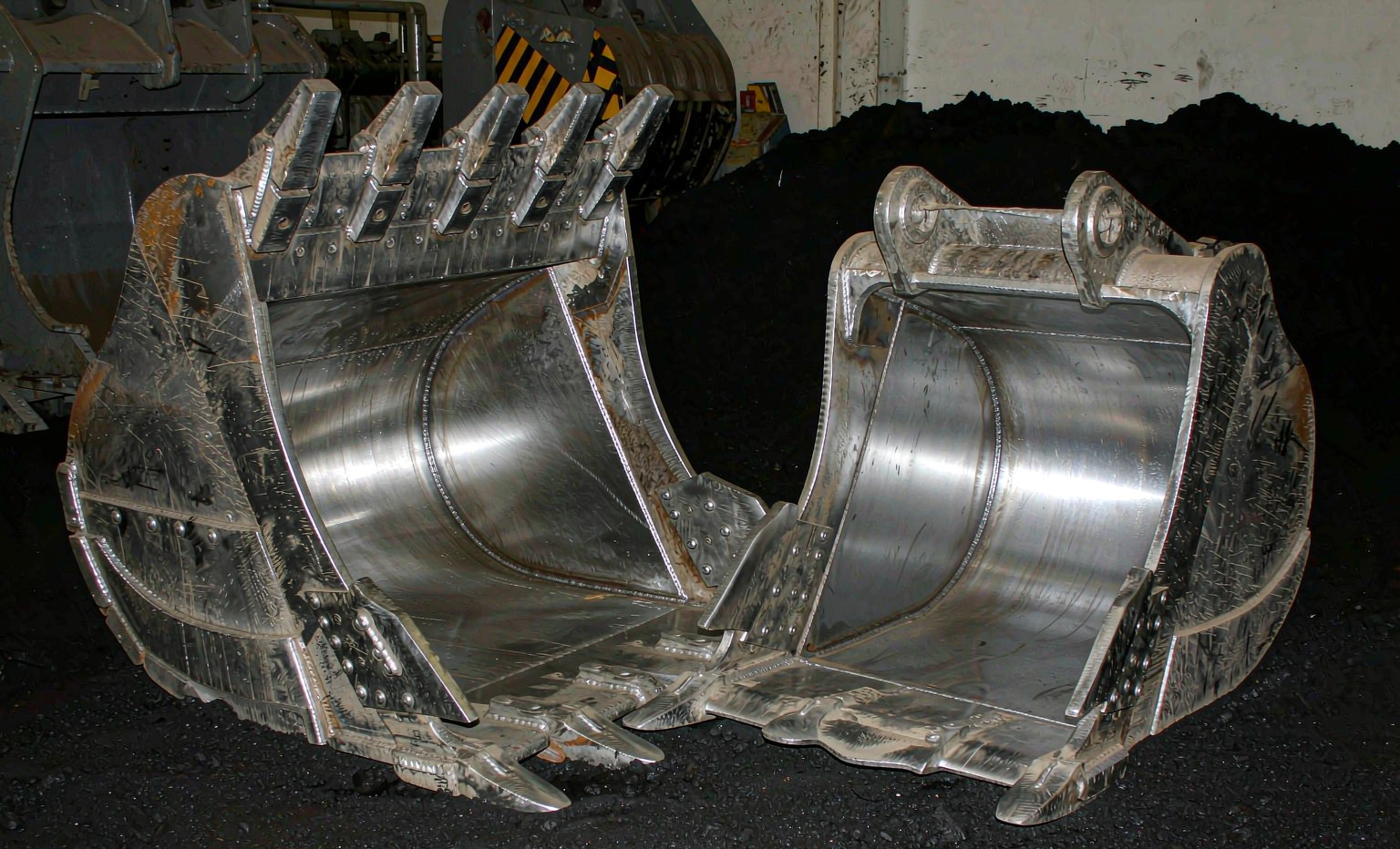
Choosing between a rock bucket and a standard digging bucket comes down to what the machine will actually be doing most of the time. Buy a standard bucket for rock work and it will be cracked within months. Buy a rock bucket for general trenching and you pay for weight and fuel you never needed. This guide sets out how the two are built differently and how to decide.
How the Two Buckets Differ
Plate thickness and material
A standard digging bucket is typically built from mild steel plate in the 8–16 mm range on the shell, with heavier plate at the cutting edge area. A rock bucket uses wear-resistant plate, often 400 or 450 Brinell hardness, and is thicker across the whole shell — commonly 20–40 mm on a mid-size machine. The hardness matters more than the thickness: abrasion resistance is what keeps a rock bucket alive, not bulk alone.
Wear protection
Rock buckets carry additional wear strips on the underside, the side plates and the heel, plus often a bolt-on or weld-on heel shroud. These are sacrificial — they wear instead of the bucket shell. Standard buckets typically have a single wear strip along the base and nothing else.
Geometry
Rock buckets generally have a wider, shallower profile with a more swept-back bottom, which helps material release when dumping and reduces the digging resistance that cracks a shell. Standard buckets are narrower and deeper for volume per pass in softer ground.
Teeth and edge
Rock buckets run heavier, larger teeth with deeper penetration, or a straight cutting edge with protection for very abrasive material. Standard buckets run general-purpose teeth sized to the machine class.
Matching the Bucket to the Job
| Working condition | Best choice | Why |
|---|---|---|
| Soft soil, sand, general trenching | Standard digging bucket | Best volume per pass, lowest weight and fuel |
| Broken rock, shot rock, demolition debris | Rock bucket | Hardened plate resists abrasion and impact |
| Frozen ground, hardpan | Rock bucket or heavy-duty bucket | Needs penetration force and impact resistance |
| Quarry loading of blasted rock | Rock bucket with heel shrouds | Constant abrasion on the underside |
| Mixed ground, varied work | Heavy-duty general-purpose bucket | Compromise avoids swapping constantly |
| Utility work with tight access | Standard bucket, narrow width | Manoeuvrability matters more than wear life |
Questions to Answer Before You Buy
- What percentage of the machine's hours are on abrasive or rocky material?
- What is the machine's operating weight and rated bucket capacity?
- Will the bucket be used for breaking, prying or lifting? (If yes, buy heavier.)
- Is the carrier fitted with a quick coupler, and what is its rated capacity?
- Does the pin-on or coupler mounting match your machine's dimensions exactly?
- What teeth and adapters are available locally, and are they a standard pattern?
- Is the extra bucket weight within the machine's tipping and hydraulic limits?
Getting the Mounting Right
The most common expensive mistake is not the bucket type but the mounting. Pin-on buckets must match the pin diameter, the pin centres and the boss width of your machine's linkage. A bucket ordered to slightly wrong dimensions either will not fit or will wear the pins and bosses rapidly because it does not seat square. If you are measuring a linkage for a replacement bucket, our guide on measuring excavator parts explains the dimensions that matter, and the bucket pin range covers the matching hardware.
The Wear Parts Inside the Bucket Are What Actually Fail
Whichever bucket you buy, the teeth, adapters, side cutters and pins are the components that wear out and get replaced. Buying a hardened rock bucket and then fitting soft, cheap teeth is a false economy — the teeth will round off and the edge will start taking the abrasion instead. Match the tooth material to the same abrasion level as the bucket shell.
JALE Excavator Parts manufactures excavator buckets, bucket pins, bushings and teeth for machines from mini excavators to large crawler units, and supplies wear parts worldwide. See our undercarriage and roller range for the other wear components that follow the same rule: buy for the ground you actually work in.