
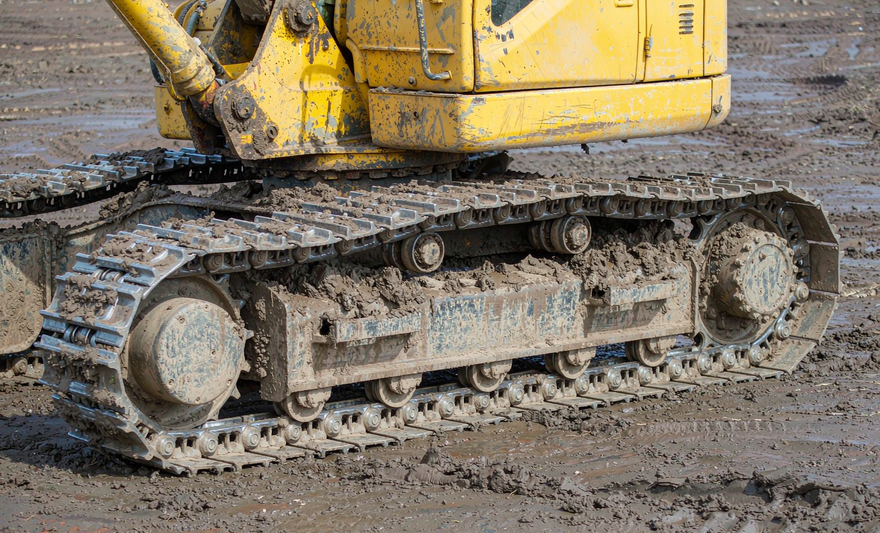
Buy SALT — sealed and lubricated track — for any machine that runs long hours in abrasive or wet ground, because the oil held inside each pin is what stops the chain stretching. Buy a dry chain only when the machine works a few hundred hours a year, the ground is not abrasive, and purchase price matters more than cost per hour.
All three chain constructions wear the same way, and the wear is internal: the pin rotates inside the bushing under load, metal is lost from both, and the distance between pin centres grows. That growth is what you are really buying against.
What is the actual difference between SALT, greased and dry chains?
Dry chain
Assembled with no lubricant between pin and bushing. Cheapest, no seals to damage, and the only type that can be rebuilt later. It is rarely fitted to new mainline excavators, but it is still made aftermarket for older machines and for buyers who put price first.
Greased (sealed) chain
Packed with a heavy grease at assembly and closed with seals. This is the common construction on hydraulic excavators. The grease is a fixed charge: once it is displaced or contaminated, nothing replaces it, and wear accelerates from that point.
SALT chain
The pin carries an internal oil reservoir. A small radial hole lets oil into the annular gap between pin and bushing, a seal at each end of the joint keeps it there, and a self-sealing rubber plug closes the pin end after the assembly has been evacuated and filled under vacuum. The oil is a working supply, not a one-off charge, so the pin and bushing run on a film instead of on each other.
Why does pitch growth matter more than anything else on the quote?
Pitch is the centre-to-centre distance between two pins. As the pin and bushing wear, pitch grows, the chain effectively gets longer, and the bushing no longer meets the sprocket tooth where the tooth was designed to meet it. The tooth tip then loads the wrong part of the bushing, both wear faster, and the undercarriage starts consuming itself.
You can measure it in the yard. Lay a tape along the outside of the chain over five pitches — six pins, five gaps — and compare with the figure for a new chain of the same pitch and link count. Do it on a clean, straight section with the chain under tension, not on a slack run. A tape and a straight edge will tell you more about the remaining life of the track chain than the hour meter will.
What happens when a SALT seal fails?
The chain keeps running and looks normal. The oil leaks out slowly, abrasive dust gets in, and the joint reverts to metal-on-metal wear while the outside of the chain still shows plenty of bushing. That is why SALT chains appear to fail suddenly: the last twenty percent of life passes quickly once the oil is gone.
Two checks find it early. First, look at the pin ends after cleaning: a thin wet oil ring that returns within a few shifts is a leaking seal, while a dry dusty pin end is not. Second, check that the rubber plug is still in the pin — pressure washing at close range blows them out, and a missing plug empties the reservoir. If the plug is gone, the joint is already running dry.
Can a worn chain be re-pinned and re-bushed instead of replaced?
On a dry or greased chain, yes, and it is a legitimate way to get a second life. The pin and bushing are rotated 180 degrees so unworn surfaces come into the working position, which restores most of the original pitch. The job only makes sense together with new or rebuilt sprockets, and only if the links and shoes are still sound.
A SALT chain cannot be treated this way. The pin has an oil hole and a plug at a defined orientation, and the reservoir serves one position; rotate it and the oil feed no longer works. SALT life is therefore one-shot, which belongs in the cost comparison from the start.
When is a dry chain genuinely the better buy?
- Low annual hours, or a machine that spends most of its life stationary with a breaker, shear or grapple.
- Compact and mini excavators, where chain cost is small and replacement is quick.
- Backup or seasonal machines, where the machine may be sold before the chain is worn out.
- Markets where a re-pinning workshop is available locally and labour is cheap.
For a 20-tonne class machine travelling and digging daily in sand, laterite or wet clay, a dry chain is a false economy: it will cost more per hour than the SALT chain it replaced, and it will take the sprockets with it.
What do you need to measure before ordering?
- Pitch: the 190 mm pitch used on most 20-tonne class machines, shorter on compact models.
- Link count of the chain on the machine, including the master link arrangement.
- Bushing outside diameter, which tells the supplier how much wear allowance the sprocket has left.
- Shoe width and bolt count, if shoes are ordered with the chain.
State the construction type as well: SALT, greased or dry. Two chains with the same pitch are not interchangeable if the sprocket has already bedded to one of them. Then look at the sprocket: pointed teeth, or a deep hook on the tooth face, mean the new chain will be destroyed by the old sprocket within a few hundred hours.
How do you get full life out of a new chain?
Match the sprocket, set tension to the manual figure rather than by eye, keep the track rollers turning freely and true, and stop operators spinning a track in slurry to clear it. Do not pressure-wash the seals at close range. Most premature SALT failures are installation and operation faults rather than manufacturing faults, and they are avoidable for the price of a tension gauge.