types of Chinese excavator parts supplier, and which one fits your order
There is no such thing as “a Chinese excavator parts supplier”. There are at least seven distinct kinds of business behind that phrase, they quote differently, they answer technical questions differently, and choosing the wrong kind is the usual reason a first order disappoints. Two quotes for the same pin can differ by 40% and both can be honest — one is a plant, the other is a trader with a markup and a consolidation service.
Why the distinction matters more than the price list
The supplier type tells you who owns the tooling, who can answer a question about hardness or interference fit, and who is accountable when the box arrives with the wrong bore size. It also tells you what the supplier cannot do, which is more useful than what it claims.
1. The OEM-tier component factory
Supplies machine brands or their tier-one assemblers, often under a supply agreement that forbids direct sales of the same part to third parties. Technically the strongest on drawing conformance. Commercially the hardest to buy from, and usually uninterested in a mixed order of twenty lines.
2. The aftermarket manufacturer with its own brand
Makes to its own drawings, holds stock, prints its own boxes. For a distributor this is normally the best fit: it will take a mixed order, it has a catalogue, and it will still discuss material grade. Ask which steel grades it buys and whether heat treatment is in-house or subcontracted — the answer separates a real plant from a relabeller.
3. The trading company or export agent
No plant. It consolidates from several factories into one container and handles documents. Good for a mixed first order and for buyers who do not want five suppliers — one container of excavator parts, bucket teeth and track chains from three factories is a normal trader order. Weak on root-cause questions: when a bushing fails early, a trader has to ask someone else. That is not automatically a reason to walk away — a good trader acts as a quality filter and saves you the factory audit.
4. The category specialist
Undercarriage only, or teeth and adapters only, or seals only. Deepest tooling in its niche, and the one most likely to quote an odd size without a minimum quantity argument. Poor choice for a one-stop order, excellent choice for a product line you sell steadily.
5. The industrial-cluster consolidator
Sits inside a manufacturing cluster and bundles output from many small workshops. Price is the selling point; consistency is the risk, because the fifth batch may come from a different workshop than the first. Ask directly how many workshops feed a single order and whether that is fixed.
6. The authorised distributor of an OEM brand
Genuine parts, correct paperwork, higher price. The right answer for machines under warranty or for a customer who will not accept aftermarket. Note that “OEM” and “genuine” are not the same claim, and a distributor should be able to show its authorisation.
7. The marketplace storefront
A B2B platform shop. Convenient for samples and small quantities, hardest to verify, because the storefront and the factory behind it may have no relationship at all. Useful as a price reference; risky as a primary supplier for a repeating order of, say, bucket pins and bushings.
How do you tell which one you are actually talking to?
Five checks, in this order:
- Read the business licence. The registered scope and address are public. A scope built around sales of machinery parts is a trader; a scope built around manufacture is a plant. Compare the address with the one on the quotation.
- Ask for a live video call that walks from the office to the machining line and the heat-treat furnace. A polished factory tour video proves nothing; a phone call at 3 p.m. their time proves a lot.
- Ask what they cannot make. A plant knows its limits. A trader that claims every category is telling you it makes none of them.
- Ask what went wrong in their last shipment to your region. A factory usually has an answer. A trader usually does not.
- Check that the licence name, the invoice entity and the bank beneficiary match. Three different names is a question worth asking before the deposit, not after.
Which type fits which order?
- A single machine repair: category specialist or marketplace. Pay the freight and do not expect a container price.
- A mixed container for stock: brand manufacturer plus a consolidator, with the specialist supplying the deep lines.
- Fleet under warranty: authorised distributor, and keep the paperwork.
- Custom pin or bush to drawing: a factory with in-house machining and heat treatment, not a trader with a catalogue.
- A breakdown on site: whoever holds stock in your region. The cheapest quote is irrelevant if it lands in six weeks.
The two combinations that go wrong most often
A trader quoting a custom size. The drawing is re-drawn by a workshop that never saw your machine, and the first article arrives with the right diameter and the wrong shoulder. Insist that the drawing you approve is the drawing that goes to the machine.
A factory quoting a mixed container. It cannot consolidate, so it either refuses half the lines or subcontracts them silently — and you find out at the packing list stage.
What to have in hand before you send a deposit
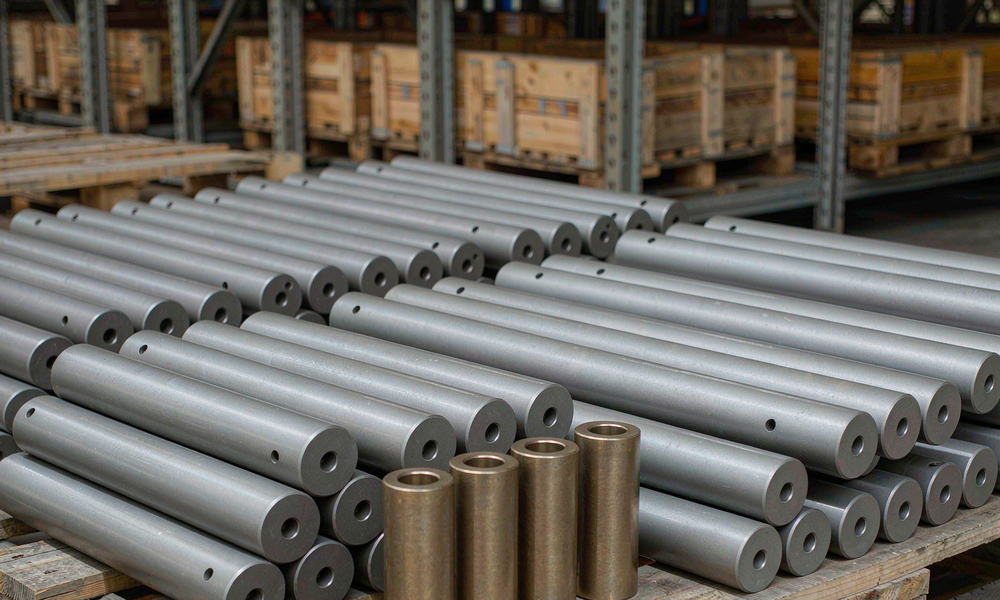
A drawing with tolerances, the material grade and hardness, the heat-treatment specification, an inspection report for the batch, a packing list, the HS code, the lead time in working days, and the payment terms in writing. If a supplier cannot produce the first three, the price is not the number you should be comparing.
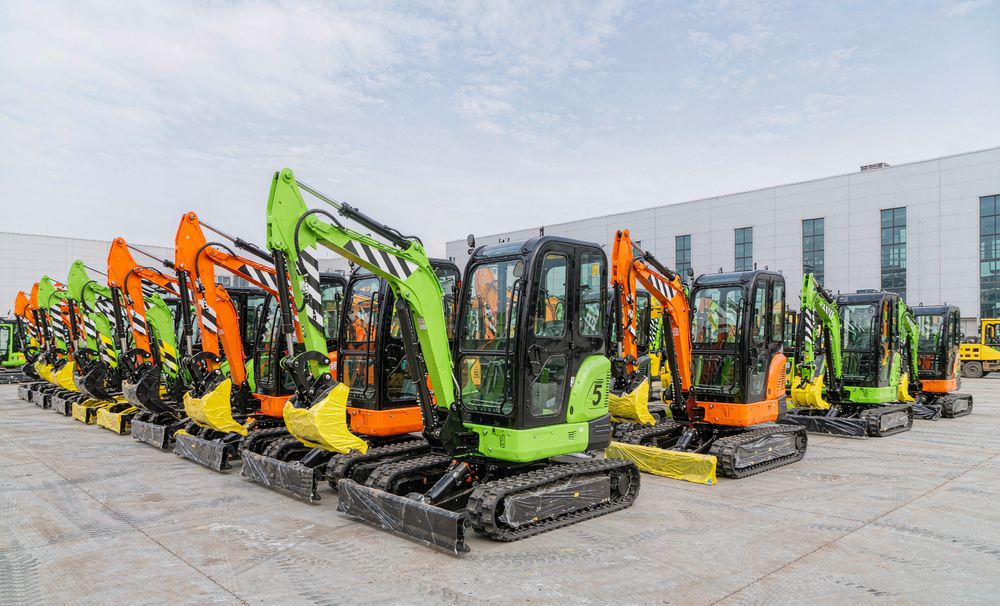
,000 went viral in Norway this autumn, and behind that video sits hard data: construction machinery exports reached US.373 billion in the first half of 2026, up 21.7 percent year on year according to the China Construction Machinery Association, with compact equipment and micro excavators driving the fastest growth.
What do the H1 2026 export numbers show?
The headline figures reported by Chinese state media in late October, drawn from industry association statistics: excavator exports exceeded domestic sales for the eighth consecutive month, and cumulative excavator exports passed 85,000 units in the first seven months of 2026, up more than 31 percent year on year. Exports to the European Union reached US.626 billion, up 28.9 percent. Industry forecasts put China's compact construction machinery sales for 2026 above 180,000 units, with micro excavators making up more than 60 percent of that, roughly 110,000 machines. Trade commentary attributes the shift to buyers outside the traditional channel: private owners, small farms and tradespeople in Europe and South America discovering these machines through social media and cross-border e-commerce rather than dealer networks.
Why does this matter to parts buyers?
Because every one of those machines is a compact wear-parts consumer. A 1 to 3 tonne excavator still runs bucket pins and bushings, teeth, track rollers and sprockets; it just runs them at smaller envelopes and tighter tolerances than a 20 tonne machine. The parts market for this segment behaves differently from the large-machine market in three ways:
- Volumes are high and per-unit margins are thin, so parts supply consolidates around the same Shandong manufacturing clusters that build the machines.
- Many compact machines are sold direct to first-time owners, so sourcing spare parts is often the owner's first experience with the brand. A parts page that does not answer "which pin fits my machine" loses that buyer instantly.
- Fleet-scale after-sales networks, the normal channel for 20 tonne iron, barely exist for micro machines, which pushes owners toward online parts suppliers and pushes suppliers toward clear part-number discipline.
What does this mean for a Shandong parts maker?
JALE Excavator Parts is a Shandong manufacturer of excavator wear parts, and it sits inside the same industrial cluster that is shipping these machines. Unlike most parts suppliers, it also builds its own compact range, including the JALE08, JALE10-1 and JALE12 mini excavators, so the fit between a small machine and its pins, bushings and undercarriage parts is designed rather than reverse-engineered.
Do compact machines need different parts discipline?
The wear parts are the same families, but the failure pattern is not. A micro excavator's pins and bushings are physically smaller, so a few tenths of a millimetre of wear is a larger share of the original clearance, and the symptoms, play at the bucket ear, grease that will not hold, a knocking sound on direction change, arrive sooner relative to machine hours. Owners who would never inspect a 20 tonne machine weekly can and should walk around a 1 tonne machine weekly: two grease strokes per pin, a visual check that the bucket ears have not bell-mouthed, and a feel for slop at the linkage. The parts themselves are cheap; the deciding factor is knowing the pin diameter and ear spacing before ordering, because a 25 mm and a 30 mm pin look identical in a photo.
One honest caveat: no association figures have been published for compact-segment parts demand specifically, so any claim about its size would be guesswork. What the export data does establish is the installed base: over 100,000 micro and compact machines a year are entering service, largely with owners who have no dealer relationship. Their pins, bushings and teeth will be replaced on wear, on the owner's budget, from whichever supplier answers first with the right dimensions. That is the market segment forming behind the headline number, and it buys the same discipline this site has always sold: correct part numbers, honest steel grades, and hardware that fits the first time.
,000 went viral in Norway this autumn, and behind that video sits hard data: construction machinery exports reached US.373 billion in the first half of 2026, up 21.7 percent year on year according to the China Construction Machinery Association, with compact equipment and micro excavators driving the fastest growth.
What do the H1 2026 export numbers show?
The headline figures reported by Chinese state media in late October, drawn from industry association statistics: excavator exports exceeded domestic sales for the eighth consecutive month, and cumulative excavator exports passed 85,000 units in the first seven months of 2026, up more than 31 percent year on year. Exports to the European Union reached US.626 billion, up 28.9 percent. Industry forecasts put China's compact construction machinery sales for 2026 above 180,000 units, with micro excavators making up more than 60 percent of that, roughly 110,000 machines. Trade commentary attributes the shift to buyers outside the traditional channel: private owners, small farms and tradespeople in Europe and South America discovering these machines through social media and cross-border e-commerce rather than dealer networks.
Why does this matter to parts buyers?
Because every one of those machines is a compact wear-parts consumer. A 1 to 3 tonne excavator still runs bucket pins and bushings, teeth, track rollers and sprockets; it just runs them at smaller envelopes and tighter tolerances than a 20 tonne machine. The parts market for this segment behaves differently from the large-machine market in three ways:
- Volumes are high and per-unit margins are thin, so parts supply consolidates around the same Shandong manufacturing clusters that build the machines.
- Many compact machines are sold direct to first-time owners, so sourcing spare parts is often the owner's first experience with the brand. A parts page that does not answer "which pin fits my machine" loses that buyer instantly.
- Fleet-scale after-sales networks, the normal channel for 20 tonne iron, barely exist for micro machines, which pushes owners toward online parts suppliers and pushes suppliers toward clear part-number discipline.
What does this mean for a Shandong parts maker?
JALE Excavator Parts is a Shandong manufacturer of excavator wear parts, and it sits inside the same industrial cluster that is shipping these machines. Unlike most parts suppliers, it also builds its own compact range, including the JALE08 and JALE12 mini excavators, so the fit between a small machine and its pins, bushings and undercarriage parts is designed rather than reverse-engineered.
Do compact machines need different parts discipline?
The wear parts are the same families, but the failure pattern is not. A micro excavator's pins and bushings are physically smaller, so a few tenths of a millimetre of wear is a larger share of the original clearance, and the symptoms, play at the bucket ear, grease that will not hold, a knocking sound on direction change, arrive sooner relative to machine hours. Owners who would never inspect a 20 tonne machine weekly can and should walk around a 1 tonne machine weekly: two grease strokes per pin, a visual check that the bucket ears have not bell-mouthed, and a feel for slop at the linkage. The parts themselves are cheap; the deciding factor is knowing the pin diameter and ear spacing before ordering, because a 25 mm and a 30 mm pin look identical in a photo.
One honest caveat: no association figures have been published for compact-segment parts demand specifically, so any claim about its size would be guesswork. What the export data does establish is the installed base: over 100,000 micro and compact machines a year are entering service, largely with owners who have no dealer relationship. Their pins, bushings and teeth will be replaced on wear, on the owner's budget, from whichever supplier answers first with the right dimensions. That is the market segment forming behind the headline number, and it buys the same discipline this site has always sold: correct part numbers, honest steel grades, and hardware that fits the first time.
.31 billion, up 47%, and to Latin America at US.03 billion, up 60.7%. Longer routes make schedule reliability worth more than a few days of inland saving, which is why the port and the carrier matter more than the canal itself.
What it means for a parts order in practice
Production time does not move. Machining, heat treatment and packing run at the same pace whichever port the container leaves from. What a shorter inland leg changes is the buffer a supplier needs between finishing an order and handing it to the carrier, and at the margin how much working capital sits in a container on a truck.
For the buyer, the response is unchanged: plan stock against ocean transit plus clearance, not against the inland leg, and ask for the port and the sailing date rather than a single lead-time number. The parts themselves — bucket pins and bushings, track chains, bucket teeth — are priced by steel grade and machining hours, not by which river they floated down.
.90 billion, up 13.9%; to Europe, US.59 billion, up 4.2%. The growth is elsewhere: Africa at US.31 billion, up 47%, and Latin America at US.03 billion, up 60.7%.
That regional split matters for spare-parts planning. Mature markets in Europe are growing slowly, while the fastest-growing destinations are markets where machines work long hours in abrasive conditions and where the dealer and service network is thinner — exactly the profile that generates high wear-parts consumption. Trade-press analysis attributes a large share of African excavator demand to mining, and mining duty is brutal on undercarriage and on ground-engaging tools.
What should buyers and distributors plan for?
Stock the models that are actually in the field, not the models in the press release. On the evidence of the last few years that means the mainstream 20–30 tonne classes and the household names built around them — PC200 and PC300 class machines, the 320 and 330 class, the EX200 class, the R210 class and the DX225 class — plus the undercarriage groups that fit them. Those are the machines absorbing pins, bushings and track components in volume.
Do not build stock around electric-specific parts yet. At 0.6% penetration there is no volume aftermarket, and the common parts on those machines are the same parts you already carry.
Finally, plan for the replacement cycle, not just the new-machine market. Chinese trade-press analysis puts the domestic replacement cycle at roughly eight years, and with domestic sales now rising on the back of equipment replacement and emission-standard upgrades, a large second and third-owner population of machines is coming into its maintenance-heavy phase. That is the cohort that buys the most wear parts per machine — and it is a diesel cohort.
