
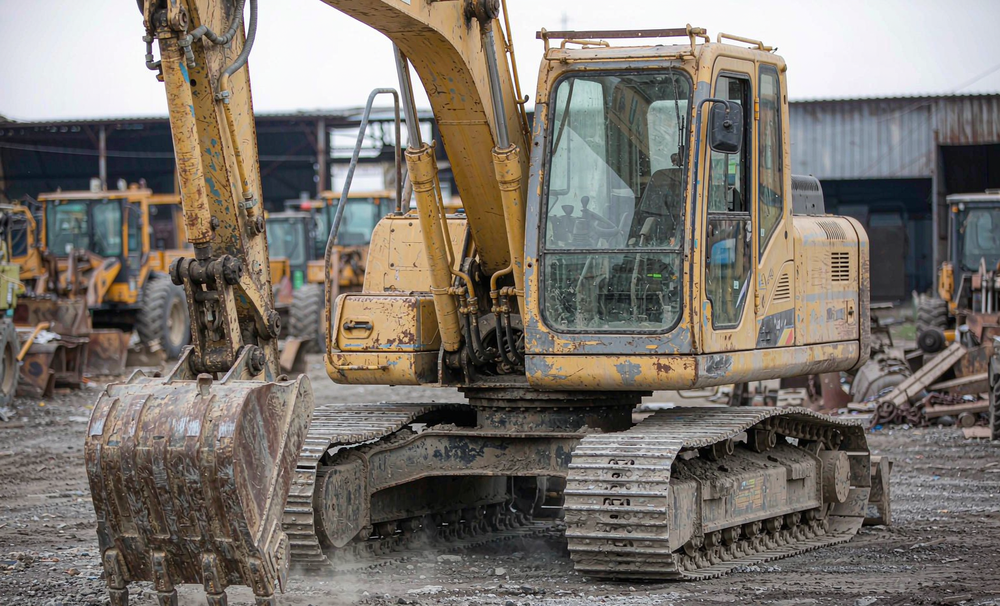
Check the undercarriage, the play at every pin and bushing joint, and the hydraulic cylinders before you look at paint or the hour meter — those three decide most of the repair bill. A cheap machine with a finished undercarriage and slack pins can cost as much to put right as a good machine costs to buy.
The order below is deliberate. Work from the ground up, because the parts that carry the machine wear out first and are the most expensive to replace.
Why does the undercarriage decide the deal?
Industry estimates commonly put the undercarriage at around half of a crawler machine's lifetime repair bill. It is also the easiest area to inspect honestly, because wear is visible and measurable without opening anything.
How do you measure undercarriage wear in the yard?
- Bushing outside diameter. Measure across the bushing on both tracks with a caliper. A new chain has a known figure; the difference is the wear.
- Sprocket teeth. Sharp, pointed tips or a hooked tooth face mean the sprocket is finished, and a new chain on it will die early.
- Roller flanges. A flange worn thin and sharp, or a roller that rocks on its shaft, is due for replacement.
- Grouser height. Compare shoe bars against a new shoe; rounded, polished grousers are past their working life.
- Five-pitch measurement. A tape over five pitches on a clean, tensioned section shows how far the chain has stretched.
Compare the left and right track. A machine that has spent its life turning one way, or working on a slope, will have one side noticeably further gone, and that tells you how it was used.
How much play is acceptable in the pins and bushings?
A new joint has almost no perceptible movement. Put the bucket flat on the ground, lift it just off the ground, and rock it by hand while watching each joint in turn: bucket to link, link to stick, stick to boom, boom to carbody. Once you can see two or three millimetres of relative movement at a joint, the bucket bushing and bucket pin are due, and the bore in the boss is probably going oval with them.
Use a pry bar for a second opinion, and look for the signs of a previous repair: weld beads around a boss, a bore that has been line-bored and fitted with an oversize pin, or a pin held in with a makeshift bolt instead of the correct retainer. Check the retaining hardware on every pin — missing bolts, spiral pins or end plates mean pins are walking, which is a safety issue as well as a wear issue.
What do the hydraulic cylinders tell you?
Look at the rod, not the barrel. A wet ring of oil and dust at the wiper means the rod seal is passing, and a scored or flaking chrome rod will destroy a new seal in a few hundred hours. Check for a bent rod by running the cylinder fully out and watching whether the rod stays centred in the gland. Then look at the hoses: chafed outer covers, weeping ferrules, and date codes older than the machine's last major service all belong on the list.
Oil condition is worth the ten minutes. Dark, burnt-smelling oil, or oil with visible metal, points to a pump or motor problem that no amount of new seals will fix. If the seller will not agree to an oil sample, treat that as information too.
Which cracks matter and which are routine?
Cosmetic dents in a bucket are normal. Cracks that matter run from a pin bore outward: boom foot bosses, the stick nose, bucket ears, and the boom cylinder mounts. A crack repaired properly — ground out, welded, plated and documented — is acceptable on an older machine. A crack that has been painted over, or one radiating from a bore, is a structural problem and a negotiating point at best.
Walk the carbody and the track frame as well. Cracks in the X-frame or around the final drive mounting are expensive, and they are easy to miss when you are looking at the boom.
What does the hour meter not tell you?
It does not separate idle hours from working hours, and on an older machine it may not be the original monitor. Judge the meter against the wear you have already measured: a machine showing 6,000 hours with a finished undercarriage has either worked hard in abrasive ground or has been round the clock. A machine with new tracks and a worn-out bucket has usually been prepared for sale rather than maintained.
What should you budget for parts immediately?
Most used machines need a second delivery of consumables within the first season: a set of pins and bushings for the working joints, a set of bucket teeth and any worn adapters, and a cutting edge if the bucket lip is thin. Price that before you agree a number, because it is the difference between a machine that earns and a machine that sits.
What belongs in the inspection record?
Photograph every joint and every measurement with the tape or caliper in frame, note the figures, and keep them. When a joint starts knocking six months later you will want to know whether it was already worn when you bought it, and a dated record settles the argument with a seller or a workshop.