
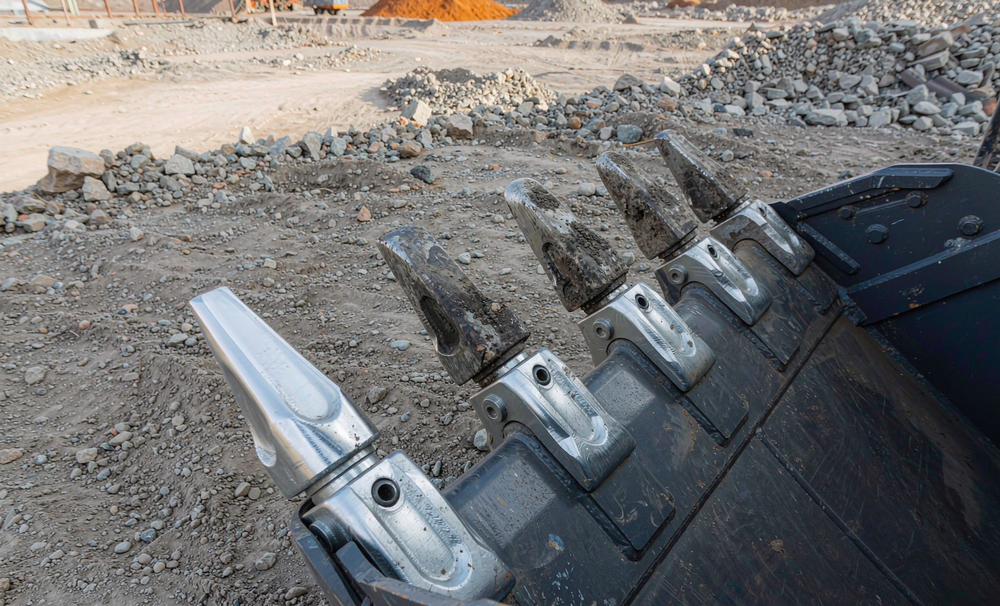
Replace excavator bucket teeth when they have worn to roughly 50–60% of their original length, or immediately if a crack appears anywhere in the tooth body. The measurement that decides it is tip length — taken from the adapter nose face to the tooth point on a new tooth as your baseline, then compared against the set on the bucket at every inspection.
What is the actual wear limit for excavator bucket teeth?
Published field guidance converges on broadly the same trigger: plan the change at 50–60% remaining original length, and treat anything below that as overdue. Some suppliers set the trigger earlier, at 30–50% wear, for abrasive applications. The spread is real, and it reflects the fact that the right number depends on what is being dug — which is why the machine or bucket manual, where one exists, overrides any general figure.
Length is not the only trigger. Any of the following means the teeth come off now, not at the next service:
- The adapter nose has become visible. Once the tooth stops covering the nose, the adapter is being ground away, and adapter replacement costs several times a set of teeth.
- A crack anywhere — tip, shoulder, or around the pin hole. Cyclic loading grows cracks quickly, and a tooth that lets go mid-cycle puts steel into whatever is downstream.
- A fully blunted or mushroomed tip. A rounded point stops cutting, and the machine starts dragging rather than penetrating.
How do I measure tooth wear in the field?
Keep one unused tooth on site as a physical reference. It settles the argument about whether the set “still looks fine”, and it costs almost nothing.
At each inspection, measure tip length from the adapter nose face to the point — on both the reference tooth and the teeth on the bucket — using a steel rule or a vernier caliper. Write the numbers down per position. When the average remaining length across the set falls to half the reference dimension, order a set. Before fitting it, check the adapter too: a pin hole worn oval, or a tooth that rocks on the nose, will wear out new teeth quickly and needs sorting first.
Why replace the whole set rather than just the worst teeth?
Because a mixed set digs unevenly. The longest teeth carry the load, wear fastest, and the adapters under the shortest teeth get exposed first. Fitting the full set together keeps the cutting edge working as designed and keeps wear rates comparable across positions.
What are the early warning signs operators notice first?
- The bucket slips across hard ground instead of biting into it.
- Cycle times creep up on unchanged material, and the operator starts using more down-force.
- The machine sounds different — a flat scrape rather than a cut.
- Teeth rattle or rotate on the adapter, which points at the pin, the retainer or an undersized nose rather than at the tooth.
- One tooth wears faster than its neighbours, which usually means a bent adapter or an issue with digging technique.
Why do new teeth fall off within a shift or two?
Almost never because of the tooth. The usual causes are an adapter nose worn undersized so the tooth sits loose, a pin hole gone oval, a retainer or washer fitted the wrong way round or undersized, or debris left in the pin hole at assembly. Clean the hole with a wire brush and compressed air, fit a new bucket tooth pin and retainer rather than reusing the old ones, and check that the pin head finishes flush with, or just below, the tooth surface.
Which tooth profile should I fit?
Three profiles cover most of the market. A chisel, or standard, tooth is the general-purpose default for soil and mixed material. A tiger or twin-tip tooth penetrates compacted ground and fractured rock better but wears faster. A heavy-duty or rock profile has a thicker cross-section for quarry and demolition work, at the cost of penetration speed. On material, Hadfield manganese steel is the usual choice where impact is significant, because it work-hardens in service, while medium-carbon and low-alloy castings suit softer ground where abrasion is low. General-duty cast alloy teeth are commonly supplied with a tip hardness in the region of 48–52 HRC; ask your supplier to state the hardness range and whether the tooth is cast or forged, because two teeth sharing a part number but not a heat treatment will not last the same.
What should I confirm before ordering a replacement set?
- The adapter system, not just the tooth number. Tooth numbering systems are not interchangeable — a tooth sized for a smaller nose will not seat correctly on a larger one, or the reverse.
- Pin and retainer part numbers. These are specific to the tooth and adapter combination, and they are frequently the reason a brand-new tooth comes off.
- The nose dimensions. Measure across the adapter nose rather than trusting the machine plate, because adapters get replaced and mixed over a machine's life.
- Whether the bucket is a pinned or bolt-on system. Bolt-on teeth are a different assembly with different spares.
JALE Excavator Parts manufactures bucket teeth, adapters and tooth pins, and quotes against part numbers, drawings or photographs.