
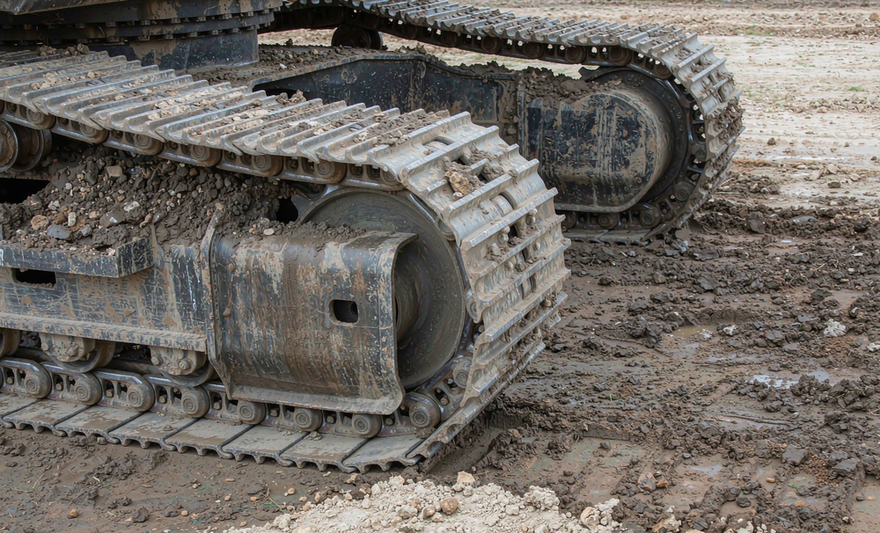
An excavator throws its track when the chain stops running inside the guide path formed by the sprocket, the front idler and the rollers — and in most cases the cause is one of seven faults, five mechanical and two down to how the machine was driven. Only the mechanical ones will keep happening, which is why finding the root cause matters more than getting the track back on.
What actually holds a track in line?
A track is a closed loop of links held onto the machine by the flanges of the front idler, the track rollers and the carrier rollers, and driven by the teeth of the sprocket. All of those parts have to sit in the same vertical plane; when they do, the flanges keep the link captive and the track cannot walk sideways. There is a design reason excavators derail more readily than bulldozers: a dozer carries full-length track guards from sprocket to idler, while most excavators carry only two short plates.
How do you measure track tension properly?
Lift the side you are checking clear of the ground with the boom and bucket, then measure the sag between the top face of the middle track roller and a straight edge laid along the track link. Never measure with the machine sitting on its tracks — that reading means nothing. Typical field figures are around 20–30 mm for compact machines and 30–50 mm for larger excavators, but the machine's manual is the only number that counts. Too loose and the track climbs; too tight and you are loading the pins, bushings and sprocket unnecessarily.
Cause 1: the track is simply too loose
Tension is held by a grease-filled cylinder that pushes the idler forward. If the cylinder seal leaks or the relief valve weeps, the track will not hold tension no matter how much grease you pump in. Look for grease weeping around the tension cylinder and for a cracked or collapsed recoil spring.
Cause 2: the chain's pins and bushings are worn out
This is the one owners miss. Grease cannot tension a chain that has grown longer: wear inside the pin-and-bushing joints increases the pitch of every link, so across a 40-link run the loop can grow by tens of millimetres and the adjuster runs out of travel. Check it by measuring pitch across a run of links against the new specification, or by looking at how far the link has worn into the carrier roller flanges. Rebuilding a chain by pressing new pins and bushings into the existing links is the cheaper route; replacing the track chain parts as an assembly is the durable one.
Cause 3: the front idler has worn or moved out of plane
The idler is the only one of the four that slides fore and aft, which makes it the one that can tilt. A worn idler shaft or worn idler bushings let the wheel cock over, and worn flanges stop guiding entirely. Check for lateral play, for cracked or missing mounting bolts, and whether the idler centre line still lines up with the sprocket. A front idler for PC200-5, PC220-7 or PC300-5 is a direct replacement rather than a rebuild, which is usually the cheaper answer once the shaft and bushes are both gone.
Cause 4: the track guards are worn down or bent
The short guard plates are what stop the link once the track starts to wander. Worn below the link's contact height, or bent out of line, they are decoration. Replace them with the chain, not after it.
Cause 5: the sprocket teeth are worn into a hook
A new sprocket tooth has a broad, blocky tip; wear turns it into a hooked shark-fin shape that no longer sits properly between the bushing and the link. Engagement goes sloppy, the chain is dragged sideways as well as round, and the worn sprocket accelerates chain wear in turn. Replacing the sprocket at the same time as the chain is almost always cheaper than replacing them separately.
Cause 6: track rollers and carrier rollers
Collapsed flanges, seized bearings, flat spots and worn shafts all let the track run off line in any track roller. A seized roller skips and flat-spots the link; a roller whose flange has worn smooth has lost its only guiding function.
Cause 7: how the machine is being driven
The remaining two causes are operator technique. Long, gripping turns on dry concrete or rock force the inside track to scrub sideways, and that is the classic way to throw a track. Tracking across a slope, slewing while travelling downhill, driving over loose rock that jams between link and roller, or travelling with a full bucket and the machine unbalanced all do the same thing.
How do you put a thrown track back on?
This is not a one-person job. Lift and block the machine solidly — never work under hydraulics alone. Back the grease valve off a turn to release tension, but do not remove the fitting, because the grease comes out under pressure. Start seating the track at whichever end the bucket can reach, usually the sprocket or the idler, then rotate the travel motor slowly to walk it back on. If the track went inward the bucket cannot reach it, and a wire rope around a section of track, pulled onto the idler, is the usual answer. For the section over the rollers, lift the track with the bucket and lower it onto a sturdy wooden beam underneath.
What should you fix before it happens a second time?
Retensioning hides the symptom. If a machine has thrown a track twice in a season, measure the chain pitch, the roller and idler flanges and the sprocket teeth before it goes back to work, and replace the wear group together so the new parts are not worn out by the old ones beside them — a track link assembly fitted alongside new rollers and a new sprocket will run its full wear life.