
A hydraulic breaker that still fires but no longer breaks rock has almost always lost nitrogen pressure in its back head. Measure that first: it is the cheapest check on the machine, it needs no dismantling, and it is the most common cause by a wide margin.
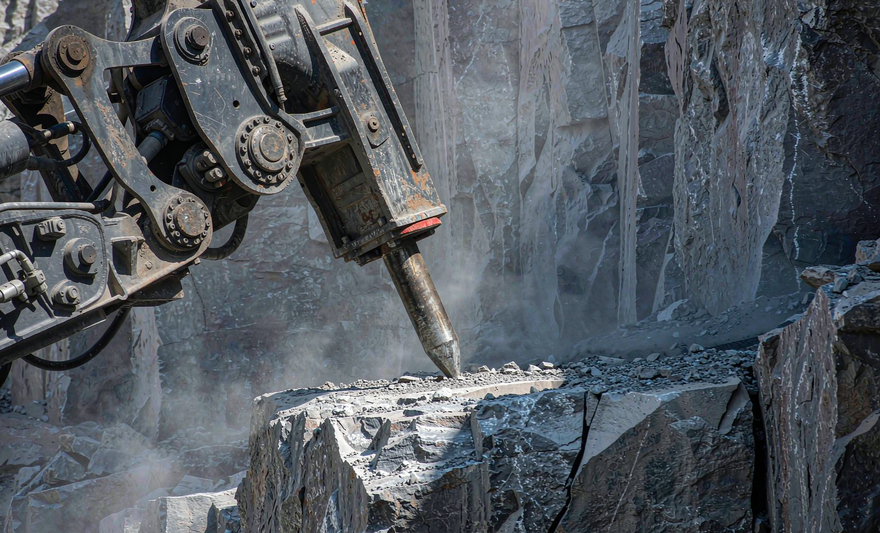
Where does a breaker's energy come from?
Two sources, not one. Hydraulic oil drives the piston through its stroke, and compressed nitrogen in the back head acts as a spring: it is compressed as the piston returns and releases that energy into the blow. In a gas-hydraulic hammer the gas supplies a large share of the impact energy. In a pure hydraulic hammer a high-pressure accumulator does the same job with oil, storing pressure on the return stroke and dumping it into the piston on the way down. Lose either one and the breaker does not stop. It just gets weaker, which is exactly why operators keep working with it.
What does low nitrogen pressure feel like?
Three symptoms, and they appear together. The blow goes soft: a crack that opened in one hit yesterday now needs the tool held on the spot. The rhythm drops, because the piston returns more slowly, so the sound becomes sparser and duller. The back head runs hot, because energy that should have become impact becomes heat instead. Heat alone can also come from too much oil flow, so read it with the other two rather than on its own.
What happens if the breaker is overcharged?
It hits worse, not better. Excess gas pressure holds the piston up, the stroke shortens, and the breaker fires fast and erratically with almost no force at the tool. It also loads the seals and the diaphragm far beyond design. More nitrogen is not a tuning knob.
How do you measure precharge properly?
Cold, and this is where most checks go wrong. A breaker that has been working has a hot back head, the gas has expanded, and the gauge reads above the true pressure. A reading taken hot and judged normal turns out low once the machine cools. Measure at the start of a shift.
- Engine off, hydraulic lines depressurised, tool resting on the ground.
- Use a charging kit: regulator, gauge and the correct adapter for that charge valve.
- Seat the adapter fully. A loose connection both misreads and vents gas while you measure.
- Compare against the figure in that model's manual. Do not borrow a number from another brand or another size class; the correct charge differs by model and by back head type.
- Top up with dry nitrogen only. Never oxygen, never compressed air. Oxygen reacts with oil under pressure, and the moisture in air corrodes the internals.
- After charging, put soapy water on the valve. Bubbles mean the valve is leaking and the charge will be gone within days.
What if the pressure drops again quickly?
Then the problem is not the charging. A charge that falls between two checks without much running points at the back head seal or the charge valve. Repeatedly topping up only delays the failure and hides the real one.
How do you tell if the accumulator has failed?
On an accumulator machine, a ruptured diaphragm or bladder lets gas cross into the hydraulic side. Precharge disappears at once, strike force drops sharply, and the boom lines start to vibrate because the accumulator is no longer smoothing the pressure pulses. The tell is oil at the gas valve, or oil in the gas chamber when the valve is opened. A slow leak and a rupture feel different: one is a gradual softening, the other is a breaker that was working at lunchtime and is useless by the afternoon.
If the gas is correct, what do you check next?
Is the carrier supplying the right flow and pressure?
A breaker is matched to a flow range in litres per minute and a relief pressure setting. Too little flow and the piston never completes its stroke. A relief valve set low cracks open early and dumps oil back to tank before working pressure is reached. Return line back pressure matters too: if the return is restricted, the piston cannot complete its return stroke and the breaker short-strokes. Check the auxiliary circuit setting and the return filter before blaming the hammer.
Are the tool bushings worn?
Worn upper and lower bushings let the chisel sit at an angle inside the front head. The piston then strikes the tool off-centre, and a large part of the energy goes sideways into the front head, the retainer pins and the tool itself instead of into the rock. A visible gap between chisel shank and bushing, or a polished crescent on one side of the shank, is the evidence. Bushes and retainer pins are cheap; a front head is not.
Are the through bolts still holding preload?
Stretched or loosened through bolts let the front head and back head move apart under load. The joint opens, preload is lost, and the gas charge escapes past the joint. Check torque at every service and replace bolts that have stretched rather than re-torquing them.
Only then look inside
Piston and cylinder scuffing from contaminated oil, worn main seals, a sticking control valve. These are the expensive answers and they should be the last ones tested, not the first.
What is the cheapest habit to build?
Check precharge at every tool change. The breaker is already stopped and cooling, so the check costs no extra time, and a log of date, hours and pressure shows whether a charge is holding. That single record separates a breaker that needs gas from one that needs stripping, before either becomes a breakdown.
For the parts side, see our breaker parts range, the through bolts for F22/35 and HB15G hammers, the matching through bolt pins, and breaker tool steel for when the chisel, not the hammer, is the worn part.