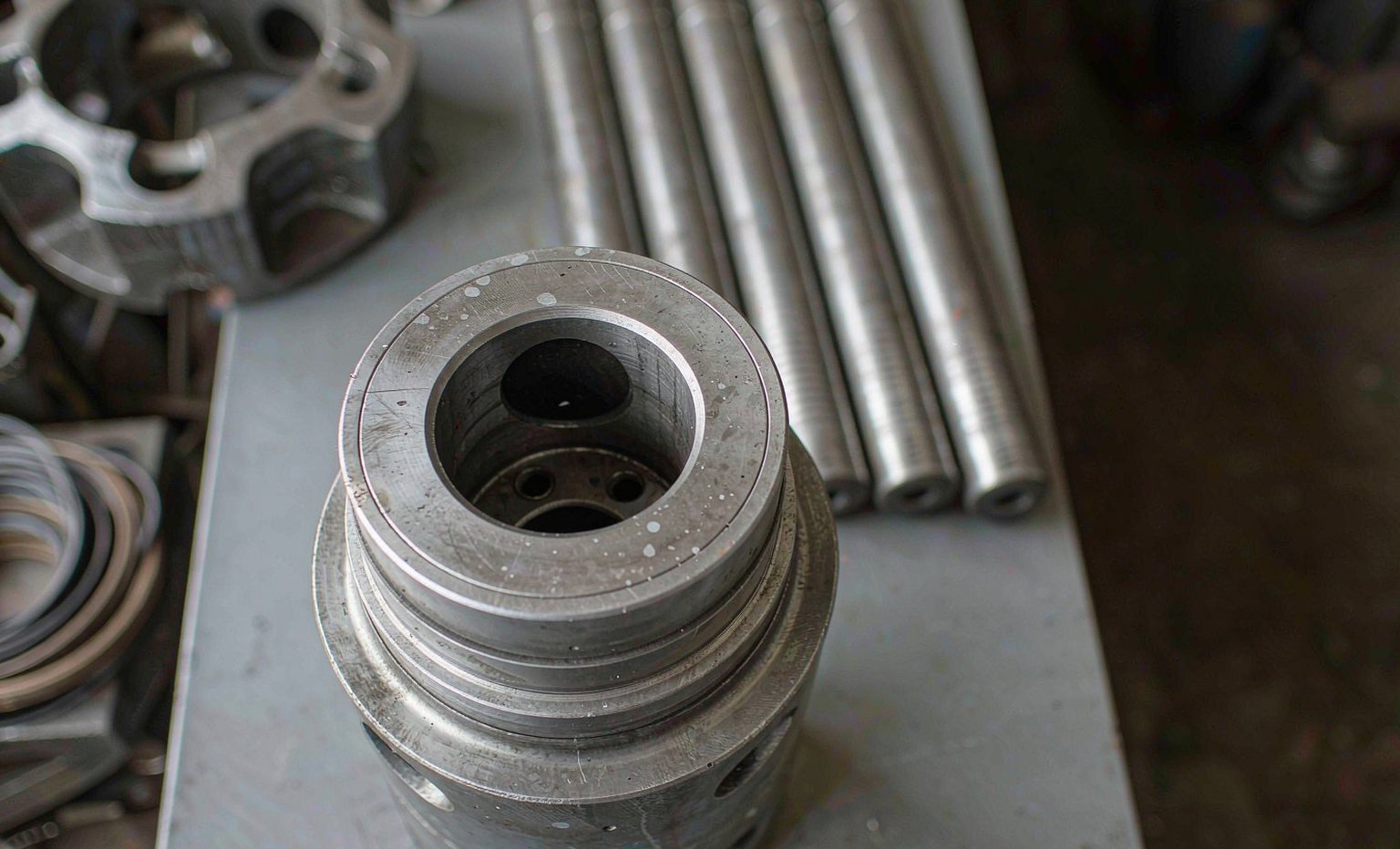
A BRV43 breaker front head is the casting at the working end of a hydraulic breaker, and it is the part nobody inspects until the chisel starts rattling in its bush. Inside it sit the upper and lower chisel bushings, the front seal that keeps rock dust out of the piston chamber, the chisel retaining pin with its rubber buffer, and the through-holes that the tie rods clamp into. The piston strikes the chisel shank through that casting several thousand times an hour, and every one of those strikes arrives as a shock load rather than as smooth hydraulic pressure.
That is why a BRV43 breaker front head is a fit-critical purchase. The tie-rod pitch, the bushing bore, the depth of the seal pocket and the position of the retaining pin all have to match the cylinder it bolts onto. A casting 2 mm out on tie-rod pitch does not bolt up, which is the good failure — you find out on the bench. A casting that is right on pitch but wrong in bushing bore fits, runs, and wears the chisel shank oval within a month, which is the expensive one.
What the front head does in a BRV43 breaker
The front head has four jobs and only one of them is structural. It closes the bottom of the cylinder, it guides the chisel so the piston strikes it squarely, it seals the piston chamber against dust and water, and it retains the chisel so it cannot fall out when the breaker is lifted. Each job has its own wear surface, and each fails in a different way.
- Structural closure. Four tie rods or through-bolts clamp the front head to the cylinder against the gas and oil pressure in the back head. The joint face is a precision surface; a burr or a scored face there leaks oil under pressure and cannot be sealed with gasket compound.
- Chisel guidance. The bushings set the chisel alignment. Once they wear, the piston no longer strikes the shank squarely, impact energy drops, and the piston face and shank both start to mushroom.
- Sealing. The front seal, usually a lip seal with a separate wiper, is the only barrier between the piston chamber and the working face of a rock breaker. It is also exposed to direct rock dust, water and grit.
- Retention. The retaining pin and buffer hold the chisel in place. A worn buffer lets the chisel move axially, which hammers the retaining pin flat and eventually cracks the pin hole in the casting.
Why a BRV43 breaker front head fails before the rest of the breaker
The front head is not usually the part that breaks. It is the part that wears until the breaker stops earning. Four mechanisms account for most of it, and each leaves a signature you can read on the bench.
- Bushing bore wear. Abrasive dust enters between the chisel shank and the bush and grinds both. The bore goes oval in the direction of the working stroke, because that is where the load is applied. The visible symptom is a chisel that rattles when the breaker is lifted but runs quietly under load.
- Bore and shank scoring. Once the bush is oval, grit is trapped in the gap and scores the chisel shank. A scored shank then destroys the new bush in days, so a front head is replaced with the chisel or not at all.
- Seal pocket damage. A front seal that has run dry or overheated can spin in its pocket and machine the pocket wall. A new seal in a damaged pocket leaks immediately and the diagnosis becomes "bad seals" when the real fault is the casting.
- Cracking at the pin holes and tie-rod seats. Shock loading propagates from the retaining-pin hole and from the tie-rod counterbores. A crack there is a crack in a pressure-retaining part and is not a repair candidate.
Hydraulic overheating accelerates all four. A breaker running on hot, thin oil loses film strength at the bushings, and the wear rate rises sharply even if the operator changes nothing.
Measuring a BRV43 breaker front head before you order
Twenty minutes with a micrometer and a bore gauge removes most of the risk from the order and costs nothing compared with a wrong casting sitting on a shelf. Calipers are not adequate for the bore; you need a three-point bore gauge or an inside micrometer reading to a hundredth of a millimetre.
- Chisel shank diameter, measured at three heights and two planes. This number, not the breaker model, is what sets the bushing bore.
- Bushing bore, measured in the worn bush in two directions at 90 degrees. The difference between the two readings is the ovality and it is the number that decides whether the front head itself is reusable.
- Tie-rod pitch, centre to centre across diagonals as well as across faces. Diagonal measurement catches a casting that has been drilled on a skewed pattern.
- Tie-rod diameter and thread, plus the length and the nut type. Rods are often replaced with the head, and a mismatched thread stops the job.
- Seal pocket width and depth, measured across the old seal's cut face rather than estimated from the groove.
- Retaining-pin diameter and hole position, measured from the chisel axis rather than from an outside face.
- Overall height and the joint face to bushing shoulder distance. This is the dimension that most often differs between castings that look identical.
Bushing clearance: the numbers that decide reuse or replacement
The working clearance between the chisel shank and the bush is the single most useful number on a breaker. Too little and the bush seizes or the chisel cannot be removed; too much and the chisel whips, the piston strike goes off-centre and the shank mushrooms. The correct figure is set by the breaker manufacturer, and it is normally quoted as a fitted clearance for a new bush and a wear limit at which the bush is condemned.
When the manufacturer's figure is not available, the practical rule is to measure rather than to guess. Take the shank diameter, take the bore in two directions, and compare the result with the same measurement on a bush you know is new. A bore that is more than a few tenths of a millimetre over the new figure, or that shows measurable ovality, is worn. A front head whose bushing seat — the bore in the casting, not the bush — has itself gone oval cannot be fixed by fitting a new bush, because the new bush will follow the worn seat.
That distinction matters commercially. Worn bushes are a consumable replacement. A worn bushing seat is a front head replacement. Fitters who replace only the bush on a head with a worn seat will do the same job again in a few weeks and will blame the bush supplier.
Seal interfaces on the front head
The front seal is the least understood part of the assembly. It is not a hydraulic seal in the normal sense — it holds no pressure, because the piston chamber is sealed further up. Its job is to keep the working face of the breaker clean, and it does that with a lip that runs on the chisel shank and a wiper that scrapes the shank as it retracts. Both lips wear against an abrasive surface, so the seal is a wear item with a short life compared with the rest of the breaker.
Two rules follow. First, if the wiper lip is gone, grit is already inside and the bushings are being ground; replacing the seal alone treats the symptom. Second, if the shank is scored, the new seal will be cut by the score line within days. Seal, bush and chisel are a set on a high-hour breaker, and pricing them separately usually produces a second stripdown.
The seal pocket geometry is standardised for reciprocating hydraulic cylinders in ISO 5597, and O-ring housing dimensions in ISO 3601 series A. Those standards are the right reference when a supplier has to work from a sample rather than a drawing, and any competent front head supplier will recognise them.
Materials and heat treatment: the questions worth asking
Front heads are cast or forged in alloy steel and then machined. The differences that matter to a buyer are not visible in a photograph, so they have to be asked as questions with checkable answers.
- What grade of steel, and is there a mill certificate with the heat number? A 3.1 certificate under EN 10204 is the normal minimum for a pressure-adjacent casting.
- Is the casting normalised before machining, and is the bushing seat finish specified? A rough seat with a tight bush is a press fit that cracks the bush on assembly.
- Are the bushings supplied as a matched pair with the head, and are they bronze, steel-backed bronze, or hardened steel? The choice changes the wear life and the chisel material it should run against.
- Is the joint face machined and checked for flatness, or ground? A joint face that is out of flat leaks oil that then looks like a failed seal.
- Are the tie rods supplied with the head, and are they torque-to-yield or reusable? Reusing stretched rods on a new head is a common cause of early joint failure.
None of these answers is exotic. The point is that a supplier who cannot answer them is selling a shape that resembles a front head rather than a part that will hold a piston chamber together.
Fitting a BRV43 breaker front head without damaging it
Most premature front head failures are assembly failures. The sequence matters more than the force applied.
- Clean the joint face and the tie-rod threads. Oil and grit on the face produce a joint that creeps loose under shock load.
- Fit the bushings with a press and a flat driver on the outer race, never with a hammer on the bore. A distorted bush has to come out again.
- Lubricate the seal lip with the system oil, not with grease. Grease packing behind a lip seal can hydraulically lock the lip off its seat.
- Tighten tie rods in a cross pattern in at least three stages to the specified torque. A single-stage pull on a four-rod head distorts the joint face.
- Check chisel fit before the breaker goes back on the carrier. A chisel that will not enter by hand is a bush problem, and forcing it will score the bore.
After the first shift, re-check the tie-rod torque. New joints settle, and a joint that has settled is a joint that will fret.
What to send with the enquiry
An enquiry that gets the right part first time contains a short list of facts and one photograph of the old casting from each of three angles. The list is: breaker model and serial if visible, chisel shank diameter, bushing bore in two directions, tie-rod pitch measured across diagonals, tie-rod diameter and thread, seal pocket dimensions, and the overall height from joint face to bushing shoulder.
Include the carrier model as well. Breaker model designations are not standardised: some track chisel diameter, some track carrier weight class, and some use a hybrid of the two, so the same designation can mean different castings from different makers. The carrier weight tells a supplier which family of castings to look in even when the designation is ambiguous.
Where the parts come from
The hydraulic breaker parts range covers front heads, chisels, bushings, seal kits and tie-rod sets for the common breaker families, and the BRV32 breaker seal kit breakdown is the companion piece to this one for anyone resealing rather than replacing. If the casting is sound and only the seals have gone, that is the cheaper route; the B140 breaker front head notes cover the same wear pattern on a smaller frame.
Judge a front head by what can be measured, not by what it looks like. The casting that arrives with a mill certificate, a machined joint face and a bushing seat that reads true in two directions is the one that will still be in service when the cheaper one has been replaced twice.