
Inspect three things before you lift any attachment with a quick coupler: the pin groove on both bucket pins, the full travel of the locking mechanism, and the safety pin or indicator. If any is wrong, the attachment does not get lifted, however firmly the coupler appears to have seated. Almost every dropped-bucket incident traces back to one of the three, and all three are visible in under a minute.
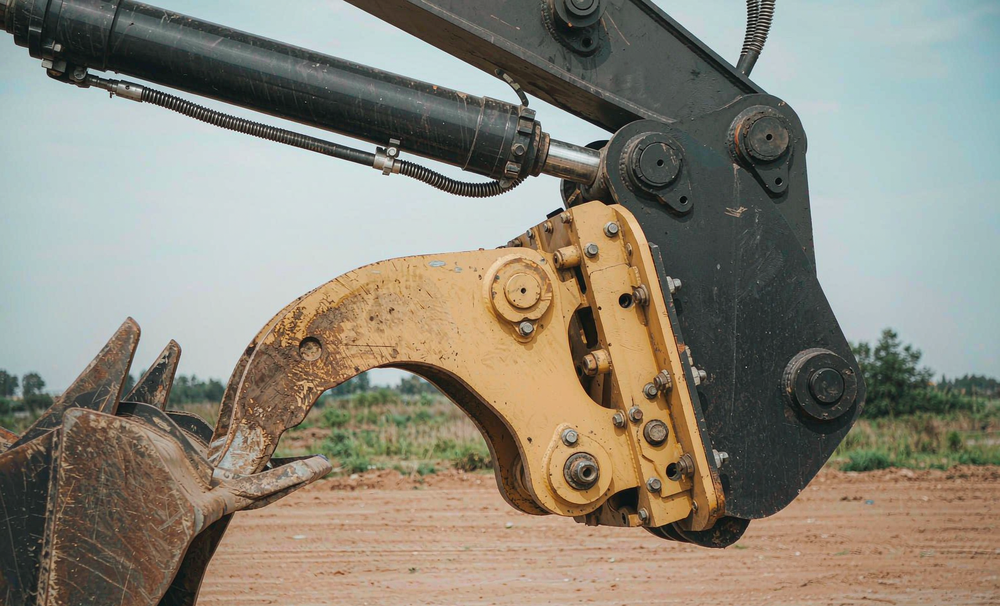
Why does a coupler drop a bucket when it looks locked?
Because the lock is holding a surface that is no longer the shape it was designed for. A quick coupler does not grip the full pin: it captures a machined groove near each end, and the load is carried by that groove's shoulder bearing on the lock pin or wedge. The shoulder starts as a square step and wears into a ramp.
Once the shoulder is ramped, the lock pin can climb out under load, especially during a curl or swing with a loaded bucket. The coupler still closes, the indicator still shows engaged, and nothing looks wrong. The attachment then releases at the worst moment, which is why a check that stops at "the pins went in" is not one.
What should you check on the bucket pins?
- The groove shoulder. Look for a square step with a sharp edge. A shiny, rounded or ramped shoulder means the groove is worn out, and the pin should be replaced before the coupler is used again.
- The groove width against the lock pin. If the lock pin can move fore and aft inside the groove by more than a millimetre or two, the fit is loose. Measure with a caliper rather than judging by eye.
- Pin diameter in the loaded zone. Measure at the point of contact, not at the end. A pin worn below the maker's limit sits low in the jaw and changes the lock geometry.
- Straightness. Roll the pin on a flat surface. A bent pin will not seat in both jaws at once, and one side carries all the load.
Pins are consumables and cheap relative to the consequence. Our bucket pins have the groove machined to the drawing rather than flame-cut, which keeps the shoulder square through its service life.
How do you test the lock without lifting a load?
Lower the attachment to firm ground, then cycle the coupler while watching the lock pin or wedge from a safe position. Both sides should reach full travel without sticking. A pin that lags or stops short points to a hydraulic or linkage fault, not wear, and must be fixed before the machine goes back to work.
Then do a low-height curl test. With the attachment just clear of the ground, curl and dump it slowly and watch the joint. Any movement between the coupler and the bucket ears, or a rattle you can hear, means the lock is not fully engaged. Lower it, clean the jaws, cycle again and re-check. Never lift the machine or swing a load to "prove" the lock; that is the test that injures people when it fails.
What wears inside the coupler itself?
The coupler is a wear component. The items that go first are the pivot pins and bushings in the body, the faces of the locking wedge or pin, the cylinder rod and its seal, and the hoses that flex on every cycle.
- Grab the attachment and try to rock it. Visible play at the coupler pivot means worn bushings, which change the lock geometry.
- Check the wedge or lock pin face for grooving and for a lip worn on the leading edge.
- Look for a weeping rod seal. A cylinder that leaks down can release the lock while the machine is parked with the attachment raised.
- Inspect the hoses where they flex near the linkage, not just at the fittings.
When play at the pivot is measurable, re-bushing the coupler is a normal repair and far cheaper than a new body. The bushings are usually standard sizes; our bucket bushings range covers the common bore and width combinations, but measure the worn bore and the pin before ordering rather than working from the machine model alone.
What does the safety pin actually do?
The safety pin or locking bar is the backup that holds the attachment if the primary lock releases. It is not a formality. Check it is present, straight, and that its retaining clip is fitted. If the coupler has an engagement indicator, confirm it reads clearly and is not painted over. A missing safety pin on a coupler that "has always been fine" is exactly what precedes an incident.
How often should this be done, and what should be recorded?
The pin and lock check belongs to every attachment change, because the pins change with the attachment. The coupler body inspection belongs to the daily walk-around, with a measured check weekly. Record the attachment, groove width and any pin replaced, so "it looked fine" becomes something you can audit.
When should you replace rather than adjust?
Replace the pin when the groove shoulder is ramped, when the groove is measurably wider than the coupler maker's limit, or when the pin is worn below the minimum diameter. Replace the coupler when the jaw or hook shows cracks, when the body is deformed, or when the lock will not hold full travel after the linkage has been repaired. Cracks in a coupler body are not a weld-and-continue item. When standardising a mixed fleet, match the coupler to the bucket first and the pins second; the dimensional check is in our guide to matching a quick coupler to a bucket.
If a pin is seized in the bucket ear, do not heat the ear to free it. The controlled way to press it out is in our note on bucket pin removal tools. Send the machine model, pin diameter and groove dimensions for a quote on pins and bushings that hold the lock shoulder square.